
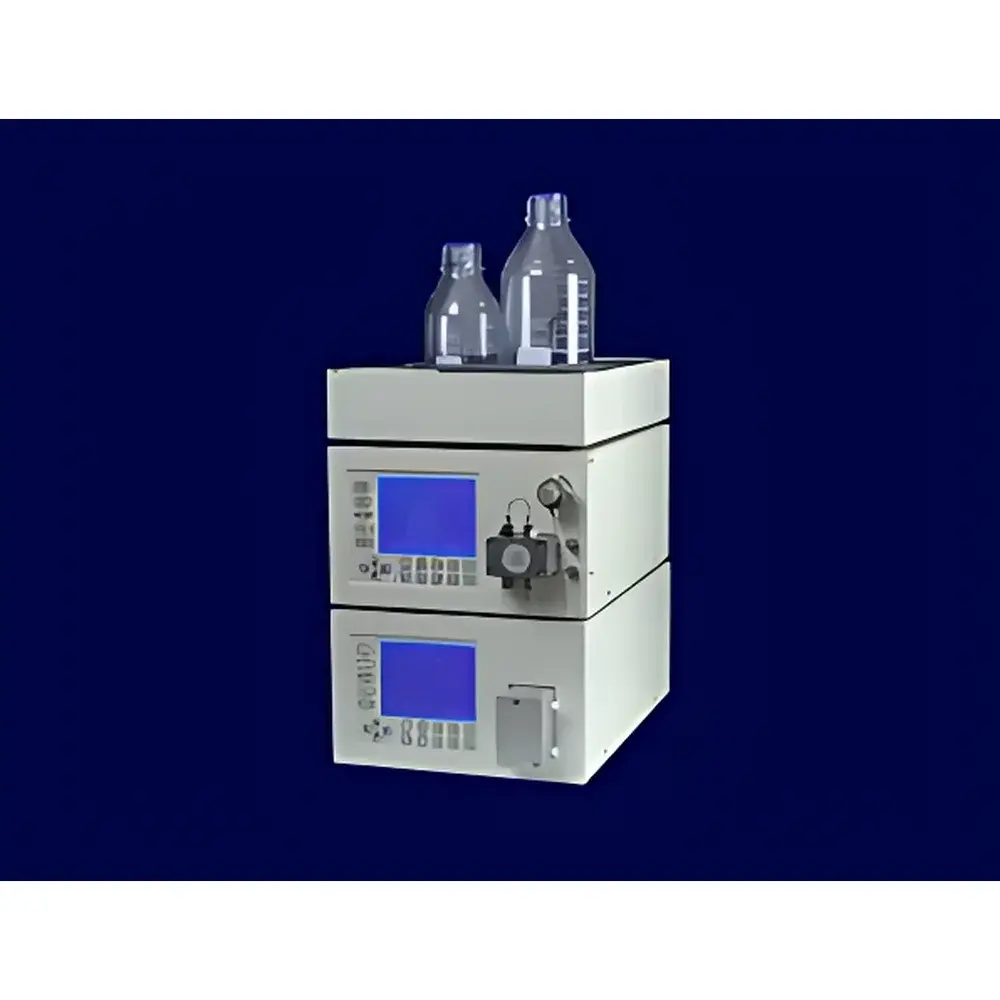
Jinpu LC-3000 High-Performance Liquid Chromatograph
| Brand | Jinpu |
|---|---|
| Model | LC-3000 |
| Pump Type | Dual-plunger reciprocating high-pressure pump (P3000 series) |
| Detector Type | UV/VIS spectrophotometric detector (UV3000) |
| Max Pressure | 42 MPa (P3110), 30 MPa (P3120) |
| Flow Range | 0.002–9.998 mL/min (P3110), 0.01–49.99 mL/min (P3120) |
| Flow Accuracy | ±2% (2–5% range, MeOH/H₂O 80:20) |
| Flow RSD | <0.1% |
| Wavelength Range | 190–700 nm |
| Wavelength Accuracy | ±2 nm |
| Wavelength Repeatability | 0.4 nm |
| Baseline Noise | 2×10⁻⁵ AU/h (254 nm, 1 mL/min, MeOH/H₂O 80:20) |
| Baseline Drift | 15×10⁻⁵ AU/h (254 nm, 1 mL/min, MeOH/H₂O 80:20) |
| Data Interface | RS-232 serial communication |
| Display | 320×240 dot-matrix LCD with adjustable blue backlight |
| Power Supply | 220 V ±10%, 50 Hz |
| Dimensions (W×H×D) | 398×149×267 mm |
| Weight | 14 kg |
Overview
The Jinpu LC-3000 is a modular, high-reliability high-performance liquid chromatograph (HPLC) engineered for routine analytical laboratories requiring robust separation performance, operational simplicity, and regulatory-compliant data handling. Based on classical reversed-phase and normal-phase chromatographic principles, the system employs isocratic or gradient elution via dual-plunger reciprocating high-pressure pumps (P3000 series) coupled with a digitally optimized UV/VIS absorbance detector (UV3000). Its architecture adheres to fundamental HPLC design tenets: precise solvent delivery under elevated backpressure, low-noise optical detection across the far-UV to visible spectrum (190–700 nm), and deterministic signal acquisition without analog-to-digital conversion bottlenecks. The absence of external data acquisition cards—enabled by direct digital signal transmission via RS-232—reduces hardware dependency and improves long-term signal integrity. Designed for method transfer compatibility, the LC-3000 supports standard 1/8″ stainless steel or PEEK capillary interconnections and accommodates industry-standard 4.6 mm ID analytical columns and semi-preparative formats.
Key Features
- Dual-plunger reciprocating pump architecture with active pulse dampening, delivering flow stability with RSD <0.1% and accuracy within ±2% across defined calibration ranges (MeOH/H₂O 80:20).
- UV3000 detector featuring deuterium lamp (standard) and optional tungsten lamp, enabling broad-spectrum quantitation from 190 nm (aromatics, nucleic acids) to 700 nm (colored dyes, transition metal complexes).
- Full digital wavelength scanning capability: programmable start/end points and step resolution support spectral verification of peak identity and purity assessment per ICH Q2(R2) guidelines.
- Integrated GLP-compliant audit trail functions: automatic logging of lamp operating hours, ignition cycles, lamp replacement events, and instrument serial identifiers—critical for FDA 21 CFR Part 11 readiness in regulated environments.
- Front-panel operation with 320×240 dot-matrix LCD and user-adjustable blue backlight; independent mode allows complete method setup without external software, while RS-232 interface enables remote control and synchronization in multi-pump gradient configurations.
- Intelligent pressure management: programmable upper/lower pressure limits, soft-start/stop sequencing, and non-volatile memory for parameter retention after power interruption.
Sample Compatibility & Compliance
The LC-3000 is validated for use with common HPLC mobile phases including aqueous buffers (e.g., phosphate, acetate), organic modifiers (acetonitrile, methanol), and ion-pairing reagents. It supports standard silica-based C18, C8, phenyl, and amino columns, as well as polymeric and HILIC phases. Column oven integration (optional) ensures retention time reproducibility across ambient temperature fluctuations. System compliance aligns with core analytical instrumentation standards: ISO/IEC 17025 method validation requirements, ASTM E2655 for UV detector performance verification, and USP chromatography system suitability criteria. All electronic records—including chromatograms, method files, and maintenance logs—are timestamped and stored in non-erasable memory, supporting GLP and GMP audit preparedness.
Software & Data Management
The LC-3000 operates with vendor-provided PC-based acquisition and analysis software compatible with Windows 10/11. Data files adhere to open ASCII-based formats (.txt, .csv) for third-party processing and LIMS integration. Raw detector signals are acquired at configurable sampling rates (up to 20 Hz) and stored with full metadata: injection time, gradient profile, lamp status, and pressure history. Software includes baseline correction algorithms, peak integration with tangent skim and exponential discard options, and customizable reporting templates compliant with ALCOA+ principles (Attributable, Legible, Contemporaneous, Original, Accurate, + Complete, Consistent, Enduring, Available). Audit trail export functionality permits review of all user actions—including method edits, data reprocessing, and report generation—for regulatory submissions.
Applications
- Pharmaceutical quality control: assay of active pharmaceutical ingredients (APIs), related substances testing per ICH Q3B, and dissolution profile analysis.
- Agrochemical residue monitoring: multi-residue screening of organophosphates, carbamates, and triazoles in food matrices per EU SANTE/11312/2021 guidelines.
- Chemical manufacturing: purity assessment of intermediates, polymer additive quantification, and catalyst leaching studies.
- Academic and contract research: method development for natural product isolation, peptide mapping, and small-molecule metabolite profiling.
- Environmental analysis: detection of PAHs, phenols, and endocrine disruptors in water and soil extracts following EPA Method 8330B protocols.
FAQ
Is the LC-3000 compatible with modern LIMS or ELN systems?
Yes—via RS-232 serial output and ASCII-formatted data exports, the system supports bidirectional integration with laboratory information management systems and electronic lab notebooks using standard middleware or custom API wrappers.
Does the UV3000 detector meet pharmacopeial requirements for noise and drift specifications?
The stated baseline noise (2×10⁻⁵ AU/h) and drift (15×10⁻⁵ AU/h) comply with USP sensitivity thresholds for quantitative UV detection at 254 nm under specified flow and solvent conditions.
Can the P3000 pump be used in gradient mode with multiple solvents?
Yes—the system supports high-pressure binary gradient formation using two synchronized P3000 units; gradient profiles are programmable via front-panel interface or host software, with real-time curve visualization on the LCD screen.
What maintenance intervals are recommended for the pump seals and detector lamp?
Pump seal replacement is advised every 6–12 months depending on solvent aggressiveness and daily run volume; deuterium lamp lifetime is typically 1,000–2,000 hours, with automated usage tracking embedded in the GLP log.
Is column oven support available as an integrated option?
Column heating is supported through third-party or OEM-compatible ovens connected via standard 1/16″ tubing; temperature control is managed externally, with system pressure and flow unaffected up to 80 °C.





