
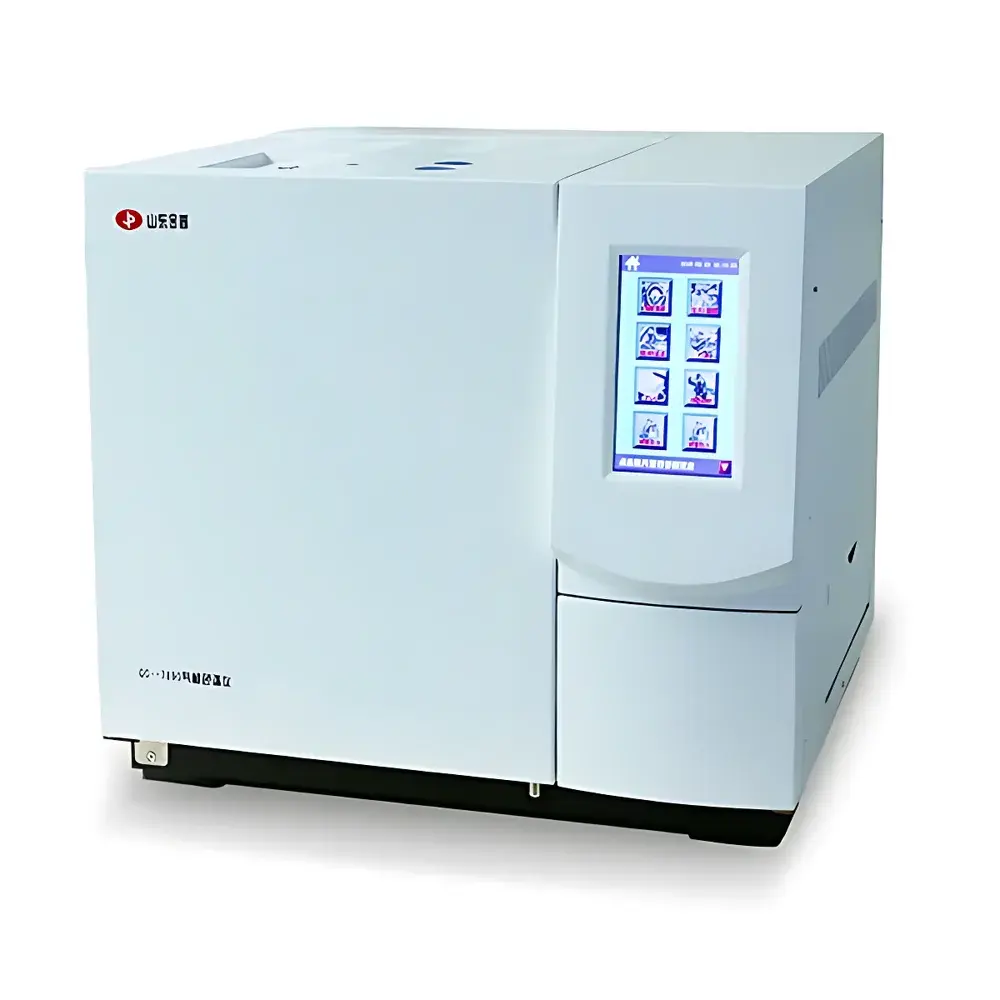
Golden普 GC-7890A Touchscreen Gas Chromatograph
| Brand | Golden普 |
|---|---|
| Model | GC-7890A |
| Type | Laboratory Gas Chromatograph |
| Origin | Shandong, China |
| Temperature Control Range | Ambient +5°C to 400°C (adjustable in 0.1°C increments) |
| Ramp Rate | 0.1–40°C/min (0.1°C increment) |
| Cooling Rate | 450°C → 50°C in ≤6 min |
| Carrier Gas Flow Range & Control | 0–1200 mL/min (7-step programmable) |
| Carrier Gas Pressure Range & Control | 0–970 kPa |
| Injector Max Operating Temperature | 400°C |
| Injector Pressure Setting Range | 0–970 kPa |
| Injector Total Flow Setting Range | 0–1200 mL/min |
| Column Oven Temperature Accuracy | ±0.1°C |
| Temperature Uniformity (100–360°C) | ±1°C |
| FID Sensitivity | ≤3×10⁻¹² g/s (benzene, CS₂) |
| FID Baseline Noise | ≤3×10⁻¹⁴ A |
| FID Drift | ≤5×10⁻¹³ A/30 min |
| FID Linear Dynamic Range | ≥10⁶ |
| Dimensions (W×D×H) | 660×460×465 mm |
| Weight | 60 kg |
| Power Supply | AC 220 V ±10%, 2200 W max |
Overview
The Golden普 GC-7890A Touchscreen Gas Chromatograph is a benchtop laboratory-grade analytical instrument engineered for high reproducibility, thermal stability, and operational flexibility in routine and method-development applications. Based on the fundamental principle of differential partitioning of analytes between a mobile gas phase (carrier gas) and a stationary liquid or polymer phase coated on the inner wall of a capillary column—or packed within a solid support matrix—the GC-7890A separates volatile and semi-volatile organic compounds with precision across diverse sample matrices. Its dual-inlet configuration supports both packed-column and fused-silica capillary column operation, enabling method transfer compatibility and broad applicability—from petrochemical hydrocarbon profiling to environmental pesticide residue screening and pharmaceutical impurity analysis.
Key Features
- Intuitive 7-inch full-color touchscreen interface with bilingual (English/Chinese) menu navigation—designed for rapid method setup, real-time chromatogram monitoring, and system diagnostics without external PC dependency.
- Advanced column oven architecture featuring triple-zone independent heating control, optimized airflow distribution, and vacuum-insulated chamber walls to ensure ±0.1°C temperature accuracy and ≤±1°C axial gradient over 100–360°C during programmed ramps.
- Programmable carrier gas delivery system with 7-stage flow/pressure control, supporting constant flow, constant pressure, or pressure-programmed modes—compatible with helium, hydrogen, and nitrogen carriers per ISO 17025-compliant method requirements.
- Dual independently temperature-controlled inlets: one split/splitless capillary injector (max 400°C) and one packed-column inlet (max 400°C), each with fully digital pressure and total flow regulation (0–970 kPa / 0–1200 mL/min).
- Rapid cooling capability: oven cools from 450°C to 50°C in ≤6 minutes via active air exchange and thermal shunt design—reducing cycle time between runs without compromising baseline stability.
- FID detector with platinum ignition wire and alumina ceramic nozzle ensures robust flame stability, low noise (≤3×10⁻¹⁴ A), and linear response over six orders of magnitude (≥10⁶), meeting ASTM D3606 and USP sensitivity thresholds for trace hydrocarbon quantitation.
Sample Compatibility & Compliance
The GC-7890A accommodates liquid, gaseous, and thermally stable solid samples following appropriate derivatization or headspace/volatiles extraction protocols. It supports standard injection volumes (0.1–10 µL) via syringe or autosampler interfaces (optional). The system complies with essential regulatory frameworks for analytical instrumentation, including ISO/IEC 17025:2017 clause 5.5.2 (equipment verification), ICH Q2(R2) guidelines for method validation parameters, and basic alignment with FDA 21 CFR Part 11 data integrity expectations when paired with compliant chromatography data systems (CDS). All temperature zones and gas parameters are logged with timestamps for GLP/GMP audit trails.
Software & Data Management
Instrument control and data acquisition are managed through embedded firmware with optional integration into third-party CDS platforms (e.g., Chromeleon, OpenLab CDS) via RS-232, USB, or Ethernet. Raw data files (.cdf or .axd format) include full metadata: method parameters, calibration history, detector settings, and environmental logs. Audit-ready reporting templates support QC checks (retention time locking, peak area RSDs), system suitability testing (SST), and compliance with pharmacopeial monographs (USP, EP, JP). Data export conforms to ASTM E1983-22 standards for chromatographic result interchange.
Applications
- Environmental analysis: VOCs in soil/water (EPA Method 8260D), BTEX in air, chlorinated solvents in groundwater.
- Petrochemical QA/QC: Hydrocarbon type analysis (HTA), simulated distillation (ASTM D2887), sulfur compound profiling (ASTM D5504).
- Food & flavor chemistry: Residual solvents, fatty acid methyl esters (FAMEs), aroma volatiles, ethanol content.
- Pharmaceuticals: Residual solvents (ICH Q3C), assay purity, degradation product identification.
- Polymers & materials: Monomer purity, plasticizer migration, extractables/leachables screening.
FAQ
What column types are supported by the GC-7890A?
Both fused-silica capillary columns (0.1–0.53 mm ID, up to 60 m length) and stainless-steel/glass packed columns (2–4 mm ID, up to 4 m) are compatible via dedicated inlets.
Is the FID detector compatible with hydrogen carrier gas?
Yes—the FID is configured for safe and stable operation with H₂ as carrier gas, provided proper gas line purging and leak-check procedures are followed per manufacturer’s safety protocol.
Can the GC-7890A be upgraded with additional detectors?
The chassis supports optional TCD, ECD, or NPD modules via standardized electrical and mechanical mounting interfaces; detector swapping requires factory calibration and firmware update.
Does the instrument meet CE or UL certification requirements?
The GC-7890A conforms to IEC 61010-1:2010 for laboratory equipment safety; CE marking is available upon request for EU market deployment with full technical documentation package.
What maintenance intervals are recommended for routine operation?
Capillary inlet liner replacement every 100 injections; FID jet cleaning every 250 runs; column trimming and oven seal inspection quarterly; full system performance verification semiannually per ISO/IEC 17025 internal audit schedule.






