
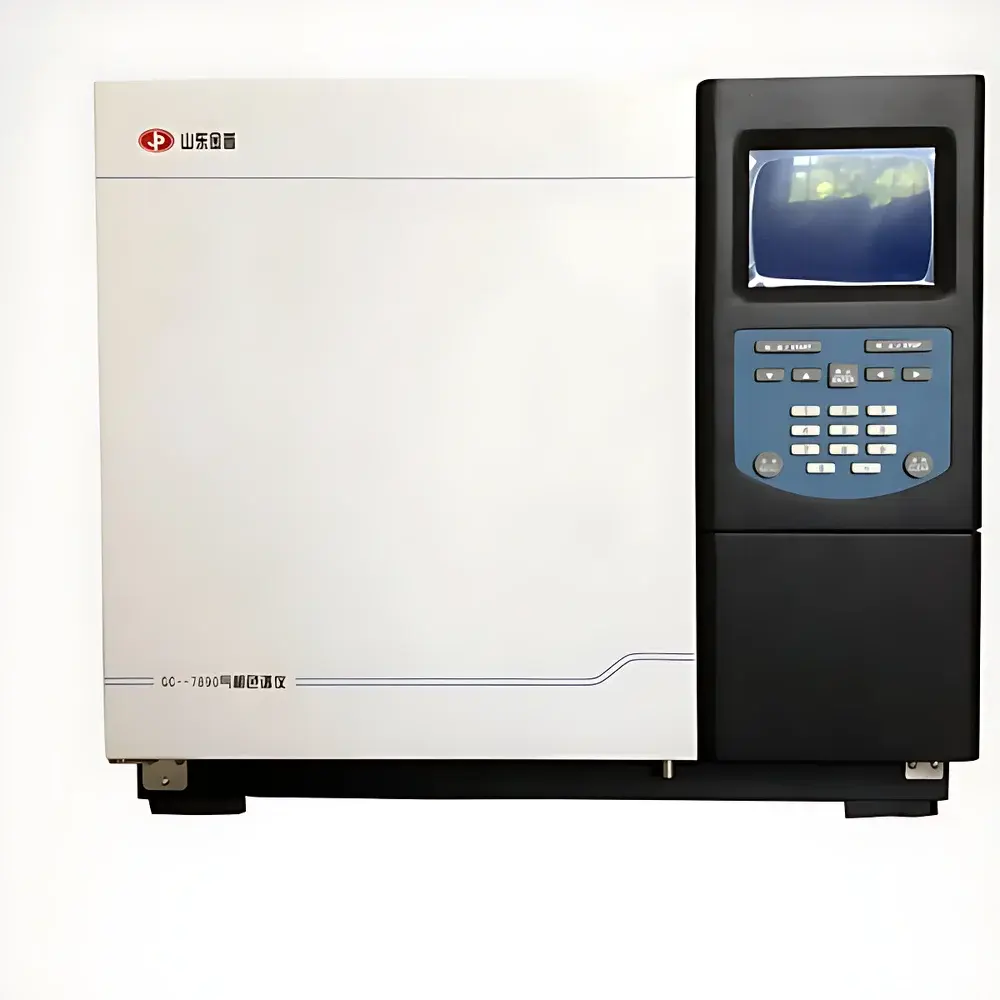
Jinpu GC-7890 Benchtop Gas Chromatograph for Ethylene Oxide (EO) Residual Analysis
| Brand | Jinpu |
|---|---|
| Origin | Shandong, China |
| Manufacturer Type | Authorized Distributor |
| Instrument Type | Laboratory Gas Chromatograph |
| Application Scope | General-Purpose / EO Residual Testing |
| Temperature Control Range | 5°C above ambient to 400°C (adjustable in 0.1°C increments) |
| Oven Ramp Rate | 0.1–40°C/min (0.1°C increment) |
| Oven Cool-Down | 450°C → 50°C in ≤6 min |
| Carrier Gas Flow Range & Control | 0–1200 mL/min |
| Carrier Gas Pressure Range & Control | 0–970 kPa |
| Injector Maximum Operating Temperature | 400°C |
| Injector Pressure Setting Range | 0–970 kPa |
| Injector Total Flow Setting Range | 0–1200 mL/min |
| Signal Outputs | Dual analog (A/B), RJ45 Ethernet interface |
| Gas Inlets | H₂, Air, Optional H₂ supply lines |
| Power Input | Standard AC mains with integrated fuse and charging circuitry |
Overview
The Jinpu GC-7890 is a benchtop gas chromatograph engineered for precise, repeatable quantification of residual ethylene oxide (EO) in medical devices, pharmaceutical packaging, and sterilized materials—applications governed by ISO 10993-7, USP , and ASTM F1980. It operates on the fundamental principle of separation via partitioning between a mobile phase (inert carrier gas, typically nitrogen or helium) and a stationary phase coated inside a fused-silica capillary column. Volatile analytes—including EO, chloroethanol, and ethylene chlorohydrin—are thermally volatilized in the heated injector, carried through the temperature-programmable oven, and resolved based on differential retention times. The system supports flame ionization detection (FID) or thermal conductivity detection (TCD), with hardware architecture optimized for stability under regulated laboratory conditions and routine QC/QA workflows.
Key Features
- Programmable oven with ultra-stable temperature control (±0.1°C) across a wide range (5°C above ambient to 400°C), enabling robust method development for EO elution at low retention times (~3–5 min) while maintaining baseline resolution from interfering solvents.
- High-precision electronic pressure control (EPC) for both inlet and detector gases, delivering reproducible flow and pressure settings (0–970 kPa; 0–1200 mL/min) critical for retention time locking and method transfer compliance.
- Dual analog signal outputs (A/B) support simultaneous connection to legacy integrators or data acquisition systems, while the integrated RJ45 Ethernet port enables networked instrument control, remote diagnostics, and audit-ready data export per FDA 21 CFR Part 11 requirements when paired with compliant chromatography data systems (CDS).
- Modular injector design accommodates split/splitless, on-column, or PTV configurations; maximum injector temperature of 400°C ensures complete vaporization of high-boiling matrix components without degradation.
- Rapid cool-down capability (450°C → 50°C in ≤6 minutes) reduces cycle time between injections—essential for high-throughput EO testing labs processing dozens of samples per shift.
Sample Compatibility & Compliance
The GC-7890 is validated for headspace analysis of EO residuals in polymeric medical device packaging (e.g., Tyvek®, PVC, PET), lyophilized drug vial stoppers, and sterilization pouches. Sample introduction is compatible with standard 20 mL headspace vials and automated headspace samplers (HS-10/HS-20 series). Method execution adheres to ISO 10993-7 Annex B (gas chromatographic determination), USP Chapter “Ethylene Oxide Residues”, and EU MDR Annex I §17.1 requirements for biocompatibility validation. System suitability testing includes resolution (Rs ≥ 2.0) between EO and internal standard (e.g., acetaldehyde), repeatability (RSD ≤ 3% for peak area), and linearity (r² ≥ 0.999 over 0.1–20 µg/g range).
Software & Data Management
The GC-7890 operates with Jinpu’s GC Navigator™ CDS software (v3.2+), supporting method creation, sequence definition, real-time chromatogram visualization, peak integration, calibration curve generation (linear, quadratic, weighted), and report export in PDF, CSV, and XML formats. Audit trail functionality logs all user actions—including method edits, injection events, and result approvals—with timestamp, operator ID, and reason-for-change fields. Data integrity safeguards include electronic signatures, role-based access control (admin/operator/auditor), and encrypted local database storage compliant with ALCOA+ principles. Raw data files (.jpd) are immutable and retain full acquisition metadata for GLP/GMP inspection readiness.
Applications
- Residual EO quantification in Class I–III medical devices prior to release (per ISO 10993-7 limits: ≤10 µg/g for most devices; ≤4 µg/g for implantables).
- Validation and routine monitoring of EO sterilization process parameters (temperature, humidity, gas concentration, exposure time).
- Stability-indicating analysis of EO-degraded excipients (e.g., polysorbates, PEGs) in parenteral formulations.
- Environmental monitoring of EO off-gassing from sterilization chambers and storage areas (using adsorbent tube sampling coupled with thermal desorption).
- QC testing of EO-based chemical intermediates in fine organic synthesis laboratories.
FAQ
What detectors are supported with the GC-7890 for EO analysis?
The system is configured for FID as standard; TCD and ECD modules are available as factory-installed options. FID provides optimal sensitivity (LOD ≈ 0.02 µg/mL) and linear dynamic range (>10⁶) for EO in headspace matrices.
Is method validation documentation provided?
Yes—Jinpu supplies a comprehensive IQ/OQ protocol package aligned with ASTM E2500 and ISO/IEC 17025, including temperature uniformity mapping, detector linearity verification, and system precision testing reports.
Can the GC-7890 be integrated into an LIMS environment?
Via its native RESTful API and HL7-compliant output modules, the instrument supports bidirectional data exchange with major LIMS platforms (e.g., LabVantage, STARLIMS, Thermo Fisher SampleManager) for automated sample registration and result ingestion.
What maintenance intervals are recommended for routine EO testing?
Column conditioning every 50 injections; inlet liner replacement every 100 injections; FID jet cleaning monthly; annual EPC calibration verification using NIST-traceable pressure standards.
Does the system meet regulatory requirements for pharmaceutical QC labs?
When deployed with validated methods, qualified hardware, and appropriate CDS configuration, the GC-7890 satisfies core expectations of FDA, EMA, and PMDA for equipment used in GxP environments—subject to site-specific risk assessment and documented qualification protocols.






