
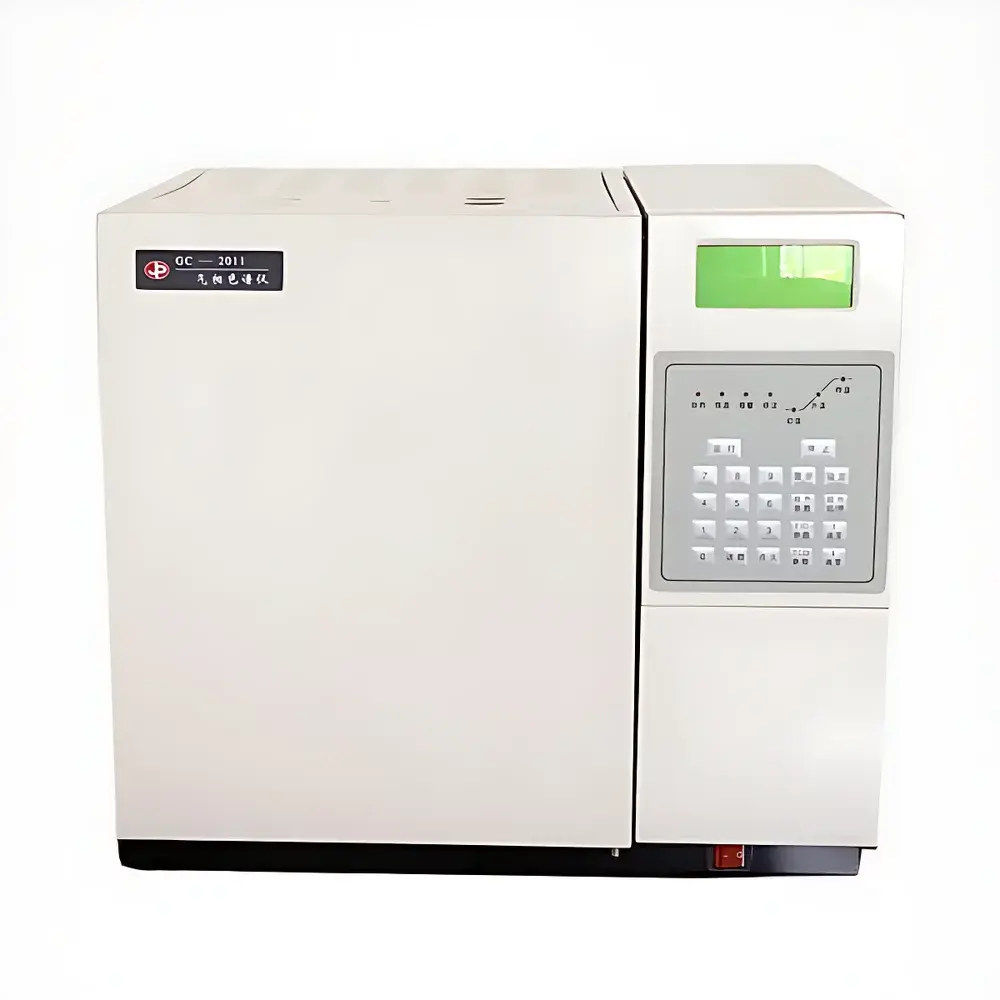
Golden普 GC-2011 Gas Chromatograph
| Brand | Golden普 |
|---|---|
| Model | GC-2011 (New Generation) |
| Origin | Shandong, China |
| Instrument Type | Laboratory Gas Chromatograph |
| Application Scope | General-purpose |
| Oven Temperature Range | Ambient +8°C to 420°C |
| Temperature Control Accuracy | ±0.1°C (≤200°C), ±0.2°C (>200°C) |
| Programmable Temperature Ramping | 5-stage linear ramping |
| Ramp Rate | 1–30°C/min (0.1°C increment) |
| Cooling Rate | 350°C → 100°C in ≤3.5 min |
| Detector Options | FID (Mf ≤2×10⁻¹¹ g/s for benzene) or TCD (S ≥3000 mV·mL/mg for benzene) |
| Dimensions | 540 × 470 × 460 mm |
| Weight | 50 kg |
| Power Supply | AC 220 V ±10%, 50 Hz, 2 kW |
Overview
The Golden普 GC-2011 Gas Chromatograph is a robust, general-purpose laboratory gas chromatograph engineered for precision separation and quantitative analysis of volatile and semi-volatile organic compounds. Based on classical packed- and capillary-column gas chromatography principles, the instrument employs carrier gas–driven partitioning through a thermally stabilized stationary phase, with detection via flame ionization (FID) or thermal conductivity (TCD) mechanisms. Designed for routine QC/QA, environmental monitoring, petrochemical screening, and academic research labs, the GC-2011 integrates dual-inlet architecture—supporting both packed columns and fused-silica capillaries—within a single column oven platform. Its modular thermal management system, featuring intelligent back-door cooling and column-tracking oven heating, minimizes thermal stress on sensitive detector components while enabling rapid method cycling and stable baseline performance.
Key Features
- 5-stage linear programmable temperature ramping with 0.1°C resolution and ±0.1°C stability at ≤200°C (±0.2°C above), ensuring reproducible retention time alignment across repeated injections.
- Dual independent inlet configuration: one packed-column vaporizer and one dedicated capillary split/splitless injector with integrated tail-purge gas control, compatible with narrow-bore (0.1–0.32 mm ID), wide-bore (0.53 mm ID), and packed columns.
- Intelligent rear-door cooling system utilizing variable-frequency motor control achieves column oven cooldown from 350°C to 100°C in ≤3.5 minutes—enabling near-ambient operation without external cryogenic aids.
- Microprocessor-controlled automatic ignition for FID; digital zero-baseline compensation eliminates mechanical potentiometer drift, improving long-term signal stability.
- Comprehensive hardware-level safety protocols: overtemperature cutoff (per channel), carrier gas failure detection with TCD filament protection logic, power surge immunity, and non-volatile parameter memory with battery-backed retention.
- Large-format Chinese-language LCD interface with intuitive menu navigation simplifies method setup, real-time status monitoring, and diagnostic feedback—optimized for operators in multilingual lab environments.
Sample Compatibility & Compliance
The GC-2011 supports broad sample class compatibility—including hydrocarbons, alcohols, esters, ketones, halogenated organics, pesticides, residual solvents, and light gases—when paired with appropriate column chemistries (e.g., DB-5ms, HP-PLOT Al₂O₃, or Porapak Q). Its thermal design conforms to ASTM D3606 (benzene/toluene in gasoline), ISO 11843-2 (detection limit validation), and USP chromatographic system suitability requirements. While not pre-certified for 21 CFR Part 11, the instrument’s deterministic firmware architecture, audit-ready error logging (with timestamped Chinese-language fault codes), and parameter lockout capability facilitate integration into GLP- or GMP-aligned workflows when deployed with compliant data acquisition software.
Software & Data Management
The GC-2011 operates as a standalone hardware platform with embedded firmware controlling all thermal zones, detector bias, and timing sequences. Raw analog signals from FID or TCD are digitized onboard and output via RS-232 or USB to third-party chromatography data systems (CDS), including OpenLab CDS, Chromeleon, or custom LabVIEW-based acquisition modules. All method parameters—including ramp profiles, detector settings, and event markers—are stored in non-volatile memory and persist across power cycles. The unit logs operational anomalies (e.g., “Column oven overtemperature”, “TCD carrier loss”) with localized Chinese text and numeric error codes, supporting root-cause analysis during regulatory audits or maintenance reviews.
Applications
- Environmental analysis: VOCs in air canisters, BTEX in water (EPA Method 8021B), chlorinated solvents in soil extracts.
- Petrochemical QA: Hydrocarbon type analysis (PIONA), gasoline oxygenates (MTBE, ETBE), and distillation profile verification.
- Pharmaceutical testing: Residual solvent quantification per ICH Q3C guidelines using headspace-GC/FID.
- Food & flavor chemistry: Fatty acid methyl ester (FAME) profiling, terpene fingerprinting, and ethanol content determination.
- Academic teaching labs: Fundamental GC theory demonstration, calibration curve construction, and retention index measurement.
FAQ
Does the GC-2011 support electronic pressure control (EPC) for carrier gas?
No—the GC-2011 uses mechanical flow and pressure regulation via precision needle valves. It does not incorporate EPC modules; users must manually calibrate flow rates using a bubble flowmeter or electronic flowmeter.
Can the instrument be operated under GLP-compliant conditions?
Yes—when coupled with validated CDS software providing audit trails, user access controls, and electronic signatures, the GC-2011’s deterministic hardware behavior, persistent parameter storage, and comprehensive fault logging meet foundational GLP data integrity expectations.
What column dimensions and phases are recommended for optimal performance?
For capillary applications: 30 m × 0.32 mm ID × 0.25 µm film thickness DB-5 or equivalent 5% phenyl polysiloxane columns. For packed columns: 2 m × 3 mm OD stainless steel columns packed with 10% OV-101 on Chromosorb W AW DMCS.
Is remote diagnostics or network connectivity available?
The GC-2011 lacks built-in Ethernet or Wi-Fi interfaces. Remote monitoring requires external serial-to-Ethernet converters or integration via OPC-UA gateways when connected to supervisory SCADA or LIMS platforms.





