
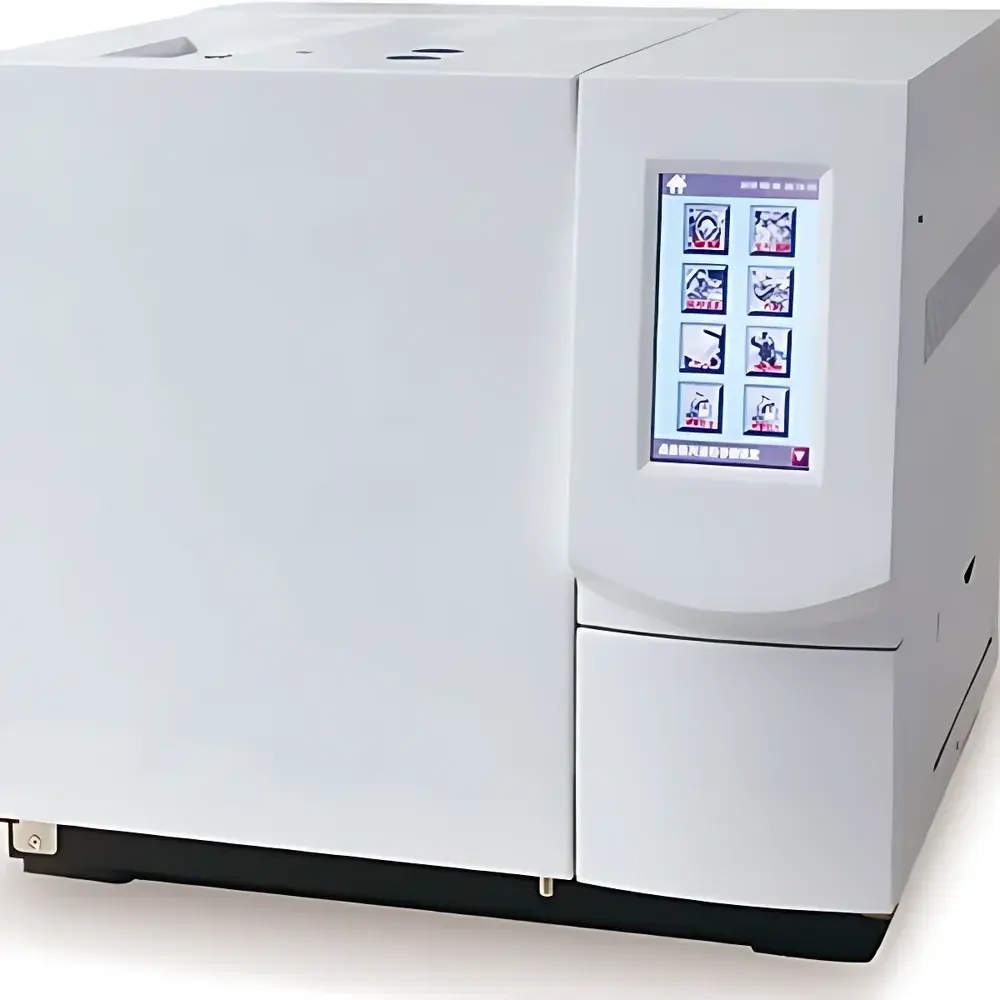
Jinpu GC-7890 Gas Chromatograph
| Brand | Jinpu |
|---|---|
| Origin | Shandong, China |
| Model | GC-7890 |
| Instrument Type | Laboratory Gas Chromatograph |
| Application Scope | General-purpose |
| Oven Temperature Range | 5 °C above ambient to 400 °C (adjustable in 0.1 °C increments) |
| Ramp Rate | 0.1–40 °C/min (adjustable in 0.1 °C/min increments) |
| Cool-down Rate | 450 °C to 50 °C in ≤6 minutes |
| Carrier Gas Flow Range & Control | 0–1200 mL/min (7 flow segments) |
| Carrier Gas Pressure Range & Control | 0–970 kPa |
| Injector Maximum Operating Temperature | 400 °C |
| Injector Pressure Setting Range | 0–970 kPa |
| Injector Total Flow Setting Range | 0–1200 mL/min |
| Temperature Stability (≤180 °C) | ±0.01 °C |
| Temperature Accuracy | ≤±0.1 °C |
| Temperature Gradient (100–360 °C, programmed ramp) | ±1 °C |
| Column Configuration | Dual packed columns + one capillary column, or dual capillary columns |
| Detector Capacity | Up to three detectors simultaneously (e.g., dual TCD, dual FID, or TCD+FID), plus optional methanizer |
| Inlet Options | Manual, auto-sampler compatible, valve injection, headspace, thermal desorption, liquid autosampler |
| Power Supply | 220 V ±10%, max. 2200 W |
Overview
The Jinpu GC-7890 is a high-performance, general-purpose laboratory gas chromatograph engineered for precision, stability, and operational flexibility in routine and method-development environments. Based on classical gas chromatographic separation principles—where analytes are partitioned between a mobile phase (inert carrier gas) and a stationary phase (coated capillary or packed column)—the GC-7890 delivers robust retention time reproducibility and peak resolution across diverse sample matrices. Its column oven features a wide operating range (5 °C above ambient to 400 °C), ultra-fine temperature resolution (0.1 °C setpoint increment), and rapid thermal response enabled by intelligent dual rear doors and optimized airflow design. The system supports both packed and capillary column configurations—including simultaneous dual-capillary operation—and accommodates multiple detector types (TCD, FID, ECD, NPD, FPD) with independent, high-stability temperature control (up to 400 °C). With its ARM9-based embedded controller and native chromatography software, the GC-7890 provides deterministic real-time instrument control, ensuring compliance-ready data acquisition for regulated laboratories.
Key Features
- 6-zone independent temperature control (oven, 2 inlets, 3 detectors) with 7-stage programmable ramping and precise 0.1 °C setpoint resolution
- Column oven cooling from 450 °C to 50 °C in ≤6 minutes—enabling high-throughput analysis without extended downtime
- Carrier gas pressure and flow control over 0–970 kPa and 0–1200 mL/min respectively, with 7 discrete flow segments for method reproducibility
- Enhanced thermal safety architecture: platinum RTD-based over-temperature cutoff, open/short-circuit detection for heater elements, and automatic power shutdown upon carrier gas failure
- 5.7-inch color TFT display supporting dual-channel real-time chromatogram overlay, live flow/pressure readouts, and intuitive bilingual (English/Chinese) UI navigation
- Optional integrated 24-bit ADC module for direct digital signal output; full PC-based remote control via USB or Ethernet (GC-7890 supports bidirectional instrument parameter synchronization)
- Negative-temperature capability down to –80 °C when coupled with external cryogenic coolants (dry ice or liquid nitrogen), extending method coverage for highly volatile compounds
- Support for auxiliary modules including headspace samplers, thermal desorbers, liquid autosamplers, and gas sampling valves—fully synchronized via TTL or RS-232 interfaces
Sample Compatibility & Compliance
The GC-7890 is validated for use with volatile and semi-volatile organic compounds (VOCs/SVOCs), residual solvents, hydrocarbon fractions, environmental pollutants (e.g., PAHs, PCBs, pesticides), and light gases (C1–C6). It meets core mechanical and electrical safety requirements per IEC 61010-1 and GB/T 18268 (Chinese equivalent of IEC 61326). While not pre-certified for FDA 21 CFR Part 11 out-of-the-box, the system’s audit-trail-capable software architecture—when deployed with timestamped user authentication, electronic signatures, and immutable raw-data storage—supports validation under GLP and GMP frameworks. Method transfer and system suitability testing align with ASTM D3612 (petroleum hydrocarbons), ISO 11843 (detection limit estimation), and USP (chromatographic system suitability).
Software & Data Management
The GC-7890 operates with proprietary chromatography data system (CDS) software built on a modular, event-driven architecture. It supports full method development—including gradient programming, peak integration with customizable baselines, retention time locking, and spectral library matching (for compatible detectors). All raw chromatograms, method files, and audit logs are stored in vendor-neutral formats (e.g., .CDF, .CSV) with embedded metadata (instrument ID, operator, date/time, calibration status). The software includes built-in tools for system suitability assessment (tailing factor, resolution, RSD of retention time), report generation compliant with ISO/IEC 17025 documentation standards, and export options for LIMS integration (via ODBC or HL7). Optional 21 CFR Part 11 add-on modules provide role-based access control, electronic signature workflows, and immutable audit trails.
Applications
- Environmental analysis: VOC screening in air/water per EPA Method 8260D and TO-17
- Pharmaceutical quality control: Residual solvent quantification (ICH Q3C), excipient purity, and stability-indicating assays
- Petrochemical QA/QC: Hydrocarbon type analysis (PIONA), simulated distillation (ASTM D5292), and sulfur speciation
- Food & flavor chemistry: Fatty acid methyl ester (FAME) profiling, terpene fingerprinting, and off-flavor compound identification
- Forensic toxicology: Blood alcohol and drug metabolite profiling using headspace-GC/FID or GC/MS coupling
- Materials science: Outgassing analysis of polymers and composites under controlled thermal desorption protocols
FAQ
Does the GC-7890 support regulatory-compliant data integrity?
Yes—when configured with the optional 21 CFR Part 11 software package, it provides electronic signatures, audit trails, and role-based permissions required for FDA, EMA, and PMDA submissions.
Can the GC-7890 operate with both capillary and packed columns simultaneously?
Yes—the instrument supports up to two packed columns and one capillary column, or two capillary columns, with independent inlet and detector temperature control.
What is the minimum detectable temperature increment during programmed heating?
All temperature parameters—including oven, inlet, and detector zones—are adjustable in 0.1 °C increments.
Is remote instrument control possible without proprietary software?
The GC-7890 exposes standardized SCPI-like command sets over USB/RS-232/Ethernet, enabling integration with third-party LabVIEW, Python, or custom CDS platforms.
How does the system ensure thermal stability during long-duration runs?
The oven employs dual PID algorithms with adaptive learning, platinum resistance thermometers (Pt100), and active airflow compensation—achieving ±0.01 °C stability at temperatures ≤180 °C.





