
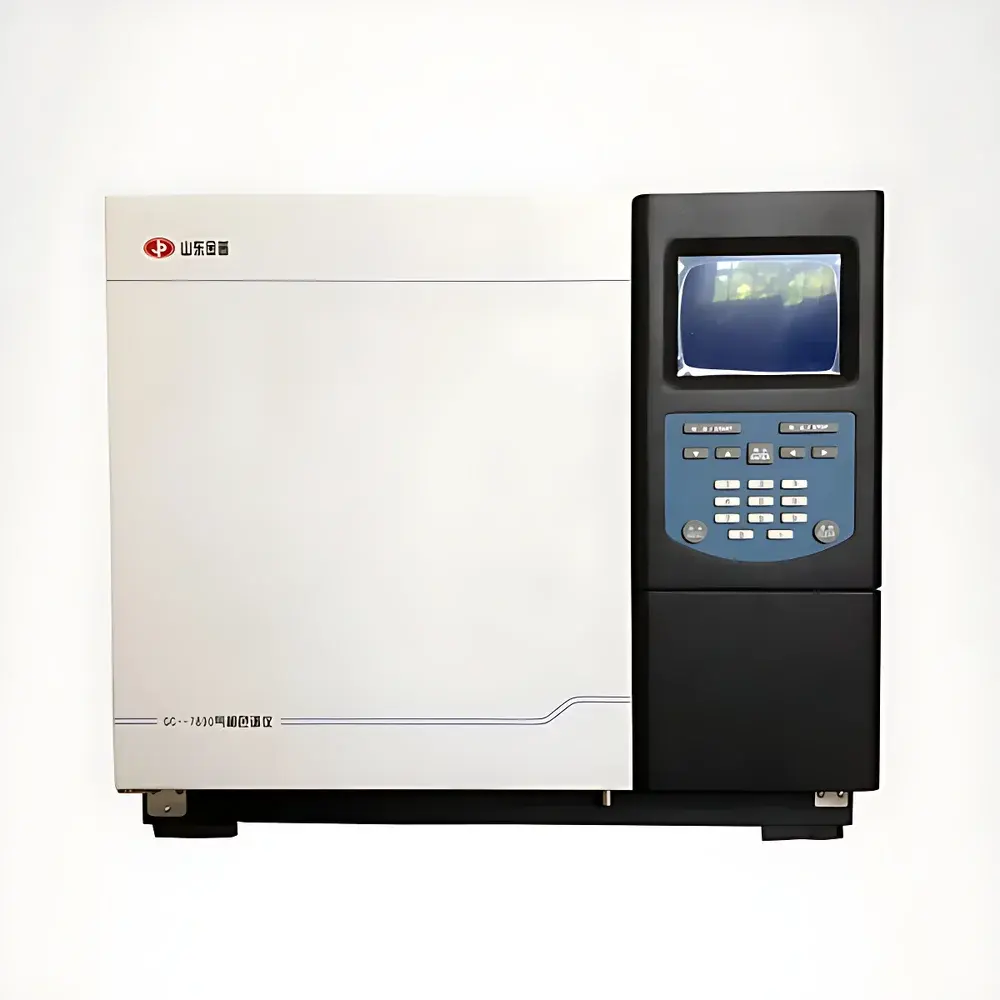
Gas Chromatograph GC-7890 by Jinpu Analytical Instruments
| [Brand | Jinpu |
|---|---|
| Origin | Shandong, China |
| Manufacturer Type | Authorized Distributor |
| Country of Origin | China |
| Model | GC-7890 |
| Instrument Type | Laboratory Gas Chromatograph |
| Application Scope | General-Purpose |
| Oven Temperature Range | Ambient +5°C to 450°C (adjustable in 0.1°C increments) |
| Ramp Rate | 0.1–40°C/min (0.1°C increment) |
| Cooling Rate | 450°C → 50°C in ≤6 min |
| Carrier Gas Flow Range & Control | 0–1200 mL/min |
| Carrier Gas Pressure Range & Control | 0–970 kPa |
| Injector Maximum Operating Temperature | 400°C |
| Injector Pressure Setting Range | 0–970 kPa |
| Injector Total Flow Setting Range | 0–1200 mL/min |
| Temperature Stability (≤180°C) | ±0.01°C |
| Column Configuration Support | Dual packed columns + one capillary column, or dual capillary columns |
| Detector Compatibility | Dual TCD, dual FID, or simultaneous TCD/FID operation |
| Programmed Temperature | 8-step ramping across 6 independently controlled zones |
| Auto-Ignition | Yes (patented) |
| Automatic Sample Injection | Yes (patented) |
| Power Supply | 220 V ±10%, 2200 W max |
| FID Sensitivity | ≤3×10⁻¹² g/s (benzene on CS₂), Noise: ≤3×10⁻¹³ A, Drift: ≤5×10⁻¹³ A/30 min, Linearity: ≥10⁶] |
Overview
The GC-7890 is a modular, laboratory-grade gas chromatograph engineered for high reproducibility and operational flexibility in routine and method-development environments. Built upon classical gas-phase separation principles—where analytes are partitioned between a mobile phase (inert carrier gas) and a stationary phase (coated capillary or packed column)—the instrument delivers precise retention time control, robust peak resolution, and reliable quantitation across volatile and semi-volatile organic compounds. Its architecture supports both packed-column and capillary-column configurations, enabling compatibility with legacy methods and modern high-efficiency separations. Designed for compliance-critical workflows, the GC-7890 meets foundational requirements for ISO/IEC 17025-accredited laboratories and aligns with ASTM D3606, USP , and EPA Method 8021B application frameworks.
Key Features
- 6-zone independent temperature control—including oven, dual injectors (packed and capillary), and up to three detector compartments—enables simultaneous optimization of separation, volatilization, and detection conditions.
- Intelligent dual rear door system (patent ZL 2012 2 0286920.0) ensures rapid, uniform cooling from 450°C to 50°C in under 6 minutes while minimizing thermal stress on column and detector components.
- High-stability oven control with ±0.01°C precision at temperatures ≤180°C and ±0.1°C accuracy across full range (ambient +5°C to 450°C), supporting narrow-boiling-point mixture analysis and regulated method transfers.
- Programmable 8-stage temperature ramping with 0.1°C resolution allows fine-grained optimization of complex sample matrices, including petrochemical cuts, environmental extracts, and flavor/aroma profiles.
- Dual injector configuration: One packed-column inlet (up to 400°C) and one split/splitless capillary inlet, each with independent pressure and flow control (0–970 kPa / 0–1200 mL/min), facilitating method portability and multi-technique validation.
- Integrated auto-ignition (patent ZL 2012 2 0285854.5) and automatic injection triggering (patent ZL 2012 2 0285852.6) reduce operator dependency and improve inter-run consistency in unattended operation.
- Comprehensive hardware diagnostics—including Pt resistance open/short detection, overtemperature cutoff, and carrier gas failure shutdown (patent ZL 2012 2 0285835.2)—ensure instrument integrity during extended runs and remote monitoring scenarios.
Sample Compatibility & Compliance
The GC-7890 accommodates a broad spectrum of sample introduction techniques via standardized interfaces: liquid autosamplers (e.g., 10.5 mm vial format), headspace samplers (with pressurized loop or static equilibrium modes), thermal desorbers (for sorbent tube analysis), and gas sampling valves (10-port, heated). It supports derivatized and underivatized analytes across C₂–C₄₀ hydrocarbons, chlorinated solvents, pesticides, residual monomers, and volatile organic compounds (VOCs). The system complies with GLP/GMP documentation prerequisites through optional audit-trail-enabled software (see Software & Data Management). All thermal modules meet IEC 61010-1 safety standards for laboratory equipment; electrical design conforms to CE and RoHS directives.
Software & Data Management
GC-7890 operates with optional PC-based chromatography data systems (CDS) supporting bidirectional instrument control (remote parameter setting, sequence launch, real-time status feedback). The embedded firmware provides native support for CSV export, AIA (.cdf) file generation, and integration with LIMS via ODBC-compliant drivers. When configured with FDA 21 CFR Part 11-compliant CDS, the platform enables electronic signatures, role-based access control, and immutable audit trails for raw data, method parameters, and processing events—fulfilling regulatory expectations for pharmaceutical QC, contract testing labs, and food safety accreditation bodies.
Applications
- Environmental testing: BTEX, PAHs, chlorinated hydrocarbons per EPA Methods 8015, 8260, and 8270.
- Petrochemical QA/QC: Simulated distillation (ASTM D2887), gasoline hydrocarbon analysis (ASTM D5134), and sulfur speciation.
- Pharmaceutical residual solvent screening (ICH Q3C guidelines) using headspace-GC/FID.
- Food & flavor analysis: Ethanol quantitation, off-flavor compound profiling, and essential oil composition.
- Polymers & materials: Monomer purity assessment, catalyst residue detection, and extractables/leachables studies.
FAQ
Does the GC-7890 support cryogenic oven operation?
Yes—when connected to external dry ice or liquid nitrogen cooling units, the oven achieves stable operation from –80°C to 450°C, enabling low-temperature trapping and high-resolution separation of light gases (e.g., permanent gases, formaldehyde).
Can I install three detectors simultaneously?
Yes—the chassis supports concurrent mounting of two FIDs, one TCD, and an integrated methanizer, with independent temperature and gas flow control for each module.
Is the instrument compatible with third-party autosamplers?
Yes—standard RS-232 and TTL-level trigger I/O ports enable synchronization with commercial liquid, headspace, and thermal desorption autosamplers without proprietary adapters.
What is the minimum detectable concentration for benzene using the FID?
Under optimized conditions (CS₂ diluent, 0.25 mm ID capillary column, 1 µL injection), the system achieves a practical limit of quantitation (LOQ) of 0.05 ppm in aqueous matrix, consistent with FID sensitivity specification (≤3×10⁻¹² g/s).
Does the GC-7890 include validation documentation?
Factory-installed IQ/OQ protocols are available upon request; full PQ execution requires site-specific test samples and user-defined acceptance criteria aligned with ISO/IEC 17025 or internal SOPs.
Related Products




