
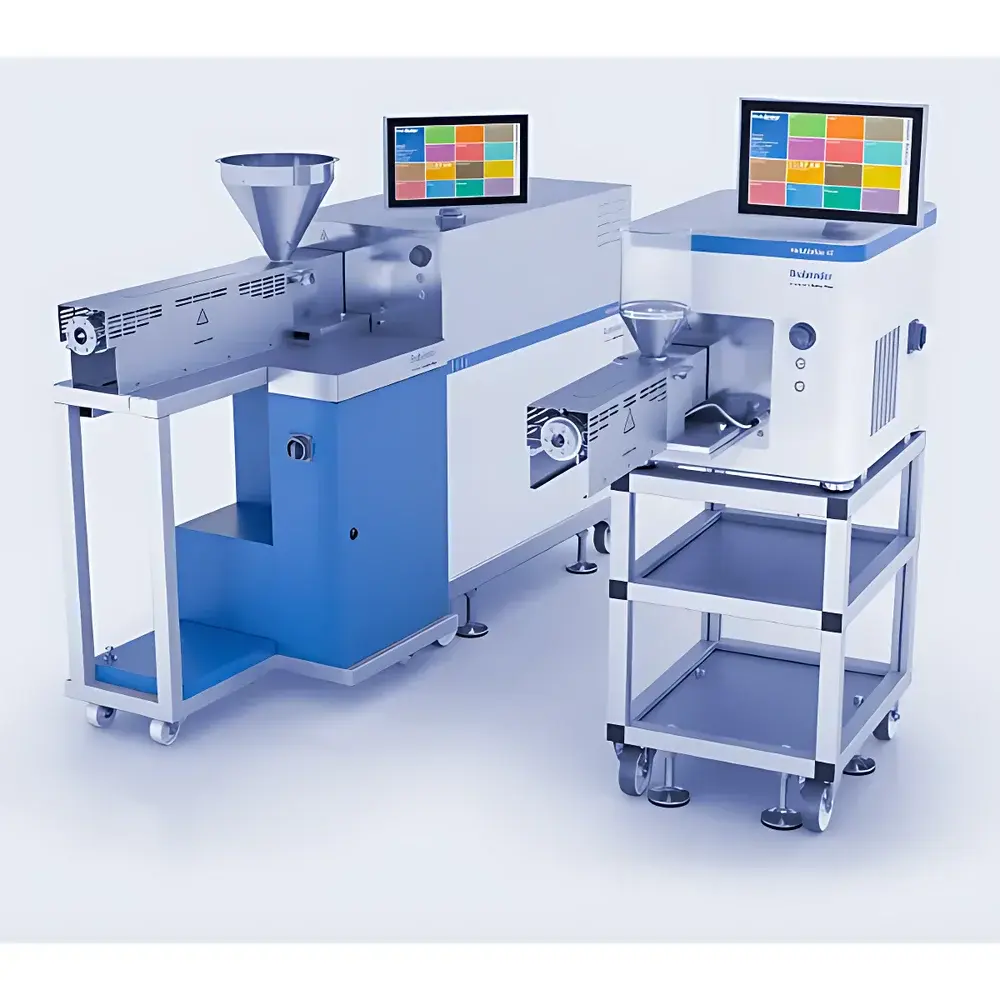
Anton Paar Brabender MetaStation Modular Torque Rheometer
| Brand | Anton Paar Brabender |
|---|---|
| Origin | Germany |
| Manufacturer Type | Authorized Distributor |
| Origin Category | Imported |
| Model | MetaStation |
| Instrument Type | Torque Rheometer |
| Sample Type | High-Viscosity Materials |
| Sample State | Molten or Paste-Like |
| Bearing Type | Mechanical Bearings |
| Frequency Range | 10⁻³–628 rad/s |
| Minimum Rotational Speed | 0.2 min⁻¹ |
| Maximum Torque | 500 N·m |
| Maximum Rotational Speed | 3000 rpm |
| Torque Resolution | <100 nN·m |
Overview
The Anton Paar Brabender MetaStation is a modular, high-torque rotational rheometer engineered for precise characterization of processing behavior and material response under shear and extensional deformation. Operating on the Couette flow principle within controlled-temperature mixing chambers, it delivers quantitative torque, temperature, and rotational speed data essential for evaluating melt viscosity, viscoelasticity, thermal stability, and curing kinetics of thermoplastics, thermosets, elastomers, and compound formulations. Designed for industrial R&D laboratories and quality control environments, the MetaStation supports both batch mixing (e.g., PVC plastification, rubber mastication) and continuous extrusion simulation—enabling correlation between lab-scale measurements and full-scale production parameters.
Key Features
- Modular architecture with interchangeable mixing modules: W 50 EHT (for PVC), 350SX (for rubber compounds), and MB 30 (for thermoset crosslinking per DIN 53764)
- High-torque drive system (up to 500 N·m) with mechanical bearings optimized for long-term stability under abrasive and corrosive conditions
- Wide dynamic range: rotational speeds from 0.2 to 3000 rpm (equivalent to angular frequencies of 10⁻³–628 rad/s) and torque resolution better than 100 nN·m
- Thermal control system supporting temperature ranges from ambient to 400 °C, with programmable ramp rates and PID-stabilized zones
- Tool-free, rapid module exchange (<15 minutes) enabling seamless transition between mixing and extrusion configurations
- Corrosion- and wear-resistant mixing elements fabricated from specialized steel alloys and surface-coated materials
Sample Compatibility & Compliance
The MetaStation accommodates high-viscosity, non-Newtonian materials in molten, pasty, or highly filled states—including PVC resins, synthetic and natural rubbers, phenolic and epoxy thermosets, and polymer composites. It complies with ASTM D2538 (PVC compound plastification), ASTM D3417 (heat distortion and enthalpy of fusion), ASTM D5992 (dynamic mechanical analysis of elastomers), and DIN 53764 (crosslinking behavior of thermosetting resins). Its design supports GLP-compliant workflows, with audit-trail-ready operation logs and instrument calibration records traceable to national standards. All mixing modules are constructed to meet ISO 9001 manufacturing requirements and support FDA 21 CFR Part 11–aligned electronic signature and data integrity protocols when used with MetaBridge software.
Software & Data Management
MetaBridge is the native Windows-based control and analysis platform for the MetaStation. It provides real-time visualization of torque, temperature, and power consumption curves, with synchronized multi-channel acquisition at configurable sampling intervals. The software includes ASTM method templates for one-click test setup, reference curve overlay functionality for in-process quality monitoring, and statistical comparison tools for inter-batch or inter-material evaluation. Data export is supported in CSV, XML, and PDF formats, with direct integration into LIMS, ERP, and MES systems via OPC UA or RESTful API interfaces. All measurement files include embedded metadata (user ID, timestamp, instrument serial number, calibration status), ensuring full traceability for regulatory submissions and internal audits.
Applications
- Plastification behavior and thermal degradation onset of PVC compounds
- Mastication efficiency and filler dispersion homogeneity in rubber formulations
- Crosslinking kinetics and gel point determination of thermosetting resins (e.g., epoxies, polyurethanes)
- Shear-thinning index, melt elasticity, and die swell prediction for extrusion-grade polymers
- Stabilizer effectiveness screening under accelerated thermal stress conditions
- Batch-to-batch consistency verification for masterbatch and compound release
FAQ
What ASTM standards does the MetaStation support out-of-the-box?
The MetaStation includes preconfigured methods for ASTM D2538, D3417, D5992, and D7028, with user-modifiable parameters to align with laboratory-specific SOPs.
Can the same mixing chamber be used for both PVC and rubber testing?
No—different material classes require dedicated geometries and thermal profiles. The W 50 EHT and 350SX modules are mechanically and thermally optimized for their respective applications and are not interchangeable without recalibration.
Is torque linearity verified across the full 0.2–3000 rpm range?
Yes—each instrument undergoes factory calibration using NIST-traceable torque standards at multiple points across the operational speed and temperature envelope.
How does MetaBridge ensure data integrity for regulated environments?
MetaBridge implements role-based access control, electronic signatures, immutable audit trails, and automatic backup to network drives—all compliant with FDA 21 CFR Part 11 and EU Annex 11 requirements.
What maintenance is required for mechanical bearings under continuous high-torque operation?
Brabender specifies a 10,000-hour service interval for bearing inspection and lubrication under typical operating conditions; extended-life variants with sealed ceramic bearings are available upon request.



