
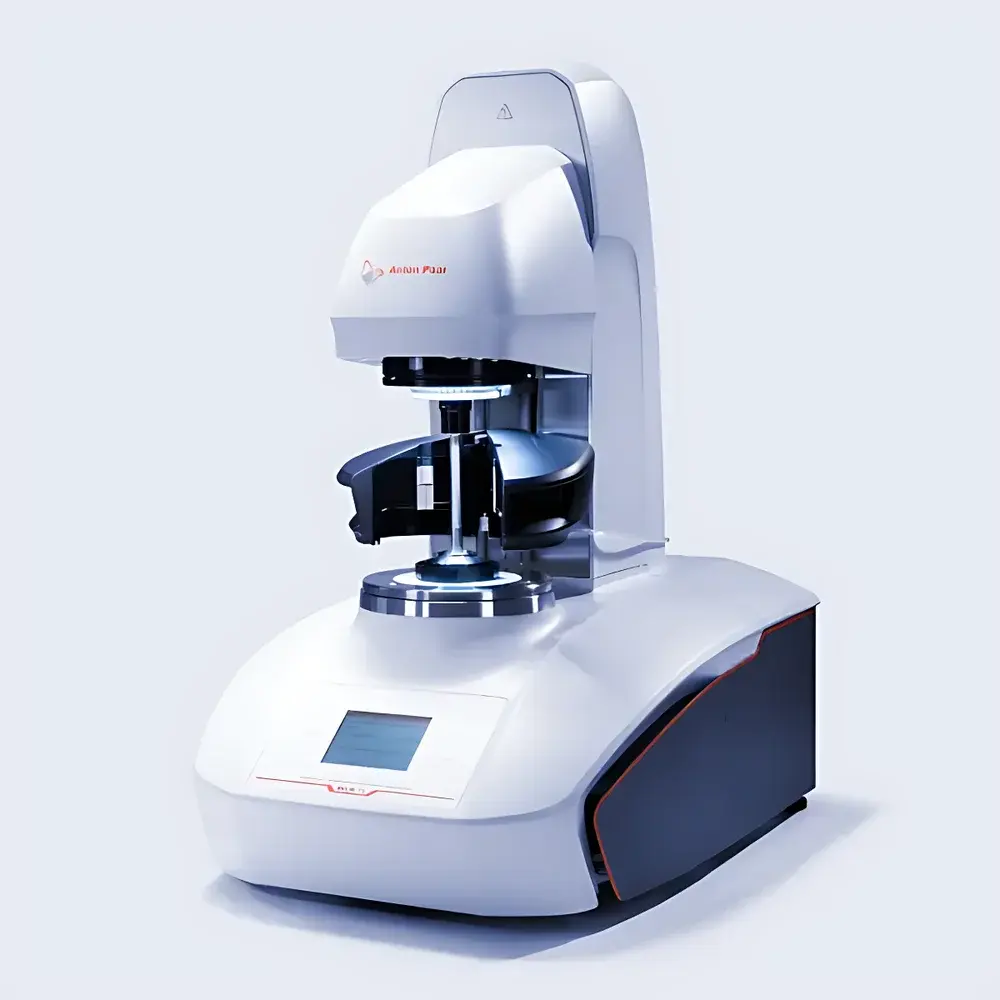
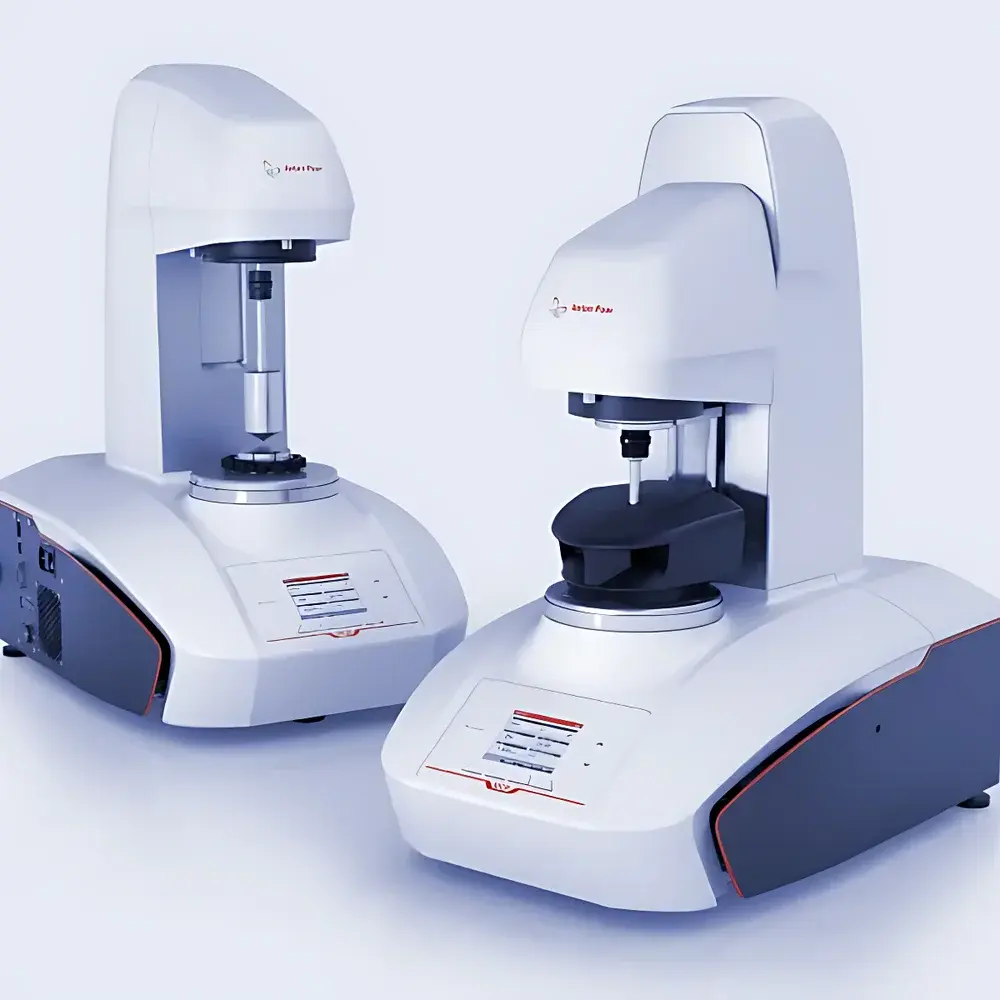
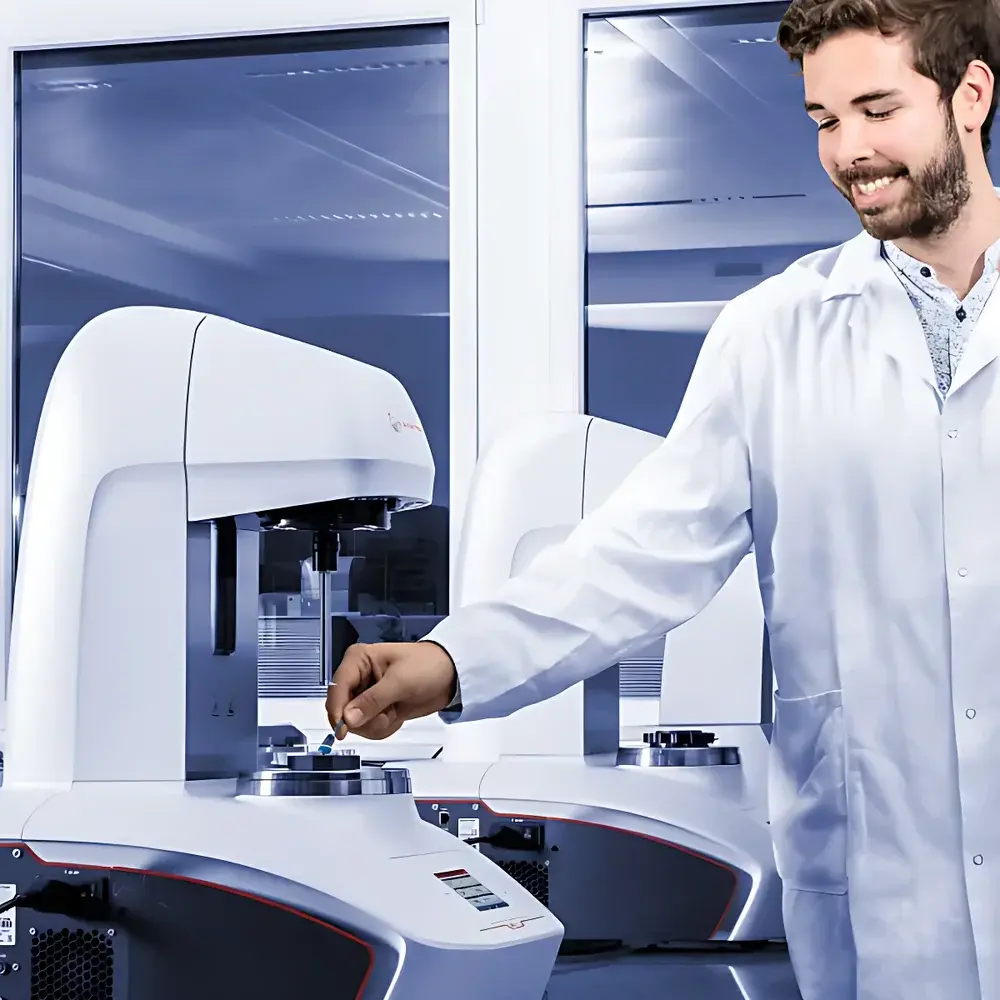
Anton Paar MCR 72/92 Advanced Rotational Rheometer
| Brand | Anton Paar |
|---|---|
| Origin | Austria |
| Manufacturer Type | Original Equipment Manufacturer (OEM) |
| Product Origin | Imported |
| Model | MCR 72 / MCR 92 |
| Instrument Type | Rotational Rheometer |
| Sample State | Solid, Semi-Solid, Paste, Gel, Molten Polymer |
| Bearing System | Ball Bearing (MCR 72) / Air Bearing (MCR 92) |
| Temperature Range | –50 °C to +400 °C |
| Minimum Angular Velocity | 10⁻⁴ rad/s (≈0.001 rpm) |
| Maximum Angular Velocity | 157 rad/s (1500 rpm) |
| Frequency Range | 10⁻⁴ to 628 rad/s (0.0001–100 Hz) |
| Maximum Torque | 125 mNm |
| Torque Resolution | 100 nNm |
| Normal Force Control | SafeGap™ integrated |
| Optical Sample Observation | TruRay™ adjustable LED illumination |
| Tool Recognition | Toolmaster™ auto-identification for transducers and temperature units |
| Drive System | EC brushless DC motor with high-resolution optical encoder |
| Control Modes | Controlled Shear Stress (CSS), Controlled Shear Rate (CSR), Controlled Strain (CSA), Controlled Stress (CSD) |
| Compliance | ASTM D3835, ISO 6721-10, ISO 3219, USP <911>, FDA 21 CFR Part 11-ready software architecture |
Overview
The Anton Paar MCR 72 and MCR 92 are high-precision rotational rheometers engineered for rigorous academic research, industrial quality control, and regulatory-compliant material characterization. Both instruments operate on the principle of controlled shear deformation in Couette or parallel-plate geometries, enabling quantitative determination of viscoelastic properties—including storage modulus (G′), loss modulus (G″), complex viscosity (η*), yield stress, thixotropy, and time-dependent structural recovery. The MCR 72 employs a robust ball-bearing motor optimized for routine rotational measurements and moderate oscillatory testing without compressed air; the MCR 92 integrates an ultra-low-friction air-bearing motor with direct strain/stress control, delivering sub-microradian angular resolution and exceptional sensitivity for weak gel networks, soft biological tissues, and low-viscosity dispersions. Each system features a modular architecture compatible with over 50 standardized measuring geometries—cone-plate, parallel-plate, concentric cylinder, vane, and serrated fixtures—ensuring method transferability across laboratories and alignment with international test standards.
Key Features
- SafeGap™ Technology: Actively regulates normal force during gap setting to prevent sample compression or extrusion, ensuring reproducible geometry definition and eliminating operator-induced variability.
- TruRay™ Illumination: Integrated, dimmable LED ring beneath the measurement stage provides shadow-free, glare-free optical access—critical for real-time assessment of sample homogeneity, phase separation, or thermal degradation during temperature ramps.
- Toolmaster™ Auto-ID: Embedded RFID chips in transducers and temperature modules enable automatic recognition of geometry type, calibration constants, and thermal limits—eliminating manual entry errors and supporting audit-trail compliance per GLP/GMP requirements.
- QuickConnect™ Interface: Tool-less, single-hand coupling mechanism secures measuring systems in under 3 seconds without threaded engagement—minimizing downtime between samples and reducing mechanical wear on shafts and bearings.
- EC Motor with Optical Encoder: High-torque, brushless DC motor with 24-bit optical encoder delivers true direct drive performance—enabling seamless transition between steady shear, creep-recovery, and multi-frequency oscillatory protocols without gear backlash or inertia artifacts.
- Modular Thermal Control: Supports Peltier-based (-40 °C to +220 °C) and electrically heated (+20 °C to +400 °C) systems with true gradient-free temperature fields verified by embedded Pt100 sensors at both upper and lower plates.
Sample Compatibility & Compliance
The MCR 72/92 accommodates heterogeneous, non-Newtonian, and structurally fragile materials—including polymer melts, thermoset precursors, pharmaceutical gels, food pastes, cementitious suspensions, and hydrogels. Its dual bearing options support application-specific optimization: the MCR 72’s ball-bearing design ensures long-term stability for high-torque polymer processing simulations, while the MCR 92’s air-bearing configuration meets the sensitivity demands of low-G′ systems (e.g., <10 Pa) where thermal drift and bearing friction must be minimized. All firmware and RheoCompass™ software comply with FDA 21 CFR Part 11 for electronic records and signatures, including role-based user management, full audit trail logging, and encrypted data storage. Test methods align with ISO 6721-10 (dynamic mechanical analysis), ASTM D3835 (polymer melt rheology), and USP (rheological evaluation of semisolid dosage forms).
Software & Data Management
RheoCompass™ is a workflow-driven, ISO/IEC 17025-aligned software platform offering pre-validated test templates for yield stress determination (flow curve + Herschel-Bulkley fit), linear viscoelastic region (LVER) mapping, time-sweep aging studies, and frequency sweeps compliant with ISO 6721-1. It supports automated report generation with customizable templates, embedded instructional videos and annotated schematics for each protocol, and native export to CSV, PDF, and XML formats for LIMS integration. Raw torque, strain, temperature, and normal force data are recorded at up to 100 Hz with timestamped metadata, enabling retrospective traceability of instrument conditions. All user actions—including parameter changes, calibration events, and tool swaps—are logged with operator ID, timestamp, and IP address for full 21 CFR Part 11 compliance.
Applications
- Polymer science: Melt elasticity quantification (die swell prediction), crosslinking kinetics, and processing window definition via temperature- and frequency-swept moduli.
- Pharmaceutical development: Gelation onset temperature of thermoresponsive hydrogels, syringeability assessment of injectables, and spreadability profiling of topical creams.
- Food science: Structural breakdown during chewing simulation (large amplitude oscillatory shear), creaming stability of emulsions, and cold-set gel formation kinetics.
- Materials engineering: Thixotropic recovery of battery slurries, filler network resilience in conductive composites, and curing behavior of epoxy adhesives.
- Academic rheology: Fundamental structure-property relationships in colloidal glasses, wormlike micelles, and biopolymer networks under controlled environmental conditions.
FAQ
What distinguishes the MCR 72 from the MCR 92 in terms of measurement capability?
The MCR 72 uses a precision ball-bearing motor suitable for high-torque rotational tests and basic oscillatory work; the MCR 92 employs an air-bearing motor with direct strain control, enabling superior sensitivity (<0.4 µNm minimum torque), lower mechanical noise, and extended low-frequency capability down to 10⁻⁴ rad/s.
Can the MCR 72/92 perform temperature-controlled oscillatory tests below 0 °C?
Yes—using CoolPeltier™ cone-plate or concentric cylinder systems, both models achieve stable operation from –40 °C to +220 °C without external chillers; sub-zero testing requires dry-air purging to prevent condensation.
Is RheoCompass™ validated for GxP environments?
Yes—the software includes configurable electronic signatures, immutable audit trails, password-protected user roles, and data encryption conforming to Annex 11 and 21 CFR Part 11 requirements for regulated laboratories.
How does SafeGap™ improve measurement reproducibility?
SafeGap™ dynamically adjusts motor position based on real-time normal force feedback during gap setting, preventing over-compression of compressible samples and ensuring identical geometry across repeated runs—even for low-modulus gels or powders.
Are third-party geometries supported?
Only Toolmaster™-enabled Anton Paar transducers are automatically recognized; non-certified geometries may be manually configured but lack auto-calibration, thermal limit enforcement, or compliance documentation.



