
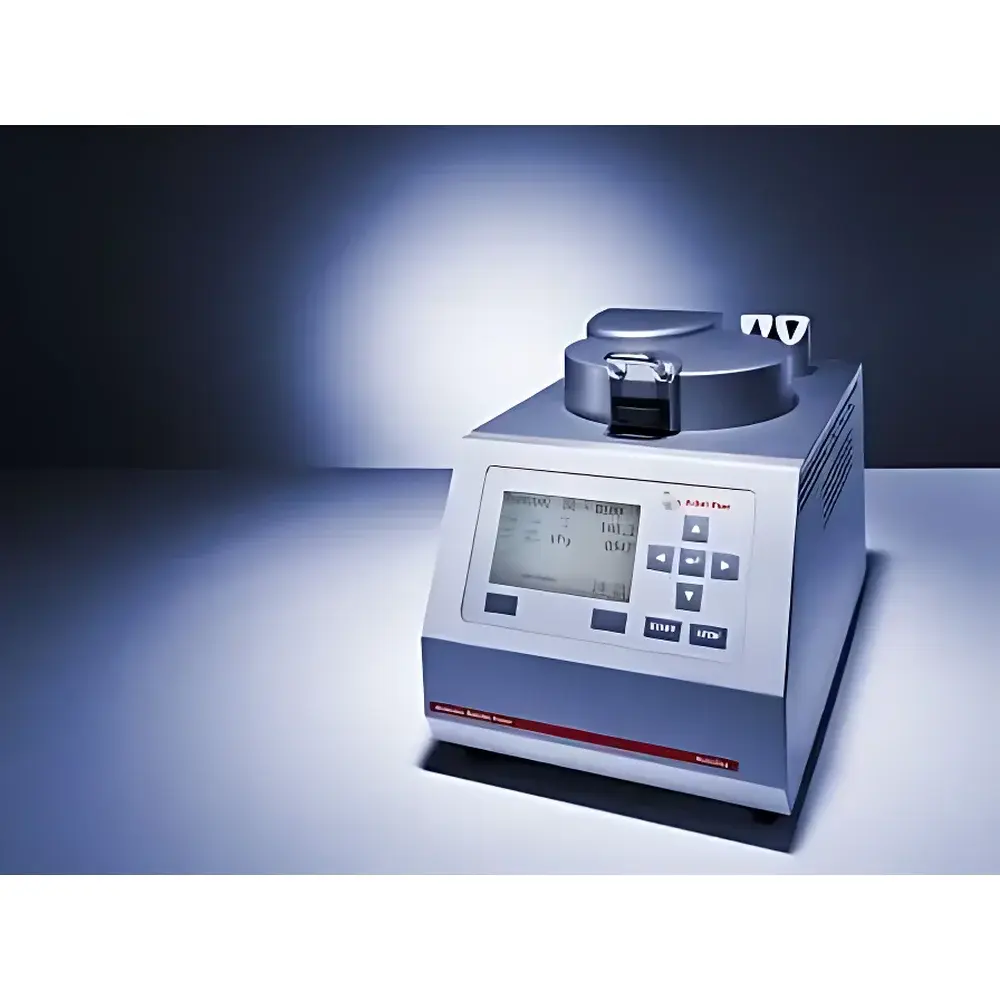
Anton Paar PetroOxy Automated Oxidation Stability Tester
| Brand | Anton Paar |
|---|---|
| Origin | Germany |
| Manufacturer | Anton Paar GmbH (Petrotest Division) |
| Type | Imported Instrument |
| Model | PetroOxy |
| Pricing | Upon Request |
Overview
The Anton Paar PetroOxy Automated Oxidation Stability Tester is a precision-engineered benchtop instrument designed for rapid, reproducible assessment of oxidation stability in petroleum products—primarily gasoline, diesel, biodiesel blends, and related hydrocarbon fuels. It operates on the principle of accelerated oxidative aging under controlled high-pressure oxygen atmosphere and elevated temperature, monitoring real-time pressure decay as an indicator of peroxide formation and subsequent oxidation kinetics. Unlike classical methods such as ASTM D2274 (induction period via Rancimat) or D525 (RBOT), PetroOxy employs a sealed micro-reaction chamber (5 mL sample volume), eliminating solvent use, minimizing operator intervention, and delivering quantitative oxidation onset data within minutes rather than hours. Its thermally stabilized reaction vessel, integrated pressure transducer with ±0.1 kPa resolution, and PID-controlled heating system ensure strict adherence to test thermodynamics required by ASTM D7525 (for gasoline) and ASTM D7545 (for diesel and biodiesel), making it suitable for QC laboratories operating under ISO/IEC 17025, API RP 45, and refinery internal specifications.
Key Features
- Automated, fully self-contained test cycle—from sample loading to final report generation—requiring no manual timing or pressure reading.
- Compact 5 mL sample capacity minimizes reagent consumption and waste generation while maintaining statistical relevance per ASTM protocols.
- Dual-sensor pressure monitoring with automatic baseline correction and drift compensation ensures long-term measurement fidelity across repeated runs.
- Integrated safety architecture includes overpressure relief valves, redundant thermal cutoffs, real-time gas leak detection, and fail-safe chamber interlock mechanisms compliant with EN 61010-1 and ATEX Zone 2 guidelines.
- Pre-programmed method templates for ASTM D7525, D7545, and IP 309 reduce setup errors and support audit-ready operation in regulated environments.
- Modular design enables field-upgradable firmware and seamless integration into LIMS via RS232 or Ethernet (TCP/IP) interfaces.
Sample Compatibility & Compliance
The PetroOxy accepts homogeneous liquid hydrocarbon samples including unleaded gasoline, low-sulfur diesel, FAME-based biodiesel (B5–B100), hydrotreated vegetable oils (HVO), and synthetic paraffinic fuels. It excludes emulsified, highly viscous (>100 cSt at 40 °C), or particulate-laden fuels without prior filtration. All operational parameters—including temperature ramp profiles (typically 95–150 °C), initial O2 pressure (up to 700 kPa absolute), and data sampling frequency—are configurable to meet method-specific requirements. The system conforms to ASTM International, ISO, DIN, IP, and GB/T standards for oxidation stability testing. Its electronic records comply with FDA 21 CFR Part 11 when paired with Anton Paar’s optional Audit Trail-enabled software module, supporting GLP/GMP traceability in fuel certification labs.
Software & Data Management
Control and analysis are executed via Anton Paar’s proprietary PetroOxy Software (v4.x+), running on Windows-based host PCs. The interface provides live graphical display of pressure vs. time curves, automatic induction period calculation using first-derivative inflection point detection, and customizable pass/fail thresholds. Raw data (.csv and .pox binary formats) are timestamped, user-ID tagged, and stored with full metadata (ambient conditions, calibration history, maintenance logs). Export options include PDF reports with embedded chromatogram-style plots, Excel-compatible datasets, and direct LIMS upload via ODBC or HL7 messaging. Audit Trail functionality logs all critical actions—including method edits, result overrides, and user logins—with immutable timestamps and digital signatures.
Applications
- Refinery QC: Rapid screening of antioxidant package efficacy during gasoline blending and diesel hydrotreating.
- Fuel Additive Development: Quantitative evaluation of hindered phenols, amines, and metal deactivators under simulated storage conditions.
- Biodiesel Certification: Compliance testing per EN 14214 Annex C and ASTM D7545 for oxidative shelf-life prediction.
- Regulatory Reporting: Generation of documented evidence for EPA Tier 3, EU Fuel Quality Directive (2009/30/EC), and CARB compliance dossiers.
- Research Laboratories: Kinetic modeling of autoxidation pathways using Arrhenius-derived activation energies from multi-temperature runs.
FAQ
What standards does the PetroOxy explicitly support?
ASTM D7525 (gasoline), ASTM D7545 (diesel/biodiesel), IP 309, ISO 12205, and DIN 51780—fully implemented in firmware with pre-validated method files.
Can PetroOxy be used for aviation turbine fuels (Jet A/A-1)?
No—ASTM D3241 (JFTOT) and D943 (TOST) remain the mandated methods; PetroOxy is not validated for jet fuel’s unique thermal stability requirements.
Is calibration traceable to national metrology institutes?
Yes—pressure transducers are factory-calibrated against PTB (Physikalisch-Technische Bundesanstalt) reference standards; annual recalibration services are available through Anton Paar certified labs.
How is data integrity ensured during power interruption?
Non-volatile memory retains active test data and system state; upon recovery, the instrument resumes logging from the last valid timestamp without data loss.
Does the system require external gas supply or purification?
It requires compressed medical-grade or industrial oxygen (≥99.5% purity); built-in particulate and moisture filters protect internal components—no additional scrubbers needed.






