
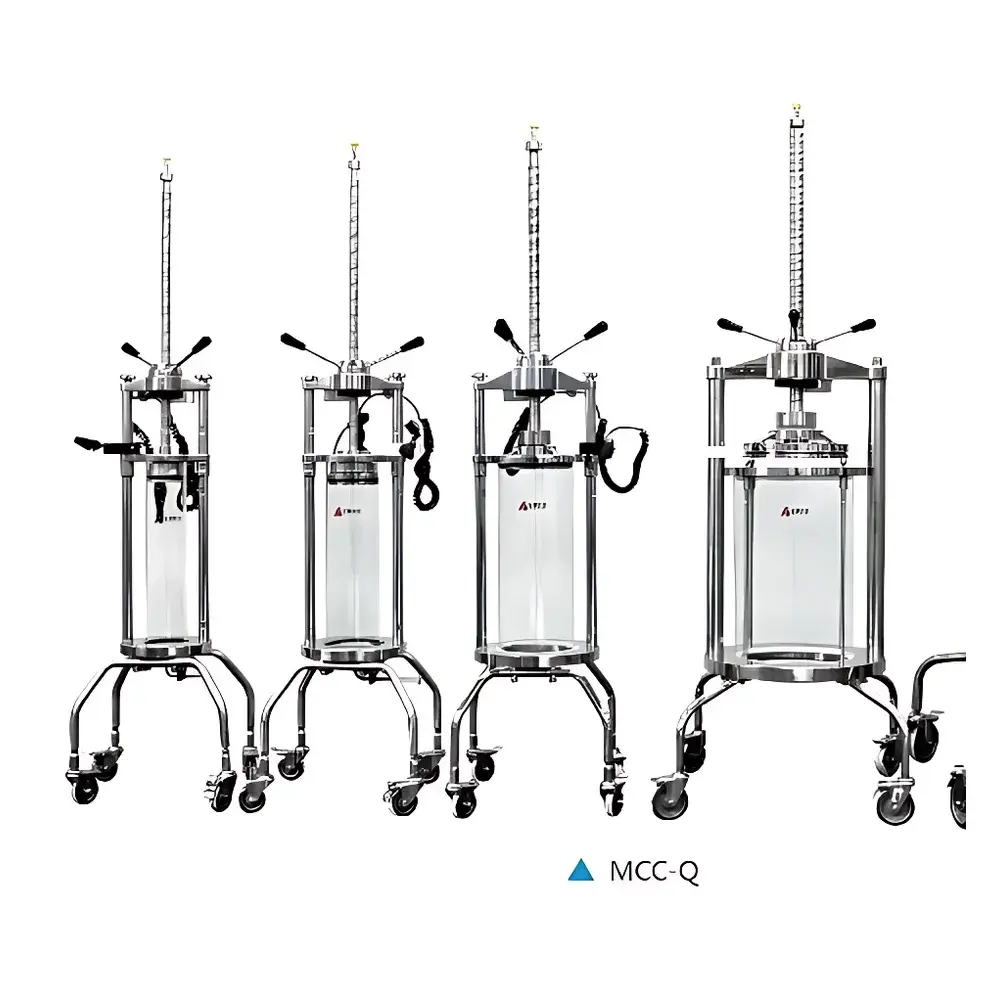

Hanbon MCC-Q100 Manual Chromatography Column
| Brand | Hanbon |
|---|---|
| Origin | Jiangsu, China |
| Manufacturer Type | Manufacturer |
| Product Category | Domestic |
| Model | MCC-Q100 |
| Purification Principle | Gravity- or Pressure-Driven Manual Chromatography |
| Column Tube Material | Schott D263 Borosilicate Glass |
| Sealing Mechanism | Pneumatically Assisted Automatic Sealing (Q-Series) |
| Flow Path Design | Dead-Volume-Free |
| Wetted Materials Compliance | ASME BPE-2023 Compliant |
| Validation Support | Full GMP Documentation Package Available |
| Column Diameter Range | 100 mm (Standard) |
| Max Operating Pressure | ≤ 3 bar (Manual Compression System) |
| Cleaning & Sterilization | CIP/SIP Compatible |
| Column Head Design | Laterally Sliding, Tool-Free Adjustment |
| Bottom Screen Replacement | Hot-Swap Capable Without Column Disassembly |
Overview
The Hanbon MCC-Q100 Manual Chromatography Column is a precision-engineered, mid-scale preparative chromatography system designed for robust, reproducible protein purification under manual operational control. Unlike automated systems reliant on programmable pumps and fraction collectors, the MCC-Q100 implements a manually actuated screw-compression mechanism to achieve uniform, repeatable bed packing of chromatographic media—including agarose-, silica-, and polymer-based resins—across a wide range of particle sizes (typically 15–150 µm). Its core architecture follows classical axial compression principles, where controlled mechanical force applied via calibrated lead screws ensures optimal column homogeneity and minimal void formation. This design supports both gravity-fed and low-pressure (<3 bar) peristaltic or diaphragm pump-driven operation—making it suitable for buffer exchange, desalting, affinity capture, ion exchange, and size exclusion applications in process development labs, QC facilities, and pilot-scale manufacturing suites compliant with ICH Q5, Q7, and FDA Guidance for Industry on Process Validation.
Key Features
- Schott D263 borosilicate glass column tube: Provides optical clarity for bed monitoring, high thermal shock resistance, and chemical inertness toward common purification buffers (pH 2–12, 0.1–1.0 M NaOH, 20% ethanol).
- Laterally sliding column head assembly: Eliminates manual lifting or repositioning during packing or resin transfer; enables rapid, ergonomic adjustment without tools or auxiliary equipment.
- Hot-swap bottom frit system: Allows replacement of stainless steel or polyetheretherketone (PEEK) screen filters without disassembling the column body—reducing downtime and contamination risk during routine maintenance.
- Pneumatically assisted automatic sealing (Q-series): Integrates a dual-stage sealing interface that engages fully upon pressurization and releases cleanly upon depressurization—ensuring consistent seal integrity across repeated cycles and minimizing operator variability.
- Dead-volume-free fluid path: All wetted internal geometries—including inlet distributor, bed support, and outlet manifold—are engineered with zero stagnant zones to meet stringent cleaning validation requirements per EU Annex 15 and ASME BPE-2023 Section SD-3.2.
- ASME BPE-compliant wetted materials: Includes electropolished 316L stainless steel fittings, PTFE-coated O-rings, and USP Class VI-certified elastomers—fully traceable with material test reports (MTRs) and extractables/leachables data packages.
Sample Compatibility & Compliance
The MCC-Q100 accommodates standard chromatographic media used in therapeutic protein purification workflows—including Protein A, ion exchange (SP/DEAE), hydrophobic interaction (Phenyl Sepharose), and gel filtration resins (Sephacryl S-100 HR, Superdex 200). Its 100 mm internal diameter supports loading capacities from 50 to 500 mL of settled resin volume, enabling scalability from benchtop method development to clinical batch production (up to 10–50 L processed volume per cycle). The column meets critical regulatory expectations for equipment qualification: IQ/OQ protocols are provided as part of the GMP documentation package, and all components comply with ISO 9001:2015 manufacturing controls. Traceability includes full serial-numbered component logs, calibration certificates for torque-controlled compression tools, and cleaning verification templates aligned with FDA 21 CFR Part 211 and EMA Guideline on Setting Specifications for Biological Substances.
Software & Data Management
As a manually operated system, the MCC-Q100 does not incorporate embedded electronics or digital controllers. However, it is fully compatible with third-party process data acquisition platforms (e.g., DeltaV, PI System, LabArchives) via analog pressure transducer outputs (4–20 mA) and optional integrated flow meters. All GMP validation documentation—including risk assessments (FMEA), URS, DQ/IQ/OQ/PQ protocols, and change control records—is delivered in editable electronic format (PDF/A-2b and .xlsx) with audit trail metadata compliant with 21 CFR Part 11 requirements. Raw data generated during column packing (e.g., compression force vs. displacement curves) can be logged externally using calibrated torque wrenches and digital calipers—supporting objective assessment of bed stability and reproducibility.
Applications
- Process development of monoclonal antibodies, Fc-fusion proteins, and viral vectors requiring manual method optimization prior to automation transfer.
- GMP-compliant purification of clinical trial materials where regulatory flexibility and operator intervention are mandated by protocol.
- Training platform for chromatography fundamentals in academic and contract development laboratories.
- Buffer exchange and polishing steps in multi-step purification trains where low-pressure operation preserves labile biomolecules.
- Cleaning validation studies supporting regulatory submissions for biologics manufacturing facilities.
FAQ
Does the MCC-Q100 support sterile filtration or SIP (steam-in-place)?
Yes—the column body and head assembly are rated for repeated exposure to saturated steam at 121°C for 30 minutes, and all seals meet USP / biological reactivity standards.
Can it be used with organic solvents such as acetonitrile or isopropanol?
Limited compatibility: Schott D263 glass and PEEK components tolerate ≤20% v/v organic content in aqueous mixtures; prolonged exposure to >30% organics is not recommended.
Is column packing pressure monitored in real time?
No built-in sensor—but external digital pressure gauges (0–5 bar range, ±0.05 bar accuracy) can be installed inline upstream of the column inlet for documented compression profiling.
What validation support is included with purchase?
Full GMP documentation package: URS, DQ, IQ/OQ protocols with blank execution records, calibration certificates, material compliance statements, and cleaning validation templates.
How does the MCC-Q100 differ from the MCC-B variant?
The MCC-B uses purely manual cam-lock sealing; the MCC-Q adds pneumatic actuation for hands-free seal engagement/disengagement—reducing operator fatigue and improving inter-operator consistency during high-cycle operations.




