
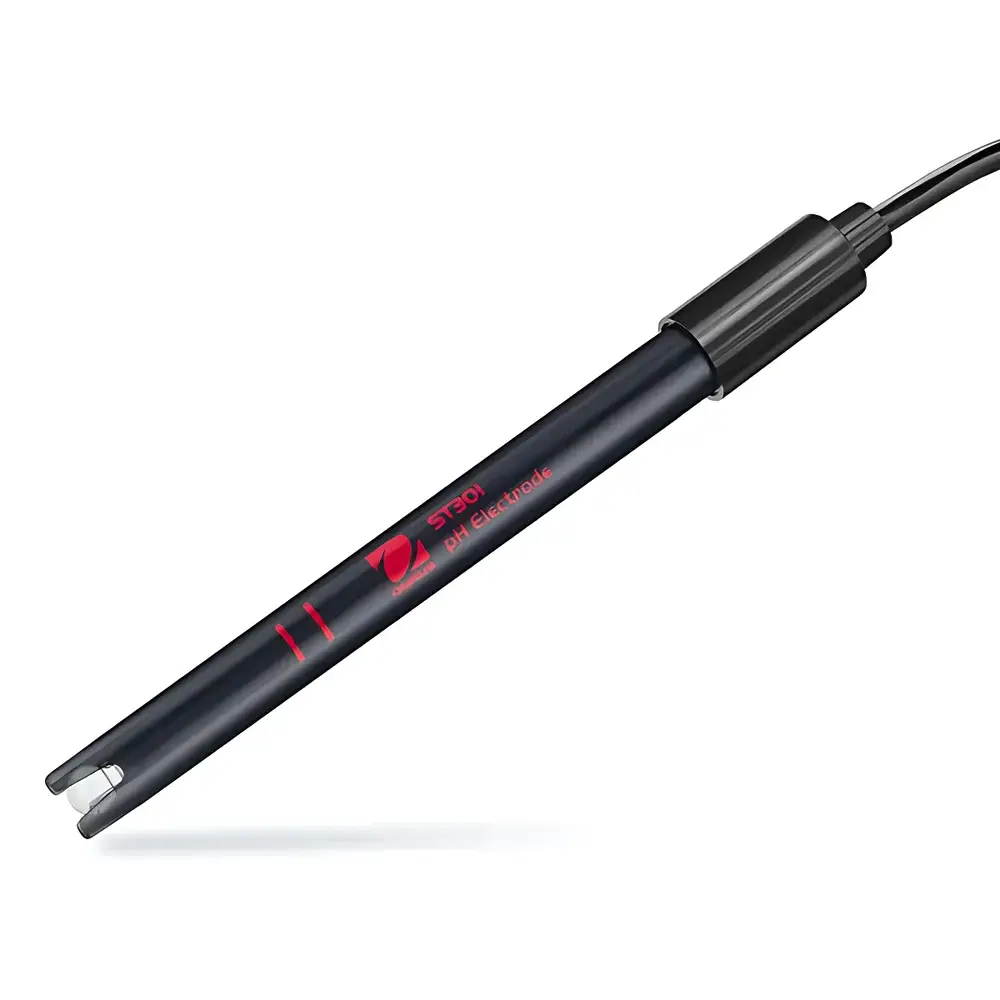
OHAUS ST301 pH Electrode
| Brand | OHAUS |
|---|---|
| Origin | Jiangsu, China |
| Manufacturer Type | Manufacturer |
| Product Origin | Domestic (China) |
| Model | ST301 |
| Price | Upon Request |
| pH Range | 0.00 – 14.00 |
| Cable Length | 1.1 m |
| Electrode Body Material | Plastic |
| Dimensions (L × Ø) | 120 mm × 12 mm |
| Net Weight | 80 g |
| Temperature Range | 0 °C – 80 °C |
| Temperature Sensor Resistance | 30 kΩ |
Overview
The OHAUS ST301 pH electrode is a robust, general-purpose combination pH sensor engineered for reliable and reproducible potentiometric measurements in laboratory, educational, and quality control environments. Designed according to standard glass electrode principles, it employs a pH-sensitive glass membrane paired with an integrated Ag/AgCl reference system and a built-in NTC thermistor (30 kΩ) for automatic temperature compensation (ATC). The electrode operates across the full aqueous pH scale—from strongly acidic (pH 0.00) to highly alkaline (pH 14.00) solutions—and maintains stable output within a temperature range of 0 °C to 80 °C. Its compact cylindrical form factor (120 mm × 12 mm), lightweight construction (80 g), and 1.1-meter shielded cable facilitate ergonomic handling and compatibility with benchtop and portable OHAUS pH meters—including ST-series meters and other standardized BNC-input instruments. As part of the broader ST electrode family, the ST301 is designed for interoperability with complementary sensors (e.g., ORP, conductivity, dissolved oxygen, and temperature probes), enabling modular deployment in multi-parameter analytical workflows.
Key Features
- Full-scale pH measurement capability: 0.00–14.00 with high linearity and low drift under routine calibration conditions
- Integrated 30 kΩ NTC thermistor for real-time temperature sensing and automatic compensation—eliminating manual input errors and improving measurement traceability
- Durable plastic body with chemically resistant epoxy junction and reinforced glass membrane housing—optimized for mechanical stability and longevity in daily use
- BNC connector with molded strain relief and 1.1 m PVC-insulated cable—designed for noise immunity and repeated flex-cycle durability
- Low-impedance reference system with double-junction design (where applicable per configuration) to minimize liquid junction potential drift and contamination from sample matrices
- Compliant with standard electrode geometry and electrical interface specifications (IEC 60746-1, ASTM E70, ISO 3696 Grade 3 water compatibility)
Sample Compatibility & Compliance
The ST301 is validated for use with aqueous buffers, process streams, environmental samples (e.g., wastewater, surface water), food extracts, pharmaceutical formulations, and educational reagent solutions. It is not recommended for non-aqueous solvents, hydrofluoric acid (HF), or highly viscous suspensions without appropriate rinsing protocols. The electrode meets essential requirements for GLP-compliant pH monitoring when used in conjunction with calibrated instrumentation and documented SOPs. While not certified to ISO/IEC 17025 or FDA 21 CFR Part 11 out-of-the-box, its analog BNC output and stable signal characteristics support integration into validated systems where audit trails, electronic signatures, and data integrity controls are implemented at the meter or LIMS level.
Software & Data Management
As a passive analog transducer, the ST301 does not incorporate onboard memory, firmware, or digital communication protocols. It delivers a millivolt-level Nernstian response (−59.16 mV/pH at 25 °C) directly to compatible pH meters equipped with high-input-impedance amplifiers (>10¹² Ω). When paired with OHAUS ST-series meters or third-party analyzers supporting ATC-enabled BNC inputs, users benefit from automated slope/offset calculation, calibration history logging, and timestamped measurement export (via USB, RS-232, or Bluetooth, depending on host instrument capabilities). Data generated using this electrode may be archived in accordance with internal QA/QC documentation practices, including calibration certificate linkage and environmental condition annotation.
Applications
- Routine pH verification in QC laboratories for raw materials, intermediates, and finished products (e.g., APIs, beverages, cosmetics)
- Academic instruction in general chemistry, analytical chemistry, and environmental science curricula
- Field-deployable monitoring of municipal water treatment effluent and influent streams
- In-process control during fermentation, titration, and buffer preparation
- Stability-indicating assays requiring pH tracking over extended time courses (e.g., accelerated degradation studies)
- Multi-sensor arrays where ST301 serves as the pH node alongside ST-series conductivity or DO electrodes
FAQ
Is the ST301 compatible with non-OHAUS pH meters?
Yes—any meter with a standard BNC input, ≥10¹² Ω input impedance, and support for external ATC via 30 kΩ NTC is functionally compatible.
What is the recommended storage solution for long-term electrode preservation?
Store immersed in 3 M KCl or dedicated electrode storage solution; never in deionized water or dry conditions.
Can the ST301 be used for high-temperature sterilization or autoclaving?
No—maximum continuous operating temperature is 80 °C; autoclaving (≥121 °C) will irreversibly damage the glass membrane and internal components.
Does the electrode require periodic refilling or electrolyte replacement?
No—the ST301 is a sealed, maintenance-free gel-filled combination electrode; no user-serviceable electrolyte reservoir is present.
How often should calibration be performed?
Calibrate before each use session or at minimum every 2 hours during continuous operation; verify with at least two NIST-traceable buffer standards (e.g., pH 4.01 and 7.00).





