
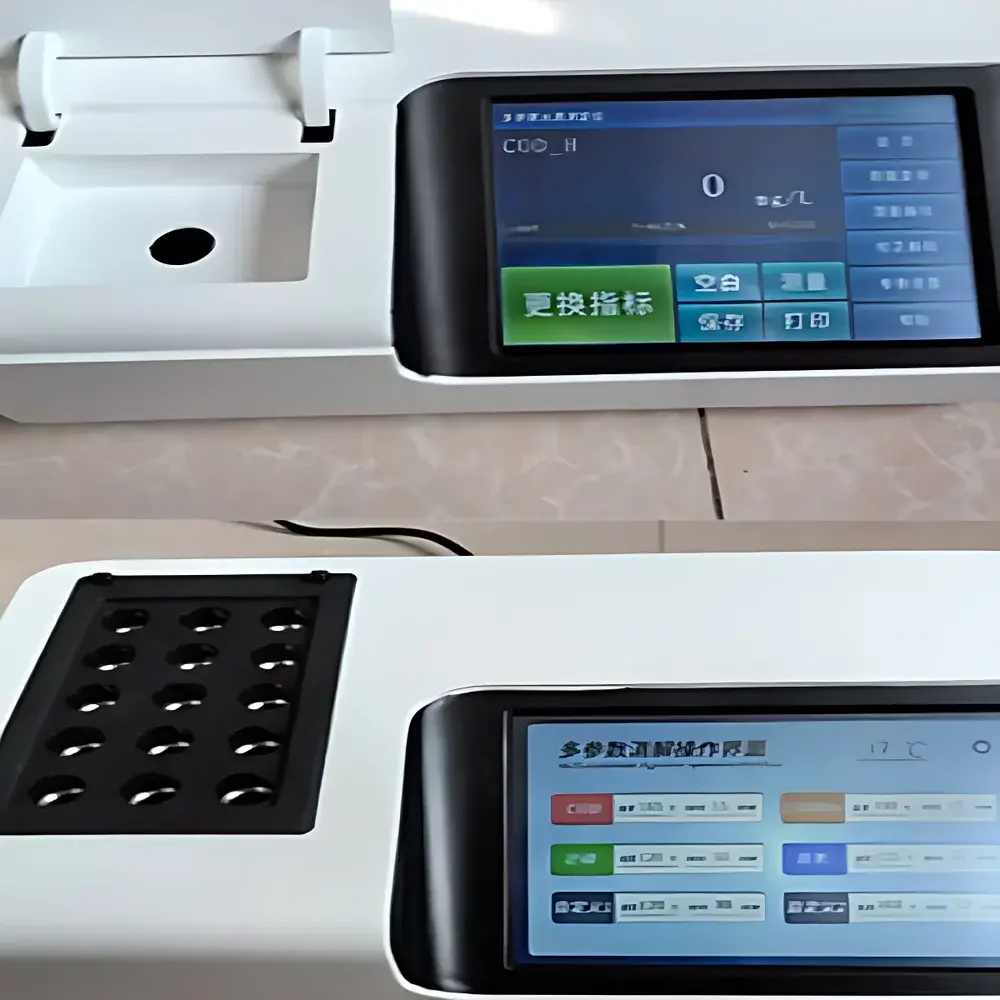
InLab-2022 Multi-Parameter Water Quality Analyzer with COD Measurement (Rapid Digestion Method)
| Brand | ZYKX |
|---|---|
| Origin | Beijing, China |
| Model | InLab-2022 |
| Instrument Type | Laboratory Benchtop Analyzer |
| Measurement Principle | Rapid Digestion Spectrophotometry |
| Wavelength Range | 590–610 nm |
| COD Range | 5–15,000 mg/L (high-range), 5–150 mg/L (low-range), 0–50 mg/L (permanganate method) |
| Repeatability | ≤ ±5% |
| Measurement Time | 20 min (typical COD cycle) |
| Batch Capacity | 15 samples |
| Temperature Control Range | 45–200 °C |
| Temperature Uniformity | ≤ 1 °C |
| Power Supply | AC 220 V ±10%, 50 Hz |
| Dimensions | 370 × 250 × 140 mm |
| Weight | Approx. 4.2 kg |
Overview
The InLab-2022 Multi-Parameter Water Quality Analyzer is a laboratory-grade benchtop spectrophotometric system engineered for rapid, accurate quantification of chemical oxygen demand (COD) and over 45 additional water quality parameters—including ammonia nitrogen, total phosphorus, total nitrogen, heavy metals (e.g., Cr(VI), Cu, Ni, Cd, Hg), physicochemical indicators (pH, conductivity, DO, ORP, turbidity, TDS), and organic contaminants (phenol, formaldehyde, aniline). It employs standardized rapid digestion spectrophotometry in accordance with ISO 15705:2002 and EPA Method 410.4, utilizing controlled thermal digestion followed by absorbance measurement at optimized wavelengths (590–610 nm for COD). The instrument integrates digestion and colorimetric analysis into a single platform, eliminating inter-instrument transfer errors and reducing operator variability. Its modular architecture supports configurable parameter expansion—users may deploy pre-validated calibration curves for up to 100 analytes and add new test modules without hardware replacement.
Key Features
- 8-inch high-resolution capacitive touchscreen with intuitive Chinese GUI—designed for rapid operator training and minimal learning curve in routine lab environments.
- Dual-function digestion-colorimetry tubes reduce reagent consumption by ≥30% versus conventional separate-vessel protocols and minimize cross-contamination risk.
- Programmable digestion module: temperature range 45–200 °C (±2 °C accuracy), time range 0–999 min, with real-time temperature profiling and auto-shutdown at preset limits.
- Integrated semiconductor cold light source with >50,000-hour service life ensures stable photometric output and eliminates warm-up drift.
- Multi-point calibration support (1–7 points) with automatic slope, intercept, and correlation coefficient calculation per curve; user-defined curve generation enabled via onboard editor.
- Onboard thermal printer and dual data export: USB mass storage + Bluetooth (optional); compatible with Windows-based data acquisition software and mobile reporting apps.
- Robust industrial-grade housing: corrosion-resistant ABS/PC composite casing rated for continuous operation in humid, acidic, or alkaline lab environments (IP20, operating humidity <85% RH, non-condensing).
- Comprehensive safety design: transparent heat-resistant splash guard, individual well numbering (15 positions), over-temperature cutoff, and power-fail data retention (30,000+ measurements preserved indefinitely).
Sample Compatibility & Compliance
The InLab-2022 accepts standard 16 mm diameter digestion/colorimetric tubes (10–15 mL volume) and accommodates raw, filtered, or pretreated aqueous samples from municipal wastewater, surface water, industrial effluents, and groundwater. It complies with core regulatory frameworks governing environmental testing: ISO 6060 (COD), ISO 7150-1 (ammonia), ISO 6878 (total phosphorus), ISO 11905-1 (total nitrogen), and ASTM D1253 (residual chlorine). While not FDA 21 CFR Part 11–certified out-of-the-box, its audit-trail-capable software (v3.2+) supports GLP/GMP-aligned workflows when deployed with timestamped user logins, electronic signature prompts, and immutable raw-data archiving—enabling traceability required for third-party accreditation (e.g., CNAS, ILAC-MRA).
Software & Data Management
Firmware v3.2 includes embedded database management supporting 30,000+ result records with sample ID, date/time stamp, operator ID, digestion protocol ID, and raw absorbance values. Data fields are exportable as CSV or Excel-compatible .xlsx files. The optional PC software provides statistical tools (mean, SD, CV%, linear regression diagnostics), QC charting (Levey-Jennings), and automated report generation per ISO/IEC 17025 clause 7.8. All calibration curves are digitally signed and version-controlled; firmware updates preserve historical curve integrity. Bluetooth connectivity enables remote monitoring via Android/iOS companion app—ideal for multi-instrument labs coordinating batch analyses across shifts.
Applications
This analyzer serves environmental monitoring laboratories conducting routine compliance testing under national discharge standards (e.g., China’s GB 8978-1996, EU Urban Wastewater Treatment Directive 91/271/EEC). It supports process control in municipal WWTPs (influent/effluent COD tracking), industrial pretreatment verification (electroplating, textile, pharmaceutical sectors), academic research on nutrient cycling and contaminant fate, and field-deployable lab validation where portability is secondary to precision. Its broad parameter coverage reduces need for multiple dedicated instruments—particularly valuable for labs with constrained space or budget but diverse analytical requirements.
FAQ
Does the InLab-2022 meet international COD measurement standards?
Yes—it implements rapid digestion spectrophotometry aligned with ISO 15705:2002 and EPA Method 410.4, with method-specific validation data available upon request.
Can I import custom calibration curves from external labs?
Yes—the instrument accepts user-uploaded CSV-formatted curves with wavelength, concentration, and absorbance columns; all imported curves undergo checksum verification.
Is the digestion block temperature uniform across all 15 wells?
Yes—temperature uniformity is ≤1 °C across the full block at setpoints between 100–160 °C, verified per ASTM E220.
What is the minimum detectable COD concentration using the low-range method?
The low-range COD method achieves a practical detection limit of 3 mg/L (signal-to-noise ratio ≥3) with 10-mm pathlength and 30-second integration time.
How often does the light source require recalibration?
The semiconductor light source requires no periodic photometric recalibration; factory calibration remains valid for ≥5 years under normal use, per manufacturer’s metrology certificate.
Related Products







