
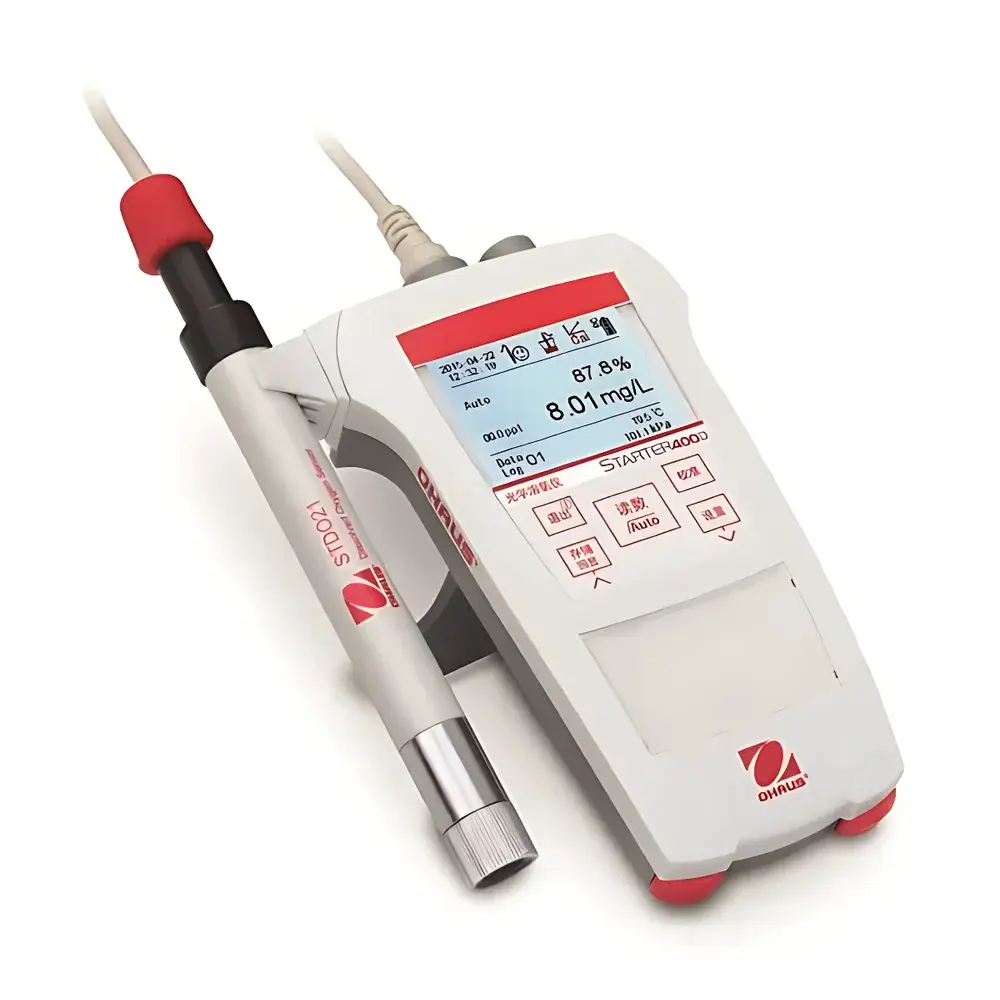
OHAUS ST400D Portable Dissolved Oxygen Meter
| Brand | OHAUS |
|---|---|
| Origin | Jiangsu, China |
| Manufacturer Type | Original Equipment Manufacturer (OEM) |
| Regional Classification | Domestic (China) |
| Model | ST400D |
| Instrument Type | Portable |
| Measurement Principle | Fluorescence Quenching |
| Range | 0.0–200.0 % saturation |
| Temperature Range | 0–50 °C |
| Accuracy | ±0.2 mg/L |
| Detection Limit | 0.00–20.0 mg/L (ppm) |
Overview
The OHAUS ST400D Portable Dissolved Oxygen Meter is an optical, maintenance-free field instrument engineered for precise and reliable measurement of dissolved oxygen (DO) in aqueous environments. Utilizing fluorescence quenching technology—where molecular oxygen modulates the lifetime and intensity of a luminescent sensor coating—the ST400D eliminates electrochemical drift, membrane fouling, and electrolyte depletion common in traditional Clark-type sensors. This solid-state optical design ensures stable calibration over extended periods, minimal warm-up time (<30 seconds), and consistent performance across variable salinity, pressure, and organic load conditions. Designed for environmental scientists, wastewater operators, aquaculture technicians, and field-based water quality professionals, the ST400D delivers laboratory-grade accuracy in a rugged, handheld form factor compliant with ASTM D888-22 (Standard Test Methods for Dissolved Oxygen in Water) and ISO 5814:2012 (Water Quality — Determination of Dissolved Oxygen — Electrochemical Probe Method, with optical probe adaptation referenced in Annex B).
Key Features
- Fluorescence-based sensing with integrated temperature compensation (0–50 °C), eliminating manual correction or lookup tables
- Auto-ranging dual display: simultaneous readout in % saturation and mg/L (ppm), configurable via intuitive button interface
- IP67-rated housing with rubberized grip and drop-tested construction (1.5 m onto concrete), suitable for outdoor, boat-based, and wastewater plant use
- Rechargeable lithium-ion battery providing >100 hours of continuous operation; USB-C charging and data export capability
- No membrane replacement, no electrolyte refills, no polarization time—zero consumables required for routine operation
- Factory-calibrated sensor with NIST-traceable certificate; optional user calibration using air-saturated water or zero-oxygen solution (sodium sulfite)
Sample Compatibility & Compliance
The ST400D is validated for use in freshwater, seawater, wastewater effluent, aquaculture ponds, and surface runoff samples. Its optical probe is chemically inert to hydrogen sulfide, chlorine residuals, and heavy metals—common interferents in municipal and industrial sampling. The instrument meets functional requirements outlined in EPA Method 360.1 (for DO determination in ambient water) and supports GLP-compliant data integrity through timestamped, non-erasable measurement logs. While not certified for FDA 21 CFR Part 11 compliance out-of-the-box, audit-ready data export (CSV format) enables integration into validated LIMS workflows where electronic records are governed by ALCOA+ principles.
Software & Data Management
Measurements are stored internally (up to 500 records) with automatic date/time stamping, probe ID, temperature, and user-defined sample ID. Via USB-C connection, users can export datasets to OHAUS DataBridge™ Desktop Utility (Windows/macOS), which supports batch export, statistical summary (mean, SD, min/max), and customizable report generation. Raw files include metadata headers compatible with third-party platforms including LabArchives, ChemStation, and LimnoTech’s WQX schema. Firmware updates are delivered via signed binary packages to ensure device integrity and traceability.
Applications
- Regulatory monitoring of receiving waters under NPDES permit requirements
- Process control in activated sludge basins and oxidation ditches
- Ecological assessment of hypolimnetic oxygen depletion in stratified lakes
- Quality assurance during fish transport and hatchery operations
- Educational field labs requiring robust, student-safe instrumentation without hazardous reagents
- Emergency response screening following chemical spills or algal bloom events
FAQ
Does the ST400D require periodic recalibration?
Calibration is recommended before each field deployment or after exposure to extreme temperatures (>45 °C) or abrasive particulates; however, due to optical stability, recalibration intervals typically exceed 30 days under normal use.
Can the probe be immersed in sediment-laden or high-turbidity water?
Yes—the optical sensor window is sapphire-coated and resistant to abrasion; routine cleaning with soft lint-free cloth and deionized water is sufficient between samples.
Is salinity compensation automatic?
Yes; the built-in conductivity sensor (optional add-on module) enables real-time salinity input for accurate % saturation conversion—otherwise, user-entered salinity value (0–45 ppt) is applied algorithmically.
What is the warranty coverage?
OHAUS provides a 2-year limited warranty covering parts and labor for defects in materials and workmanship under normal use conditions.
Are calibration standards included with the instrument?
A sealed air-saturation vial and zero-oxygen reagent kit (sodium sulfite) are available as optional accessories; factory calibration documentation is supplied standard with each unit.
Related Products







