
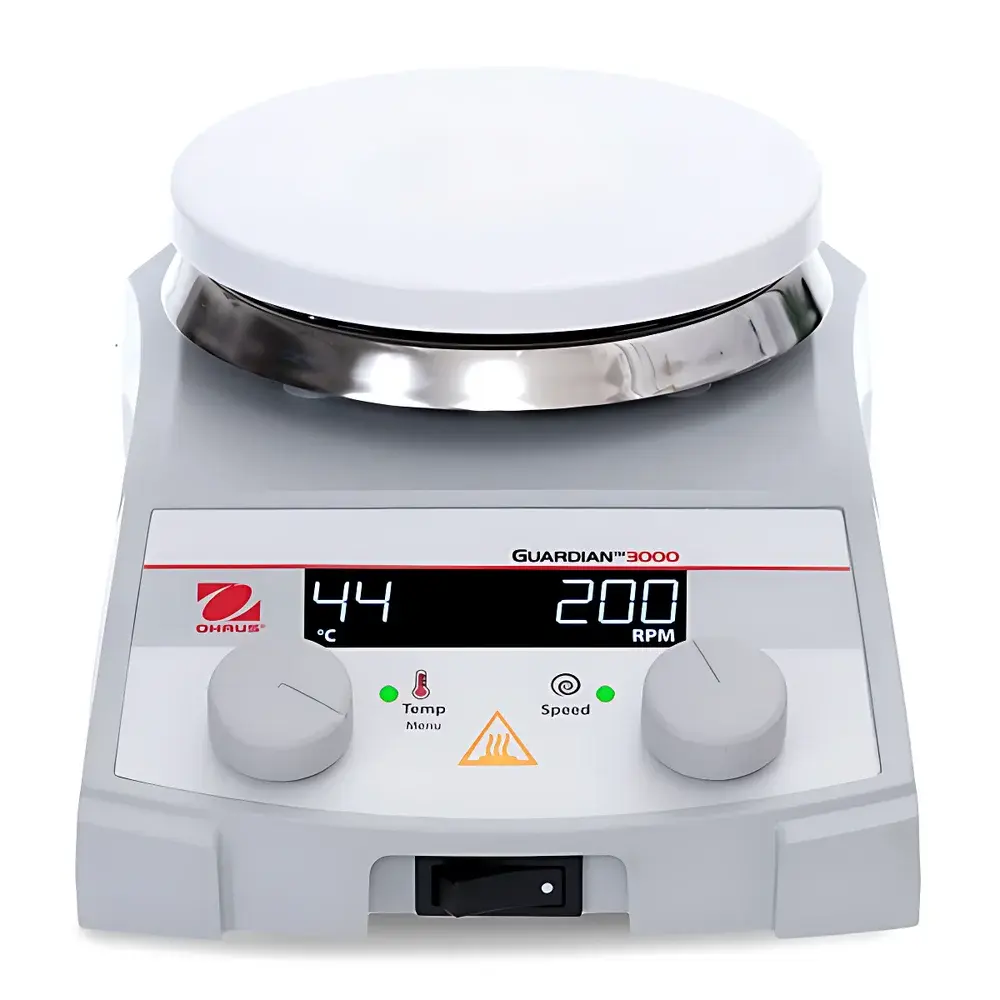
OHAUS GUARDIAN™ 3000 Heated Magnetic Stirrer
| Brand | OHAUS |
|---|---|
| Origin | Jiangsu, China |
| Manufacturer Type | Original Equipment Manufacturer (OEM) |
| Product Category | Domestic |
| Model | e-G31HSRDS |
| Instrument Type | Heated Magnetic Stirrer |
| Maximum Stirring Volume | 15 L |
| Speed Range | 80–1600 rpm |
| Temperature Control Range | Ambient +5°C to 500°C |
Overview
The OHAUS GUARDIAN™ 3000 Heated Magnetic Stirrer is an engineered solution for laboratories requiring simultaneous precise thermal regulation and robust mechanical agitation. Based on the principle of magnetic coupling—where a rotating permanent magnet beneath the heating plate induces rotational motion in a PTFE- or glass-coated stir bar immersed in the sample—the instrument delivers consistent torque transfer without mechanical shaft penetration. Its integrated resistive heating element enables rapid thermal ramping and stable setpoint maintenance across a wide operational range (ambient +5°C to 500°C), making it suitable for applications involving high-boiling-point solvents (e.g., silicone oil, ethylene glycol) and temperature-sensitive reactions requiring tight thermal margins. Designed for continuous-duty operation, the system supports uninterrupted stirring for up to 720 hours under nominal load conditions—validated using aqueous and silicone oil media—ensuring reliability in extended synthesis, dissolution testing, and material aging protocols.
Key Features
- Continuous-duty motor architecture with reinforced bearing assembly and thermally optimized stator windings, enabling sustained operation at 1600 rpm without thermal derating.
- Advanced anti-temperature overshoot algorithm that dynamically adjusts power delivery based on real-time thermal inertia estimation, minimizing deviation from setpoint—particularly critical when heating high-heat-capacity fluids.
- Dual-redundant SafetyHeat™ thermal protection system: independent bimetallic cut-off switch and digital PID-based overtemperature monitor, both triggering automatic heater shutdown if surface temperature exceeds user-defined safety threshold.
- High-visibility status indication: amber LED remains illuminated for ≥30 minutes after power-off when plate surface temperature exceeds 40°C, providing unambiguous thermal hazard awareness.
- Corrosion-resistant stainless steel housing with optimized fin geometry for passive convective cooling; ceramic or ceramic-coated aluminum top plate offering chemical resistance to acids, bases, and organic solvents while maintaining low thermal mass for responsive control.
- Intuitive rotary encoder interface with tactile feedback, supporting parameter navigation, speed/temperature setpoint adjustment, and timer activation without menu nesting.
Sample Compatibility & Compliance
The GUARDIAN™ 3000 accommodates standard laboratory vessels—including borosilicate glass beakers (50 mL–5 L), stainless steel reaction flasks, and polypropylene containers—within its three available plate sizes (130 mm, 160 mm, and 190 mm diameter). Optional external PT100 temperature probe integration enables closed-loop sample-core temperature control, meeting requirements for ASTM E2910 (Standard Practice for Validation of Thermal Processing Equipment) and supporting GLP-compliant documentation workflows. The device conforms to IEC 61010-1:2010 for electrical safety in laboratory equipment and includes CE marking per EU Directive 2014/30/EU (EMC) and 2014/35/EU (LVD). Its firmware architecture supports audit-trail-ready operation when paired with OHAUS LogTec™ software, aligning with FDA 21 CFR Part 11 data integrity expectations for regulated environments.
Software & Data Management
While the GUARDIAN™ 3000 operates as a standalone instrument, it is fully compatible with OHAUS LogTec™ PC software via RS-232 or USB-to-serial interface. LogTec™ provides time-stamped logging of speed, temperature, runtime, and alarm events—including overtemperature triggers and motor stall detection—with CSV export capability for traceability and statistical process analysis. All logged parameters are timestamped with millisecond resolution and include operator ID fields (when configured with network authentication), fulfilling ALCOA+ (Attributable, Legible, Contemporaneous, Original, Accurate, Complete, Consistent, Enduring, Available) data governance criteria. Firmware updates are delivered through digitally signed packages verified at boot, ensuring integrity during field maintenance.
Applications
- Chemical synthesis requiring controlled exothermic reaction management (e.g., Grignard formation, polymerization initiation).
- Pharmaceutical dissolution testing per USP , where precise bath temperature stability (±0.2°C) and uniform agitation are mandated.
- Materials science protocols including nanoparticle dispersion in high-viscosity matrices and thermal aging of polymer composites.
- Environmental testing labs performing BOD incubation or heavy metal leaching studies under elevated temperature conditions.
- Quality control workflows in food and beverage production, such as viscosity stabilization trials and emulsion homogenization validation.
FAQ
Does the GUARDIAN™ 3000 support external temperature probe feedback control?
Yes—when equipped with the optional PT100 probe and enabled via front-panel configuration, the unit switches from surface-sensing to sample-core temperature regulation mode.
Is the ceramic plate resistant to hydrofluoric acid?
No—standard ceramic or ceramic-coated plates are not HF-resistant; users handling HF must employ secondary containment and verify compatibility with OHAUS technical support prior to use.
Can the device be integrated into a LabVantage or Thermo Fisher SampleManager LIMS environment?
Direct native integration is not supported; however, LogTec™-generated CSV logs can be ingested via standard LIMS import modules or middleware APIs.
What is the maximum allowable ambient operating temperature?
The unit is rated for continuous operation in environments up to 40°C ambient, with relative humidity ≤80% non-condensing.
Does the motor maintain rated torque at 1600 rpm when heating at 500°C?
Yes—thermal management of the motor housing ensures no torque reduction within the full combined speed/temperature envelope, as verified per OHAUS Engineering Test Report ET-G31HSRDS-2023-089.



