
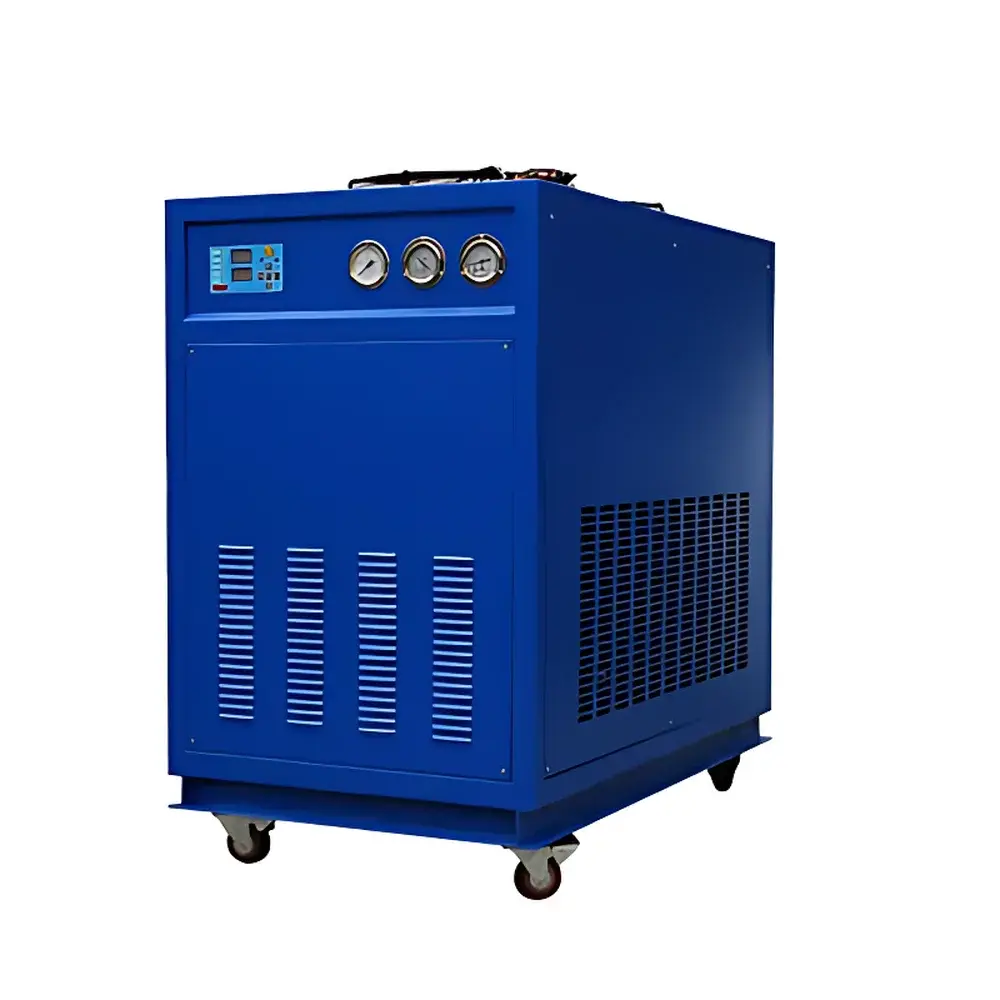
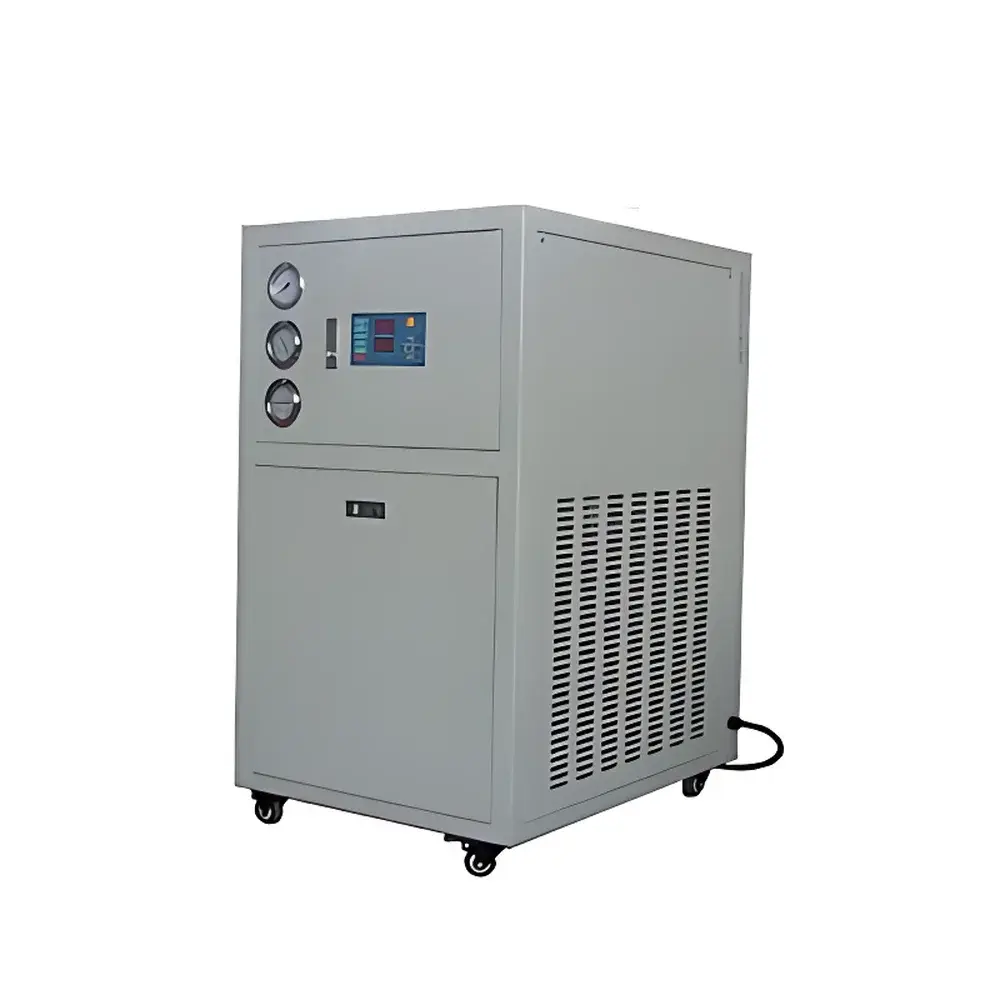
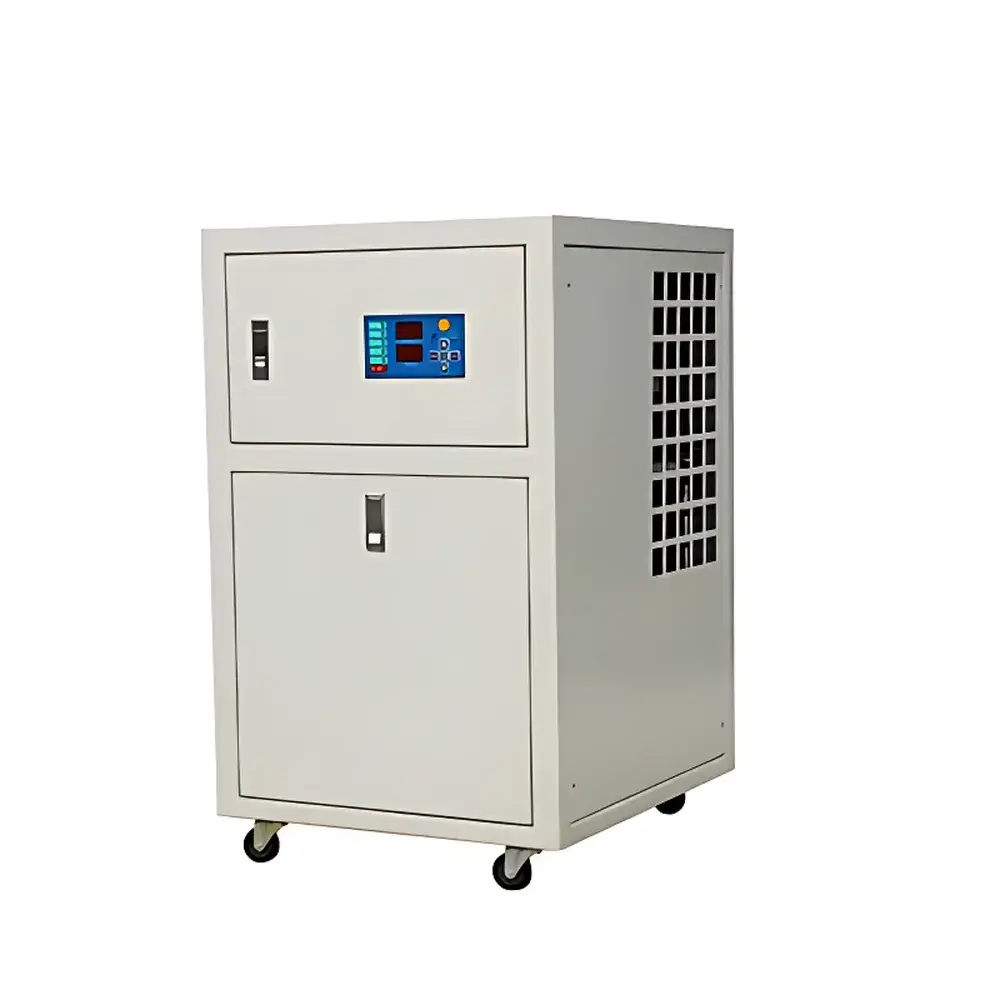
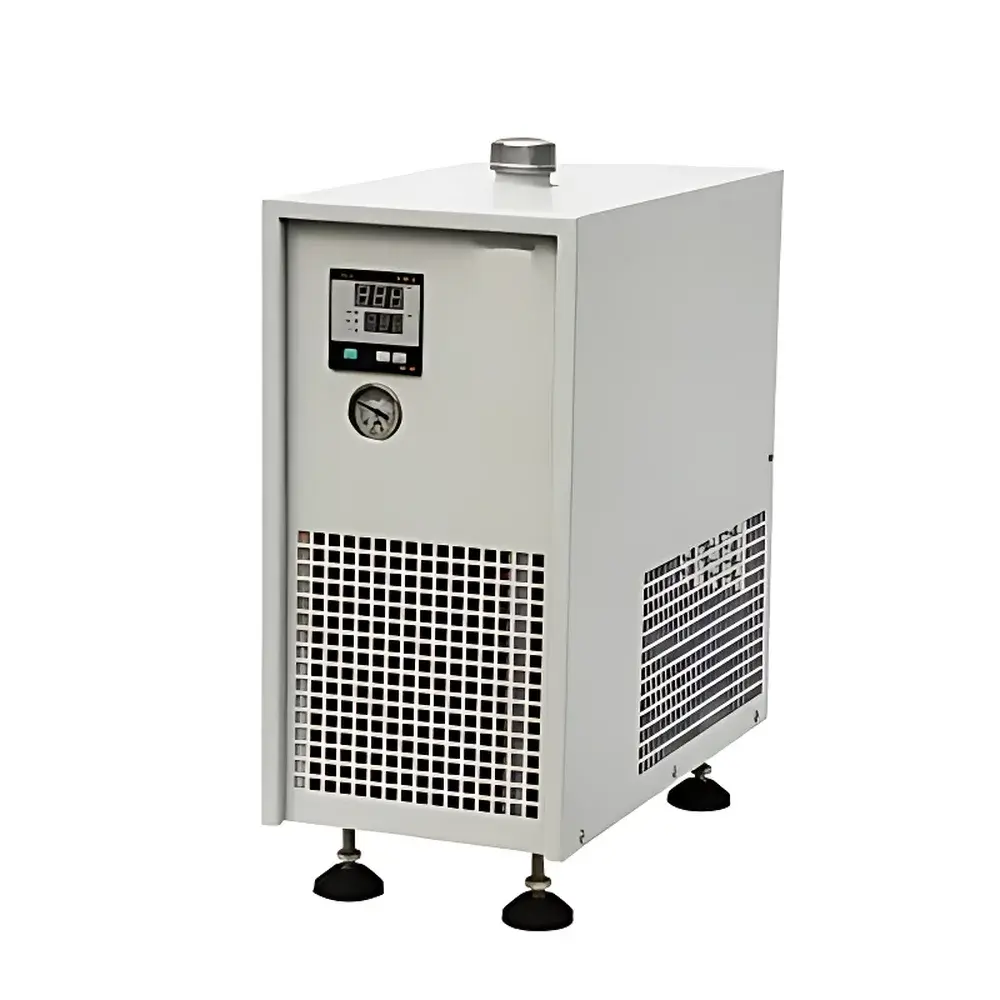
Tianfeng LS-10KW Integrated Circulating Chiller
| Brand | Tianfeng |
|---|---|
| Origin | Shanghai, China |
| Manufacturer Type | OEM Manufacturer |
| Equipment Type | Integrated Circulating Chiller |
| Cooling Method | Water-Cooled |
| Temperature Control Range | 0–40 °C |
| Refrigeration Capacity | 3–9 kW (300–9000 W) |
| Temperature Stability | ±0.1 °C |
| Circulating Pump Pressure | 2.0 bar |
| Circulating Flow Rate | 38 L/min |
| Reservoir Volume | 5–550 L |
| Operating Mode | Continuous Duty |
| Compressor Type | Scroll Compressor |
| Power Supply | 220 V, 50 Hz |
| Dimensions (L×W×H) | 1350 × 800 × 1500 mm |
| Weight | Not specified |
| Safety Protections | Compressor overheat protection, high/low pressure cut-off, overcurrent protection, overtemperature alarm |
| Construction | Stainless steel reservoir and pump |
| Controller | Domestic PID temperature controller (optional RKC Japan unit) |
| Electrical Components | Siemens / Schneider / Omron |
| Refrigeration Components | Imported expansion valve & solenoid valve (Italy/Germany) |
| Noise Level | Low-noise operation |
| Compliance | ISO 9001:2000 certified design and manufacturing |
Overview
The Tianfeng LS-10KW Integrated Circulating Chiller is an engineered thermal management solution designed for precision temperature stabilization of laboratory and industrial equipment requiring consistent coolant delivery under continuous-duty conditions. It operates on a vapor-compression refrigeration cycle, utilizing a high-efficiency scroll compressor and optimized refrigerant circuitry (R22 or R407C, per model configuration) to maintain tight thermal control across a wide operational range. Unlike ambient-air-cooled units, this water-cooled chiller transfers heat via a secondary cooling loop—making it especially suitable for installation in temperature-sensitive or space-constrained laboratory environments where ambient heat rejection must be isolated. Its core function is to absorb thermal load from heat-generating components—including optical benches, plasma sources, X-ray generators, electron beam columns, and laser diode arrays—and reject it through an external cooling tower or facility water system. The chiller delivers chilled water at precisely regulated temperatures between 0 °C and 40 °C, with stability maintained within ±0.1 °C under steady-state conditions—a critical specification for applications demanding reproducible thermal boundary conditions.
Key Features
- Integrated architecture with compact footprint (1350 × 800 × 1500 mm), enabling flexible placement in laboratories and equipment rooms.
- Stainless steel reservoir and circulation pump—resistant to corrosion and compatible with deionized water, glycol-water mixtures, and other non-aggressive coolants.
- Dual-mode operation: fixed-setpoint constant-temperature mode and intelligent adaptive control mode, where output adjusts dynamically in response to real-time thermal load fluctuations.
- Digital PID temperature controller with LED display; optional upgrade to RKC (Japan) controller for enhanced resolution and programmable ramp-soak profiles.
- Multi-layer safety architecture: compressor overheat detection, high/low refrigerant pressure monitoring, motor overcurrent cutoff, and reservoir overtemperature alarm—all with relay-based fault signal output for integration into facility SCADA or equipment interlock systems.
- Low-noise scroll compressor and vibration-damped mounting ensure acoustic compatibility with quiet-zone labs and microscopy suites.
- Full compliance with ISO 9001:2000 quality management standards throughout design, component sourcing, assembly, and factory testing.
Sample Compatibility & Compliance
The LS-10KW chiller supports continuous circulation of aqueous and low-viscosity coolant media across a broad flow range (0–38 L/min) and pressure head (up to 2.0 bar), making it compatible with analytical instruments requiring stable thermal interface conditions—including graphite furnace atomic absorption spectrometers (GFAAS), inductively coupled plasma optical emission spectrometers (ICP-OES), ICP-mass spectrometers (ICP-MS), X-ray fluorescence (XRF) spectrometers, X-ray diffractometers (XRD), scanning electron microscopes (SEM), and transmission electron microscopes (TEM). Its temperature stability (±0.1 °C) meets the thermal repeatability requirements of ASTM E1509 (for GFAAS), ISO 17025 clause 5.4.3 (equipment calibration traceability), and USP guidelines for analytical instrument qualification. All electrical components conform to IEC 61000-6-3 (EMC emissions) and IEC 61000-6-2 (immunity) standards. No refrigerant-related CE marking is applicable due to its classification as a Class II refrigeration device under EU F-Gas Regulation (EU) No 517/2014—however, documentation confirms use of low-GWP alternatives where configured.
Software & Data Management
While the base LS-10KW model features hardware-based PID control without embedded software, optional configurations support analog (0–10 V / 4–20 mA) and digital (RS485 Modbus RTU) interfaces for integration into centralized lab infrastructure. These enable remote setpoint adjustment, real-time temperature/flow monitoring, and alarm status reporting via LIMS or building management systems (BMS). All firmware and controller logic are validated for GLP-compliant audit trails when paired with third-party data loggers meeting FDA 21 CFR Part 11 requirements (electronic signatures, event logging, user access controls). Factory calibration certificates include NIST-traceable temperature sensor verification at three points (10 °C, 25 °C, and 35 °C) with uncertainty ≤ ±0.05 °C (k=2).
Applications
This chiller serves as a primary thermal regulation platform across multiple domains: In analytical laboratories, it stabilizes plasma torches in ICP systems, cools X-ray tube anodes in XRF/XRD, and manages detector housing temperatures in SEM/TEM to minimize thermal drift during long-duration imaging or elemental mapping. In materials science, it maintains mold temperature during polymer characterization experiments and regulates cooling rates in differential scanning calorimetry (DSC) auxiliary systems. In life sciences, it supports cryo-EM sample preparation workflows by cooling stage chillers and vacuum pump condensers. Industrial applications include thermal management of CNC spindle motors, laser cutting heads, and semiconductor wafer inspection tools—where sub-degree temperature control directly impacts dimensional accuracy and process yield.
FAQ
What is the maximum allowable return water temperature for safe operation?
The chiller is rated for inlet water temperatures up to 40 °C. Exceeding this threshold may trigger high-pressure cut-off or reduce compressor service life; facility cooling water should be maintained ≤35 °C at the chiller’s condenser inlet.
Can the unit operate with 30% ethylene glycol solution?
Yes—the stainless steel wetted parts and pump seals are compatible with glycol concentrations ≤35%. Flow rate and pressure drop must be recalculated per ASHRAE Handbook Fundamentals Chapter 21.
Is the chiller compliant with GLP or GMP environmental monitoring requirements?
While the chiller itself is not a measurement device, its documented temperature stability, calibration traceability, and alarm logging capability support qualification under Annex 15 (IQ/OQ/PQ) and FDA guidance for ancillary equipment used in regulated environments.
Does the unit include a built-in water level sensor and low-flow protection?
Yes—integrated float switch and flow meter provide automatic shutdown if reservoir level falls below operational minimum or if flow drops below 15 L/min for >30 seconds.
What maintenance intervals are recommended for long-term reliability?
Compressor oil and refrigerant filter driers should be replaced every 24 months under continuous operation; condenser coil cleaning is advised quarterly in dusty environments; annual verification of pressure switches and thermostat calibration is recommended.



