
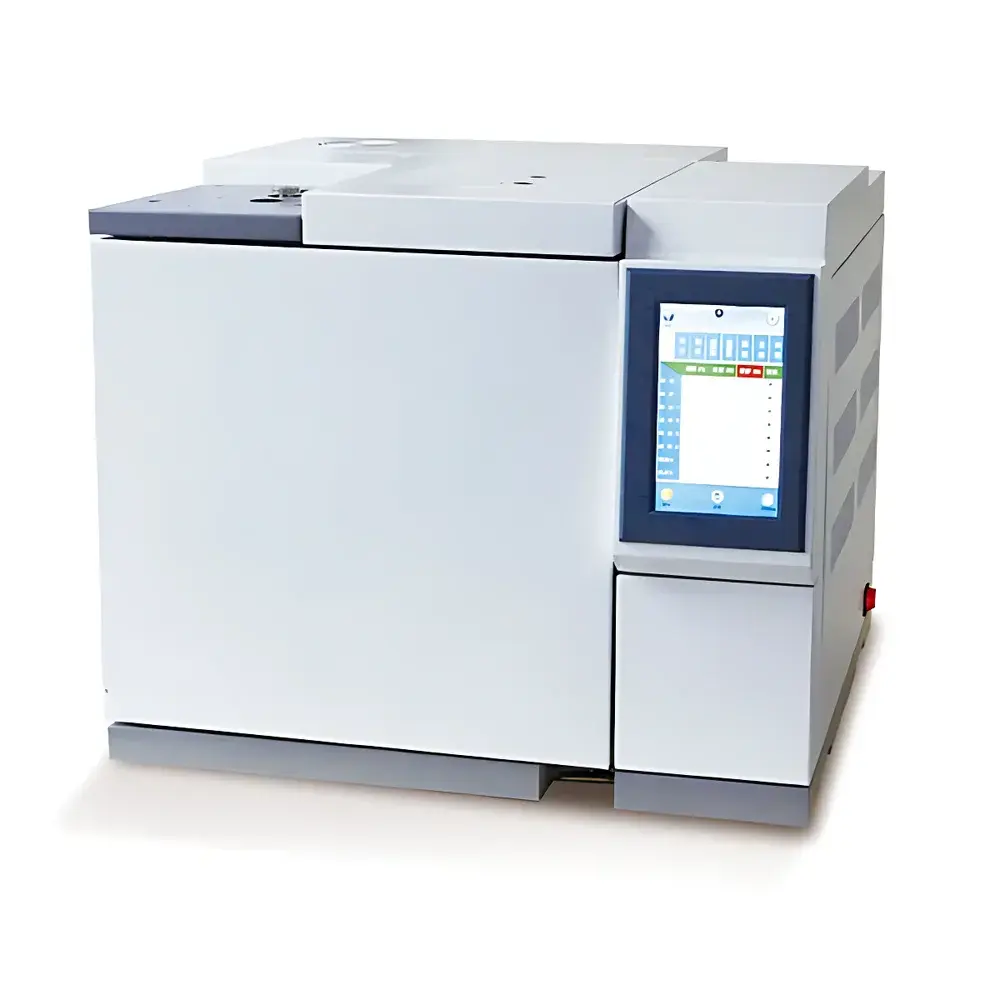
Jinpu GC-8890 Advanced Laboratory Gas Chromatograph
| Brand | Jinpu |
|---|---|
| Origin | Shandong, China |
| Model | GC-8890 (New Generation) |
| Instrument Type | Benchtop Laboratory Gas Chromatograph |
| Application Scope | General-Purpose Analysis |
| Oven Temperature Range | 5 °C above ambient to 400 °C (adjustable in 0.1 °C increments) |
| Oven Ramp Rate | 0.1–40 °C/min (0.1 °C/min increments) |
| Oven Cool-Down | 450 °C to 50 °C in ≤6 min |
| Carrier Gas Flow Control | 0–1200 mL/min, 7 programmable segments |
| Carrier Gas Pressure Control | 0–970 kPa |
| Injector Maximum Temperature | 400 °C |
| Injector Pressure Setpoint Range | 0–970 kPa |
| Injector Total Flow Setpoint Range | 0–1200 mL/min |
| Temperature Zones | 6 independently controlled zones |
| Max. Programmed Temperature Ramping | 16 steps |
| Electronic Pressure Control (EPC)/Electronic Flow Control (EFC) | 4-step pressure/flow programming |
| precision | ±0.01 kPa (pressure), ±0.01 sccm (flow) |
| Supported Detectors | FID, TCD, ECD, FPD, NPD |
| Display | 5.7-inch color LCD with dual-channel chromatogram overlay and optional touch interface |
Overview
The Jinpu GC-8890 is a high-performance, microprocessor-controlled laboratory gas chromatograph engineered for precision separation and quantitative analysis of volatile and semi-volatile organic compounds. Built upon a robust dual-channel architecture with fully independent temperature and gas control for each analytical path, it employs classical packed and capillary column separation principles governed by partition coefficients, retention time indexing, and carrier gas linear velocity optimization. The system integrates advanced electronic pressure and flow control (EPC/EFC) modules compliant with ASTM D3606, ISO 10156, and USP , enabling reproducible method transfer across laboratories. Its modular detector bay supports concurrent or sequential operation of up to five detector types—including flame ionization (FID), thermal conductivity (TCD), electron capture (ECD), flame photometric (FPD), and nitrogen-phosphorus (NPD)—making it suitable for regulated QC environments requiring multi-analyte verification per ICH Q2(R2) guidelines.
Key Features
- 6-zone independent temperature control with ±0.1 °C accuracy over a range from 5 °C above ambient to 450 °C, supporting complex multi-step oven programs (up to 16 ramps)
- High-speed thermal management: 0.1–40 °C/min ramp rates (0.1 °C/min resolution); rapid cool-down from 450 °C to 50 °C in under 6 minutes
- Full digital EPC/EFC system with 4-stage pressure/flow programming; compatible with N2, H2, He, and air; pressure control range 0–970 kPa (±0.01 kPa), flow control 0–1200 mL/min (±0.01 sccm)
- Intelligent auto-ignition via solenoid-controlled H2/air delivery; real-time flame status monitoring and fail-safe shutdown
- Dual automatic back-door mechanism with adaptive angular adjustment synchronized to oven temperature profiles
- Integrated 5.7-inch color LCD with dual-channel real-time chromatogram display; optional resistive touch interface for local method editing and run initiation
- 10/100M adaptive Ethernet interface enabling bidirectional remote control—single instrument controllable from up to three PCs; single PC capable of managing up to 5000 instruments via TCP/IP
- Four configurable external event ports for precise synchronization with multi-valve systems, enabling comprehensive multidimensional GC (MDGC) configurations
Sample Compatibility & Compliance
The GC-8890 accommodates standard ¼″ and ⅛″ packed columns as well as fused-silica capillaries (0.1–0.53 mm ID). It supports liquid, headspace, purge-and-trap, pyrolysis, and solid-phase microextraction (SPME) injection techniques through standardized GC interfaces. All hardware and firmware comply with electromagnetic compatibility (EMC) requirements per IEC 61326-1 and safety standards IEC 61010-1. Data acquisition and processing meet ALCOA+ principles when operated with validated software; audit trail, electronic signatures, and 21 CFR Part 11-compliant user access controls are achievable via optional LIMS integration. Routine calibration and performance qualification follow ASTM E260, ISO 17025, and pharmacopeial monographs (USP , EP 2.4.24).
Software & Data Management
The GC-8890 operates with vendor-supplied ChromaVision™ acquisition and analysis software, supporting Windows 10/11 (64-bit). Raw data files adhere to ANDI/NetCDF format for cross-platform compatibility. Software features include automated peak integration with customizable baselines, retention time locking (RTL), spectral library matching (NIST MS Search optional), and report generation compliant with GLP/GMP templates. Audit trail logs record all parameter changes, sequence edits, and manual interventions with timestamps and operator IDs. Remote diagnostics, firmware updates, and method synchronization are supported over secure TLS-enabled HTTP(S) connections. Data backups may be scheduled to network-attached storage (NAS) or cloud repositories meeting ISO/IEC 27001 requirements.
Applications
The GC-8890 delivers validated performance across environmental testing (VOCs in water/soil per EPA Method 8260C), petrochemical analysis (hydrocarbon typing per ASTM D5186), food safety (pesticide residues per EN 15662), pharmaceutical impurity profiling (ICH Q3B), and forensic toxicology (blood alcohol and drug metabolites). Its dual-detector capability allows simultaneous FID/TCD analysis for natural gas composition, while ECD sensitivity enables trace-level detection of halogenated pollutants in air samples. The system’s stability under variable ambient conditions—enabled by active oven insulation and real-time ambient compensation—makes it suitable for field-deployable lab-in-a-box configurations.
FAQ
What detector configurations are factory-supported?
FID, TCD, ECD, FPD, and NPD modules are available as plug-in units with pre-aligned optical paths and calibrated signal conditioning circuits.
Is the GC-8890 compatible with third-party autosamplers?
Yes—it supports RS-232 and TTL-level trigger protocols used by major OEM autosamplers (e.g., CTC Analytics, Gerstel, and Pal Systems) via configurable I/O events.
Can the instrument operate unattended for extended periods?
Fully—when paired with an autosampler and configured with scheduled method sequences, the GC-8890 executes overnight runs with automatic shutdown, leak detection, and error logging.
How is temperature uniformity verified across the oven chamber?
Each unit undergoes DIN 12880-compliant thermal mapping during final QA, with validation reports documenting axial/radial gradients at 100 °C, 250 °C, and 400 °C.
What maintenance intervals are recommended for EPC modules?
Pressure transducers and mass flow sensors require annual recalibration using NIST-traceable reference standards; filter replacement is advised every 6 months under continuous operation.





