
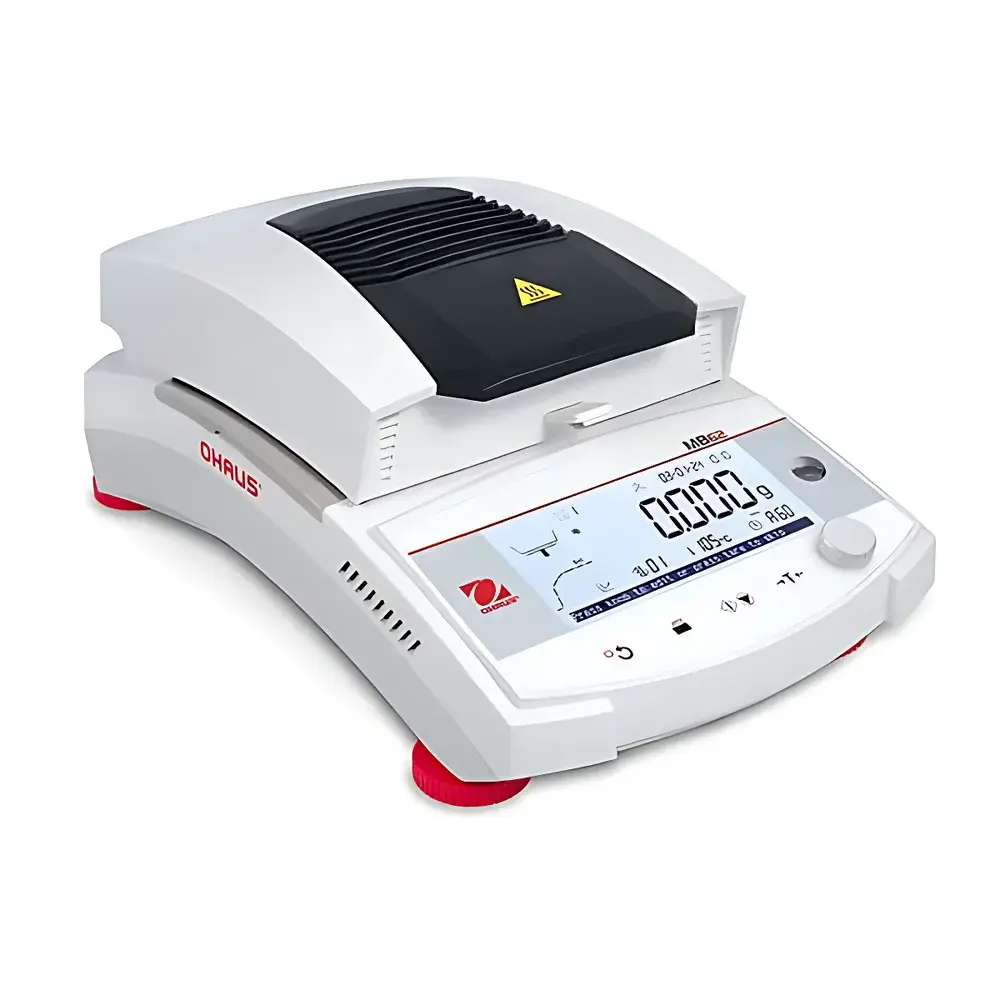
OHAUS MB62 Infrared Moisture Analyzer
| Brand | OHAUS |
|---|---|
| Origin | Jiangsu, China |
| Manufacturer Type | Manufacturer |
| Product Category | Domestic |
| Model | MB62 |
| Pricing | Upon Request |
| Heating Method | Infrared |
| Max Capacity | 90 g |
| Readability | 1 mg / 0.01% moisture |
| Pan Diameter | 90 mm |
| Heater Type | Carbon Fiber |
| Communication | USB Device, RS232 |
| Moisture Range | 0.01% – 100% |
| Repeatability | 0.018% (10 g sample), 0.10% (3 g sample) |
| Temperature Range | 40 °C – 200 °C |
| Calibration | Temperature calibration at 100 °C and 160 °C |
| Dimensions (L×H×W) | 352 mm × 210 mm × 138 mm |
| Net Weight | 4.3 kg |
| Operating Ambient | 10 °C – 40 °C |
| Display | 5” LCD, dual-line |
| Data Storage | 100 results |
| Method Library | 20 pre-programmable methods |
| Heating Modes | Slow, Standard, Step, Fast |
| Result Outputs | Moisture content, Solid content, Moisture regain, Weight loss, Heating temperature, Elapsed time, Method ID, Sample ID |
| Status Indicator | Multi-color status LED |
| Auto Shutdown | Timer-based, Automatic, Manual |
| Screen Protection Cover | Included |
| Environmental Compliance | CE, RoHS compliant |
| Software Compatibility | OHAUS MoisturePro™ (optional PC software for data export and audit trail) |
Overview
The OHAUS MB62 Infrared Moisture Analyzer is a precision benchtop instrument engineered for rapid, reliable, and repeatable determination of moisture content in solid and semi-solid samples using infrared (IR) thermogravimetric analysis. Unlike traditional halogen-based systems, the MB62 employs a high-efficiency carbon fiber heating element that delivers uniform thermal distribution, faster ramp-up times, and extended service life—critical for laboratories requiring consistent throughput across multiple daily assays. The analyzer operates on the fundamental principle of mass loss upon controlled thermal drying: sample weight is continuously monitored by a high-stability electromagnetic force compensation sensor (1 mg readability) while subjected to programmable IR heating profiles. Real-time weight change is converted into moisture percentage based on initial and final mass values, enabling trace-level quantification down to 0.01% with documented repeatability under defined test conditions.
Key Features
- Carbon fiber infrared heater providing stable, uniform heating from 40 °C to 200 °C with minimal thermal inertia and no bulb replacement requirements
- High-resolution 5-inch LCD display with dual-line output and intuitive graphical interface—including progress bars, contextual prompts, and multi-color status LED for operational feedback
- Four user-selectable heating modes (Slow, Standard, Step, Fast) to optimize drying kinetics for diverse matrices such as polymers, pharmaceutical granules, food powders, and agricultural commodities
- Integrated method management supporting up to 20 stored protocols, each configurable for target temperature, heating profile, endpoint criteria (time-based or slope-based), and result reporting format
- Comprehensive data handling via built-in storage for 100 test records, with timestamped entries including moisture %, solid content, moisture regain, elapsed time, method ID, and sample identifier
- Standard communication interfaces—RS232 and USB device port—for direct connection to PCs, printers, or LIMS; compatible with optional OHAUS MoisturePro™ software for enhanced data export, report generation, and 21 CFR Part 11–compliant audit trails
- Robust mechanical design (4.3 kg net weight) with integrated splash-resistant pan cover and ergonomic footprint (352 × 138 × 210 mm), suitable for QC labs operating under GLP/GMP-aligned workflows
Sample Compatibility & Compliance
The MB62 accommodates a broad spectrum of non-volatile and low-volatility materials, including but not limited to pharmaceutical excipients, active pharmaceutical ingredients (APIs), dairy powders, cereal flours, coffee beans, tea leaves, soil aggregates, and polymer resins. It conforms to core industry-standard methodologies referenced in ASTM D4442 (wood moisture), ISO 712 (cereals), USP <921> (moisture determination), and AOAC 952.03 (food moisture). While not a primary compliance-certified instrument for regulated submissions, its traceable calibration procedures—external mass calibration using a certified 50 g weight and dual-point temperature verification at 100 °C and 160 °C—support alignment with ISO/IEC 17025 documentation requirements. All electronics meet CE and RoHS directives for electromagnetic compatibility and hazardous substance restriction.
Software & Data Management
Data integrity is reinforced through structured digital workflows. Test results are stored locally with full metadata (date/time, operator ID if entered, method parameters, raw weight traces). When connected to a Windows PC via USB or RS232, the optional MoisturePro™ software enables batch export to CSV or PDF, customizable report templates, and password-protected user accounts. Audit trail functionality logs all critical events—including method edits, calibration actions, and result deletions—with immutable timestamps, satisfying baseline requirements for FDA 21 CFR Part 11 adherence when deployed within validated environments. Raw weight vs. time datasets can be exported for secondary statistical analysis or integration into enterprise quality management systems (QMS).
Applications
- Pharmaceutical manufacturing: Moisture verification of tablet granulations prior to compression and lyophilized product residual solvent screening
- Food quality control: Routine monitoring of flour, sugar, spices, and infant formula to ensure shelf-life stability and regulatory labeling accuracy
- Chemical R&D: Kinetic drying studies of catalyst supports, desiccants, and hygroscopic reagents
- Agricultural testing labs: Rapid field-moisture estimation in grain, hay, and compost samples per AOAC guidelines
- Plastics & polymers: Quantifying moisture in PET, nylon, and polycarbonate pellets before extrusion to prevent hydrolytic degradation
- Academic research: Teaching thermogravimetric principles and validating alternative drying models in material science curricula
FAQ
What is the recommended sample size for optimal repeatability?
For best reproducibility, use ≥10 g samples where possible—the specification states ±0.018% RSD at 10 g, versus ±0.10% at 3 g. Smaller masses increase susceptibility to environmental drift and surface-area-to-volume effects.
Does the MB62 support internal calibration?
No. Weight calibration requires an external 50 g Class M2 or better certified weight. Temperature calibration is performed manually at two fixed points (100 °C and 160 °C) using a traceable reference thermometer.
Can I export raw weight-vs.-time data for kinetic modeling?
Yes—when used with MoisturePro™ software, full second-by-second mass readings are accessible in CSV format for derivative analysis, Arrhenius modeling, or custom endpoint algorithm development.
Is the carbon fiber heater replaceable by the user?
The carbon fiber heating module is a sealed, factory-assembled component. Replacement must be performed by authorized OHAUS service personnel to maintain thermal calibration integrity and safety certification.
How does the MB62 handle hygroscopic or thermally sensitive samples?
The Step and Slow heating modes allow gradual temperature ramping to minimize spattering or premature decomposition. Users may also configure lower endpoint temperatures or shorter hold times to preserve sample integrity while still achieving gravimetric equilibrium.
Related Products




