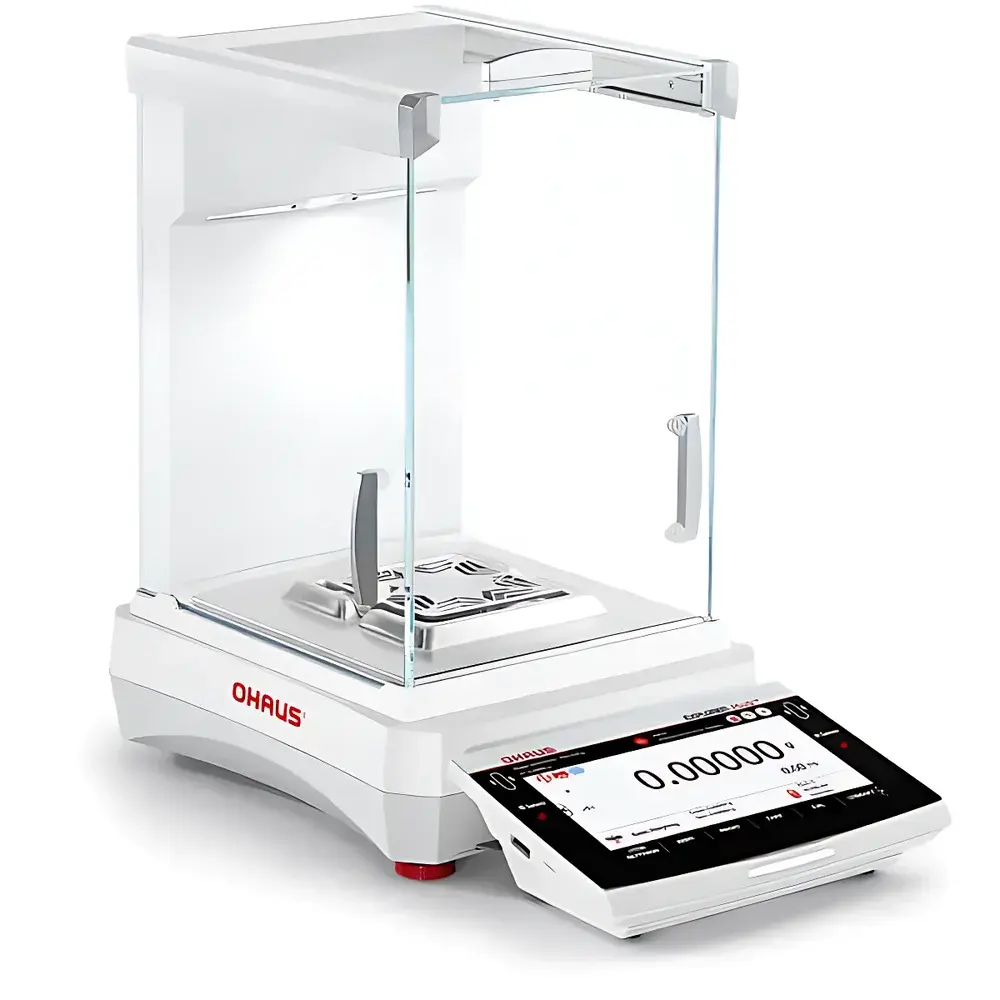
OHAUS Explorer Plus Precision Microbalance EXP225ZH/AD
| Brand | OHAUS |
|---|---|
| Origin | Jiangsu, China |
| Manufacturer Type | Manufacturer |
| Product Category | Domestic |
| Model | EXP225ZH/AD |
| Instrument Type | Analytical Balance |
| Readability | 0.01 mg |
| Maximum Capacity | 220 g |
| Repeatability (typical) | 0.02 mg |
| Minimum Weight (USP <41>, 0.1% tolerance, typical) | 20 mg |
| Linearity Error (typical) | ±0.2 mg |
| Pan Size | 80 mm × 80 mm |
| Stabilization Time | 5 s |
| Internal Calibration | Fully Automatic |
| Display | 7-inch TFT color touchscreen (16.7M colors), detachable with tempered glass panel |
| Connectivity | USB Host (Type-A) ×2, USB Device (Type-C) ×1, Ethernet (RJ45) ×1, RS232 ×1, RJ11 ×1 |
| Environmental Operating Range | 10–30 °C, ≤80% RH (non-condensing) |
| Net Weight | 7.8 kg |
| Dimensions (L×H×W) | 408 × 229 × 372 mm |
| Construction | Zinc-alloy pan, die-cast metal base and housing, electrostatic-dissipative glass draft shield, dual non-contact sensors, integrated ionizer, auto-leveling system, motorized anti-pinch draft door with LED status indicator and sample illumination |
| Compliance | Designed to support ISO/IEC 17025, USP <41> & <1251>, ASTM E898, and GLP/GMP data integrity requirements including audit trail, user access control (4+1 roles), and 100,000-entry system log |
Overview
The OHAUS Explorer Plus Precision Microbalance EXP225ZH/AD is an analytical balance engineered for laboratories requiring trace-level mass determination under regulated and research-intensive environments. Utilizing high-stability electromagnetic force restoration (EMFR) technology, it delivers consistent 0.01 mg readability across its full 220 g capacity range. Its design integrates metrological rigor with operational intelligence: the dual non-contact position sensors minimize mechanical hysteresis, while the built-in ionizer and electrostatic-dissipative glass draft shield actively suppress charge-induced drift—critical for low-mass measurements of powders, crystalline APIs, or nanomaterials. The fully automatic internal calibration system—activated via scheduled or event-triggered protocols—ensures long-term traceability without manual intervention. With a minimum weight of 20 mg (per USP at 0.1% tolerance), the EXP225ZH/AD meets the threshold for high-accuracy quantitative analysis in pharmaceutical QC, reference standard preparation, and materials science characterization.
Key Features
- 7-inch detachable TFT color touchscreen with gesture-responsive interface and configurable home screen layouts
- Auto-leveling system with real-time tilt compensation—eliminates manual bubble-level adjustment and ensures consistent sensor alignment
- Motorized draft door with anti-pinch safety logic and proximity-sensing activation; integrated LED status indicators for operational mode (e.g., stable, calibrating, error)
- Zinc-alloy weighing pan (80 mm × 80 mm) optimized for thermal stability and corrosion resistance in humid or solvent-exposed environments
- Dual independent non-contact displacement sensors for enhanced signal redundancy and improved long-term repeatability
- Built-in ionizer with continuous discharge monitoring—validated to reduce electrostatic interference below 0.5 V residual surface potential
- Time synchronization via NTP protocol for timestamp accuracy across multi-instrument networks and LIMS integration
- HID-compliant USB interface enabling direct plug-and-play connection to Windows/macOS systems without driver installation
Sample Compatibility & Compliance
The EXP225ZH/AD accommodates diverse sample forms—including hygroscopic solids, volatile solutes, fine particulates, and micro-volumes in tared vials—through its optimized airflow management and rapid stabilization (≤5 s). Its draft shield design conforms to ISO 9001 and ISO/IEC 17025 environmental control guidelines for balance enclosures. The instrument supports full audit trail generation per FDA 21 CFR Part 11 requirements when paired with compliant software (e.g., OHAUS Acquire or third-party LIMS), including electronic signatures, immutable event logging (100,000 entries), and role-based access control (five distinct user levels). All calibration and performance verification records—including internal calibration logs, linearity checks, and repeatability assessments—are exportable in CSV or PDF format with embedded digital signatures. It is validated for use in USP weighing applications, ASTM E898 gravimetric procedures, and pharmacopoeial density determination (with optional AV EP VP PA kit).
Software & Data Management
- Internal storage for up to 3,000 user-defined sample IDs with metadata (name, CAS#, batch#, density, tare ID)
- Export-ready data output via USB, Ethernet (TCP/IP), or optional Wi-Fi/Bluetooth—supports direct transmission to ELN, LIMS, or ERP systems
- Configurable print templates compatible with SF40A impact and thermal printers (including GLP-compliant header/footer with operator ID, timestamp, and balance ID)
- System log retains full operational history: power cycles, calibration events, door open/close timestamps, error codes, and firmware updates
- Optional fingerprint scanner (FIN-100A) and wireless tool kit (LM842) enable biometric authentication and remote diagnostics
- Support for SOP-driven workflows via customizable method templates—e.g., “USP Minimum Weight Check” or “Density Determination per ISO 1183”
Applications
This microbalance serves as a primary mass standard in regulated laboratories performing: active pharmaceutical ingredient (API) assay validation; reference standard dilution and gravimetric standard solution preparation; catalyst loading quantification in heterogeneous catalysis studies; nanoparticle mass fraction analysis in composite material R&D; and volumetric instrument calibration (e.g., pipette verification per ISO 8655 using gravimetric methods). Its density determination module enables solid/liquid density measurement with buoyancy correction applied per Archimedes’ principle. The integrated animal weighing mode—with dynamic averaging and motion compensation—is routinely deployed in preclinical toxicology units for longitudinal small-animal dosing studies. In quality control labs, its SQC and fill-weight deviation functions automate statistical process control for blister-pack or vial-filling line validation.
FAQ
What regulatory standards does the EXP225ZH/AD support?
It is designed to facilitate compliance with USP , , ISO/IEC 17025, ASTM E898, and FDA 21 CFR Part 11 when configured with appropriate software and procedural controls.
Is external calibration required?
No—fully automatic internal calibration eliminates routine external weight usage; however, periodic verification with certified Class E2 or F1 weights is recommended per ISO 17025 accreditation requirements.
Can the balance operate on battery power?
No—it requires AC input (100–240 VAC, 50–60 Hz) via the included 12 VDC adapter; no internal battery is provided.
How is electrostatic interference mitigated during ultra-low-mass weighing?
Through integrated ionizer hardware, conductive draft shield coating, zinc-alloy pan grounding path, and real-time charge potential monitoring—reducing static-related uncertainty to <0.005 mg in controlled environments.
What data security features are embedded?
Role-based user authentication (4+1 hierarchical permissions), encrypted system log, tamper-evident timestamps, and exportable audit trails with digital signature capability.