
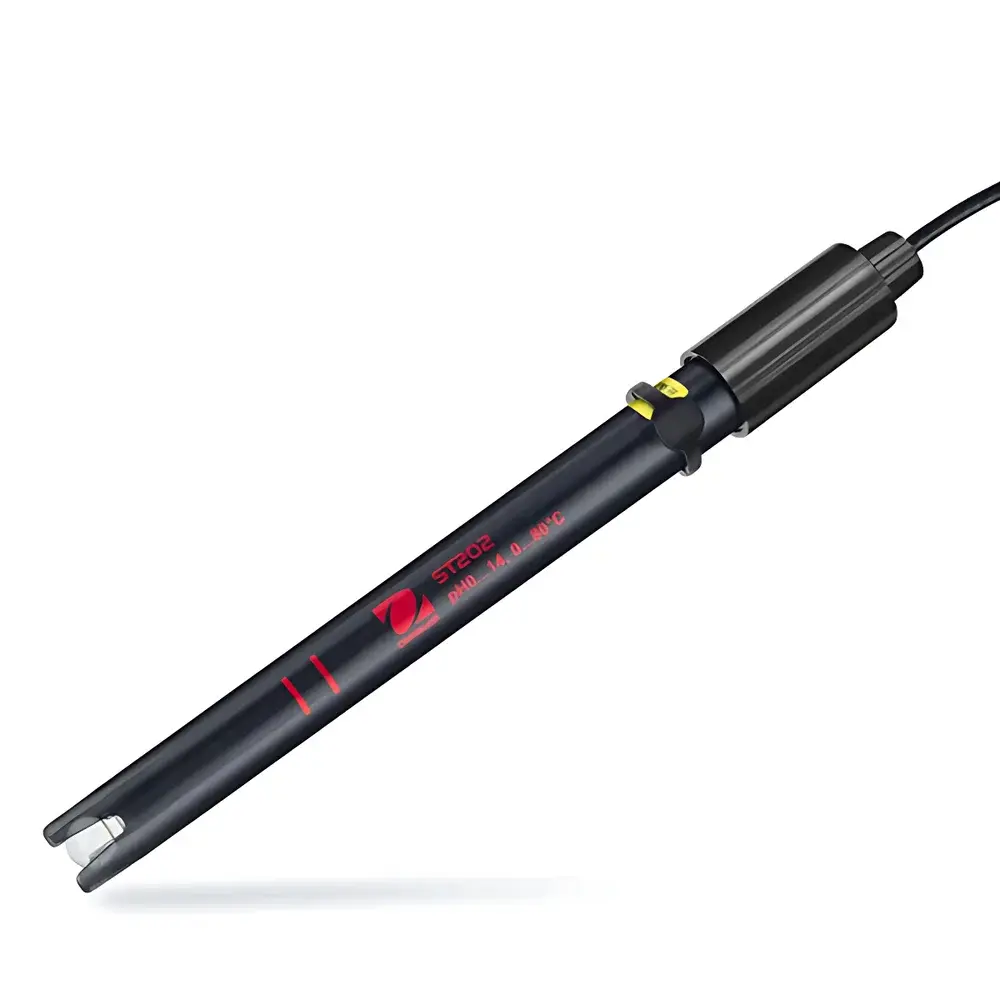
OHAUS ST202 pH Electrode
| Brand | OHAUS |
|---|---|
| Origin | Jiangsu, China |
| Manufacturer Type | Manufacturer |
| Product Origin | Domestic (China) |
| Model | ST202 |
| Price | Upon Request |
| pH Measurement Range | 0.00 – 14.00 pH |
| Cable Length | 1.1 m |
| Electrode Body Material | Plastic |
| Dimensions (L × Ø) | 120 mm × 12 mm |
| Net Weight | 70 g |
| Temperature Operating Range | 0 °C – 80 °C |
| Integrated Temperature Sensor | No |
Overview
The OHAUS ST202 pH Electrode is a robust, general-purpose combination pH electrode engineered for reliable and reproducible potentiometric hydrogen ion activity measurements in routine laboratory, educational, and quality control environments. Designed according to standard glass electrode principles—featuring a pH-sensitive glass membrane, internal reference solution (typically Ag/AgCl in KCl), and a stable liquid-junction reference system—the ST202 delivers accurate potential differentials across the full aqueous pH scale (0.00–14.00). Its compact cylindrical geometry (120 mm × 12 mm) and lightweight plastic body ensure ergonomic handling and compatibility with benchtop, portable, and handheld pH meters equipped with BNC or DIN connectors. The absence of an integrated temperature sensor necessitates external temperature compensation—either via manual input or pairing with a separate temperature probe—ensuring compliance with ISO 3696, ASTM D1293, and USP guidelines for pH measurement accuracy under variable thermal conditions.
Key Features
- Full-scale pH measurement capability from 0.00 to 14.00 with high chemical resistance to common buffers, acids, bases, and mild organic solvents
- Durable plastic shaft construction offering mechanical resilience and reduced risk of breakage compared to all-glass alternatives
- Optimized liquid-junction design minimizing clogging and electrolyte leakage during extended use in turbid or particulate-laden samples
- 1.1-meter shielded coaxial cable with standardized BNC termination for universal connectivity to OHAUS ST-series meters (e.g., ST200, ST300) and third-party analyzers
- Low thermal mass and rapid response time (<15 seconds to 95% stabilization in stirred buffer solutions at 25 °C)
- Calibration-compatible with standard two-point (pH 4.01 / 7.00 or 7.00 / 10.01) or three-point protocols per ISO 17025–accredited QC workflows
Sample Compatibility & Compliance
The ST202 is validated for aqueous and mildly aggressive media including tap water, wastewater effluents, nutrient solutions, food extracts, pharmaceutical buffers, and cosmetic emulsions. It is not recommended for strongly oxidizing agents (e.g., hypochlorite >100 ppm), hydrofluoric acid, or non-aqueous solvents without prior validation. Electrode performance adheres to IUPAC-recommended slope criteria (≥95% theoretical Nernstian response: −59.16 mV/pH at 25 °C) and drift specifications (<0.02 pH/h after equilibration). While the ST202 itself carries no CE, UKCA, or FDA registration, its design and materials meet general requirements for GLP-compliant documentation when used within validated instrument systems. Users deploying this electrode in regulated environments (e.g., ISO 13485 medical device manufacturing or USP-controlled pharmaceutical testing) must establish and maintain calibration logs, electrode performance verification records, and storage condition controls per 21 CFR Part 11 data integrity expectations.
Software & Data Management
As a passive analog transducer, the ST202 does not incorporate onboard memory, firmware, or digital communication interfaces. All signal processing, calibration management, temperature compensation, and data logging occur externally—within the connected pH meter or data acquisition system. When paired with OHAUS ST-series instruments, users benefit from built-in calibration history tracking, automatic buffer recognition, and GLP-compliant timestamped reports exportable via USB or RS-232. For integration into LIMS or ELN platforms, analog output (mV) or digitized pH values must be captured through compatible DAQ hardware supporting IEEE 1241-compliant ADC resolution. Audit trails—including calibration dates, operator IDs, and electrode ID tagging—are maintained at the host instrument level, satisfying traceability requirements under ISO/IEC 17025 Clause 7.7.
Applications
- Routine pH monitoring in environmental labs (surface water, leachate, soil extracts)
- Process control in beverage and dairy production lines (pasteurization tanks, fermentation vessels)
- Quality assurance testing of cleaning agents, disinfectants, and topical formulations
- Student laboratories for fundamental electrochemistry instruction and buffer characterization
- Supporting multi-parameter analysis when used alongside ST-series ORP, conductivity, DO, and temperature electrodes on shared meter platforms
FAQ
Does the ST202 include an integrated temperature sensor?
No. Temperature compensation must be performed manually or using an external temperature probe.
What is the recommended storage solution for long-term stability?
Store upright in 3 M KCl solution or manufacturer-recommended storage fluid; never in deionized water or dry conditions.
Can the ST202 be used for measurements in high-ionic-strength samples?
Yes—its double-junction option (available separately as ST202-DJ) is advised for samples containing sulfides, proteins, or heavy metals to prevent reference contamination.
Is the electrode compatible with non-OHAUS meters?
Yes, provided the meter accepts standard BNC-input pH electrodes and supports manual or automatic calibration routines.
How often should the ST202 be recalibrated?
Minimum once per analytical session; more frequently if measuring extreme pH values, viscous samples, or following cleaning procedures.




