
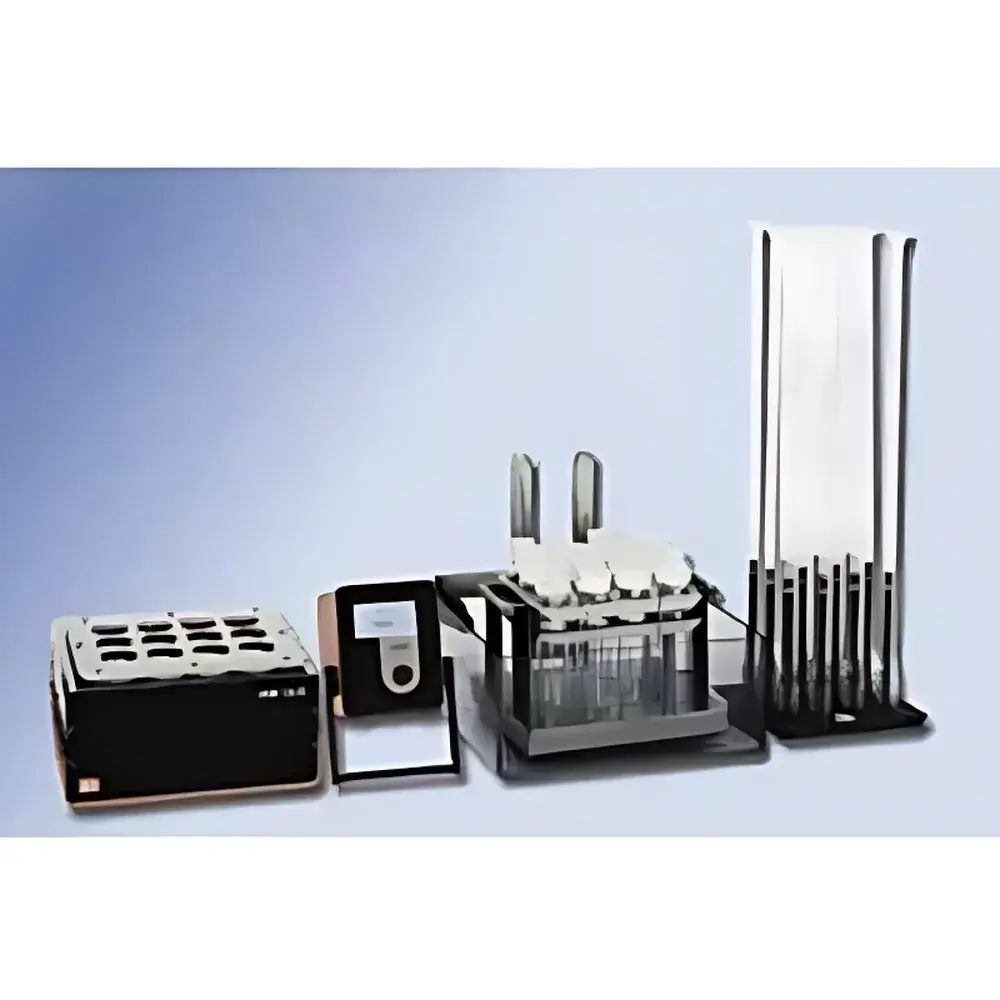
Behr PA-CSB COD Sample Digestion Unit
| Origin | Germany |
|---|---|
| Manufacturer Type | Authorized Distributor |
| Origin Category | Imported |
| Model | Behr PA-CSB |
| Instrument Type | Laboratory Benchtop Unit |
| Measurement Principle | Closed-Tube Colorimetric Oxidation (Dichromate Reflux Method per ISO 6060 / DIN 38409-H41) |
| Wavelength | 610 ± 20 nm |
| Measurement Range | 10–5000 mg/L COD |
| Accuracy | ≤ ±10% of reading |
| Repeatability | ≤ ±5% RSD |
| LOD | 0.1 mg/L |
| Digestion Time | 20 min |
| Batch Capacity | 15 or 30 samples (configurable via reaction block configuration) |
Overview
The Behr PA-CSB COD Sample Digestion Unit is a precision-engineered, laboratory-grade thermal digestion system designed for standardized chemical oxygen demand (COD) determination in aqueous environmental matrices. It implements the closed-tube dichromate reflux oxidation method in strict accordance with ISO 6060 and DIN 38409-H41—internationally recognized protocols for wastewater, surface water, and industrial effluent analysis. Unlike open-reflux systems, the PA-CSB utilizes sealed RG2 reaction vessels to ensure complete oxidation of organic matter under controlled high-temperature conditions (typically 150 °C), minimizing reagent loss, operator exposure, and inter-laboratory variability. The unit integrates seamlessly with spectrophotometric COD analyzers operating at 610 nm, enabling quantitative colorimetric detection of Cr3+ formed during reduction of K2Cr2O7. Its fixed 20-minute digestion cycle delivers reproducible results across the full 10–5000 mg/L range, supporting both routine compliance monitoring and method validation under GLP and ISO/IEC 17025 frameworks.
Key Features
- Microprocessor-controlled TRS 300 timer-temperature regulator ensures precise thermal profiling (±1 °C stability) throughout the 20-minute digestion cycle.
- Modular CSB/E heating module with integrated RG2 reaction vessel support frame (KW/N) enables rapid, tool-free configuration for either 15- or 30-sample batches.
- Dual-stage cooling architecture: E/BRG2 passive cooling trough + LK1 air-cooling assembly with dedicated LS rack ensures uniform post-digestion temperature equilibration (<40 °C within 10 min), critical for accurate spectrophotometric readout.
- RG2 reaction vessels are borosilicate glass, chemically inert, and calibrated to ISO-compliant volume tolerances (±1%), eliminating volumetric error sources.
- Compliance-ready design: All thermal and timing parameters are logged internally; optional RS232/USB interface supports traceable data export for audit trails required under EPA Method 410.4, ISO/IEC 17025, and FDA 21 CFR Part 11 environments.
Sample Compatibility & Compliance
The PA-CSB accommodates standard 16 mm OD × 100 mm L RG2 vials containing up to 2.5 mL sample + reagent mixture. It is validated for use with domestic and industrial wastewater, leachates, pretreated influents, and low-salinity surface waters. High-chloride matrices (>2000 mg/L Cl−) require mercury sulfate masking per ISO 6060 Annex B. The system meets CE marking requirements for electrical safety (EN 61010-1) and electromagnetic compatibility (EN 61326-1). Documentation includes full conformity declarations, calibration certificates for the TRS 300 controller, and test reports verifying thermal uniformity across all positions (±0.8 °C max deviation).
Software & Data Management
While the PA-CSB operates as a standalone hardware module, its TRS 300 controller supports bidirectional communication with third-party LIMS and laboratory informatics platforms via ASCII protocol over RS232 or USB virtual COM port. Timestamped digestion logs—including start time, setpoint temperature, actual chamber temperature profile (recorded every 30 s), and completion flag—are exportable as CSV files. These records satisfy ALCOA+ data integrity principles (Attributable, Legible, Contemporaneous, Original, Accurate) and provide auditable evidence for regulatory submissions under EU Water Framework Directive reporting or US EPA NPDES permit compliance.
Applications
- Routine COD monitoring in municipal wastewater treatment plants (influent, effluent, sludge supernatant).
- Industrial discharge verification for textile, food processing, pharmaceutical, and pulp & paper facilities.
- Method validation and QC/QA for accredited environmental testing laboratories (ISO/IEC 17025 scope).
- Educational use in university environmental engineering labs requiring ISO-aligned experimental protocols.
- Supporting BOD5/COD ratio assessments for biodegradability screening of novel wastewater streams.
FAQ
Is the PA-CSB compatible with Hach, Lovibond, or other brand spectrophotometers?
Yes—provided the analyzer accepts 16 mm round cells and measures absorbance at 610 ± 20 nm. RG2 vials meet standard photometer cell dimensions and optical path specifications.
Can digestion temperature be adjusted beyond the default 150 °C?
No—the PA-CSB is factory-configured for ISO/DIN-compliant 150 °C operation only. Temperature modification would invalidate method compliance and void calibration certification.
What maintenance is required for long-term accuracy?
Annual verification of TRS 300 temperature sensor calibration using NIST-traceable dry-block calibrators is recommended. RG2 vials should be inspected for etching or residue buildup before each batch.
Does the unit include digestion reagents or vials?
No—RG2 vials, potassium dichromate/sulfuric acid reagent sets, and standard reference solutions must be procured separately per ISO 6060 Annex A.
How is cooling performance validated across all positions?
Each PA-CSB unit undergoes thermal mapping per ASTM E2251, with thermocouples placed in all 30 vial positions. Final report documents maximum ΔT between positions during cooldown phase (≤2.5 °C).







