
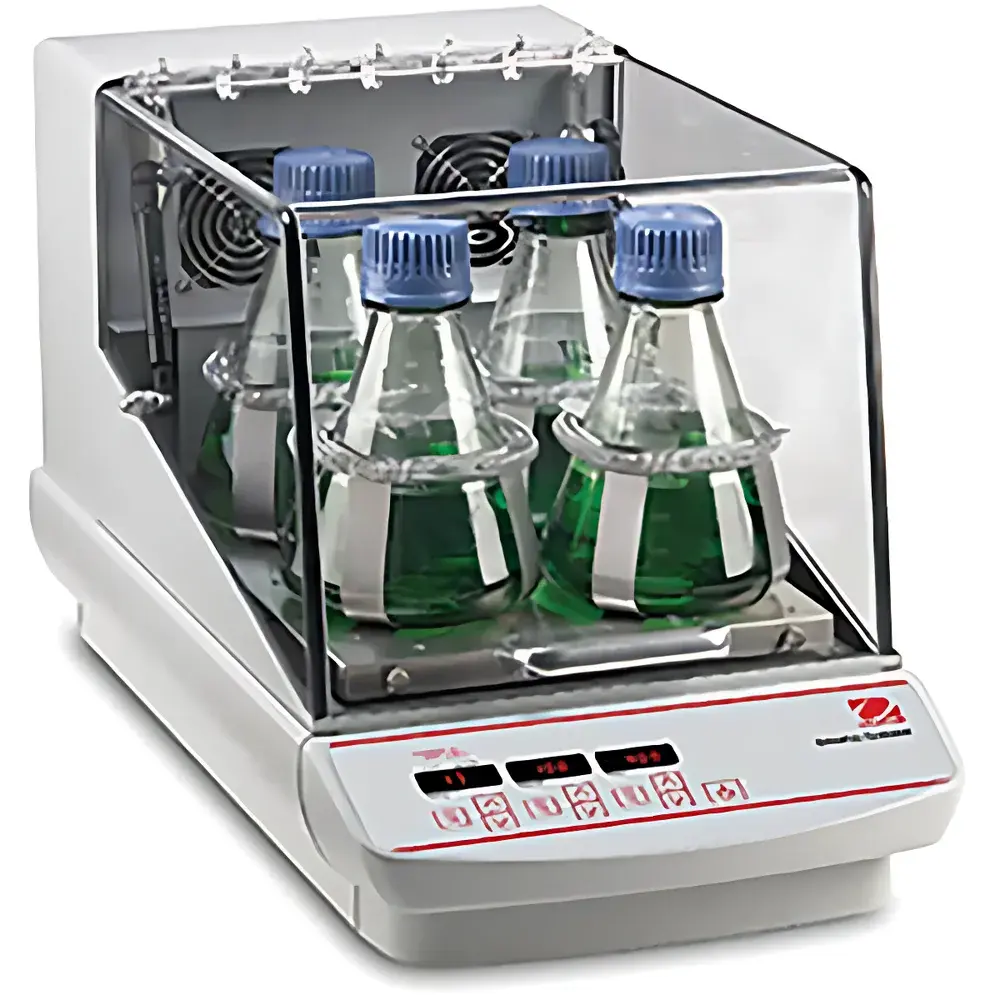
OHAUS ISHD16HDG High-Capacity Temperature-Controlled Orbital Shaker
| Brand | OHAUS |
|---|---|
| Origin | USA |
| Manufacturer | OHAUS Corporation |
| Product Type | Air-Bath Temperature-Controlled Orbital Shaker |
| Timer Range | 1 s – 160 h |
| Orbital Motion | Circular, 25 mm diameter |
| Speed Range | 15 – 500 rpm |
| Temperature Range | Ambient +5°C to 65°C |
| Tray Dimensions | 330 mm × 279 mm (L×W) |
| Max Load Capacity | 16 kg (at ≤75 rpm) |
| Temperature Uniformity | ±0.5°C at 37°C |
| Drive System | Triple-eccentric shaft balanced drive with brushless DC motor |
| Control | Digital PID temperature controller with independent LED displays for temperature, speed, and time |
| Calibration | User-accessible temperature calibration function |
| Safety Features | Overload protection, temperature overshoot protection, integrated load sensor |
| Communication Interface | RS232 |
| Power Supply | 230 V, 5 A, 50/60 Hz |
| Power Consumption | 450 W |
| Net Weight | 35.9 kg |
| External Dimensions | 648 mm × 406 mm × 356 mm (L×H×W) |
| Internal Chamber Dimensions | 340 mm × 241 mm × 305 mm (L×H×W) |
| Operating Environment | 15–32°C, ≤80% RH (non-condensing) |
| Safety Certification | TUV |
Overview
The OHAUS ISHD16HDG High-Capacity Temperature-Controlled Orbital Shaker is an engineered platform for reproducible, long-duration incubation and agitation of biological and biochemical samples under precisely regulated thermal conditions. Designed around the principles of orbital motion—where a circular horizontal displacement (25 mm diameter) generates gentle yet effective mixing without shear-induced cell damage—the instrument delivers uniform heat distribution and mechanical stability across wide load ranges. Its air-bath heating architecture eliminates direct contact between heating elements and samples, minimizing thermal gradients and condensation risks inside vessels. The triple-eccentric shaft drive system ensures low-vibration, high-inertia performance even at maximum payload (16 kg), while maintaining speed accuracy within ±1 rpm below 100 rpm and ±1% above—critical for sensitive suspension cultures and solubility assays requiring strict kinetic consistency.
Key Features
- Triple-eccentric shaft balanced drive mechanism coupled with a brushless DC motor for maintenance-free operation, extended service life, and minimal electromagnetic interference.
- PID-based digital temperature control with user-accessible calibration capability, enabling traceable adjustments compliant with GLP documentation requirements.
- Independent LED displays for real-time monitoring of setpoint and actual values of temperature, rotational speed, and elapsed/timer duration—each adjustable without cross-parameter interference.
- Integrated load sensor and dynamic overload protection that automatically reduces torque or halts operation upon detection of excessive mass imbalance or mechanical resistance.
- Temperature overshoot suppression algorithm prevents transient excursions during ramp-up, ensuring thermal integrity for thermolabile cultures such as primary mammalian cells or recombinant protein expression systems.
- TUV-certified electrical safety architecture, including reinforced insulation, grounded chassis design, and overcurrent circuit protection aligned with IEC 61010-1 standards.
Sample Compatibility & Compliance
The ISHD16HDG accommodates standard laboratory vessels—including Erlenmeyer flasks (up to 5 L), deep-well plates, and custom trays—on its rigid aluminum tray (330 × 279 mm). Its internal chamber (340 × 241 × 305 mm) supports multi-tier stacking configurations when used with optional shelf kits. Temperature uniformity of ±0.5°C at 37°C meets ASTM E145 Class II specification for gravity convection ovens and exceeds typical requirements for microbial growth studies per ISO 8573-1 and USP . The device operates within defined environmental limits (15–32°C ambient, ≤80% RH non-condensing), ensuring stable performance in shared core facilities. All firmware and hardware design elements adhere to FDA 21 CFR Part 11 readiness protocols, supporting audit-trail-enabled data logging when paired with validated RS232-connected software platforms.
Software & Data Management
Equipped with a standard RS232 serial interface, the ISHD16HDG enables bidirectional communication with external PCs running OHAUS-provided or third-party LIMS-compatible applications. Command-line protocol support allows integration into automated workflows governed by SOP-driven scheduling engines. Logged parameters—including timestamped temperature and speed profiles, error codes, and calibration event records—are exportable in CSV format for archival per 21 CFR Part 11 Subpart B requirements. Firmware updates are performed via secure authenticated transfer; no internal storage media is present, eliminating data residency concerns in regulated environments.
Applications
- Mammalian and insect cell suspension culture in serum-free or chemically defined media, where consistent oxygen transfer and low-shear agitation directly impact viability and productivity.
- Bacterial and yeast fermentation optimization, including induction-phase shaking for recombinant protein expression under controlled thermal setpoints.
- Solubility and dissolution rate profiling of APIs and excipients under pharmacopeial conditions (e.g., USP , ).
- Extraction kinetics for natural product isolation, where temperature-modulated solvent penetration must be decoupled from mechanical disruption.
- Environmental microbiology assays involving soil slurry homogenization or waterborne pathogen enrichment at elevated incubation temperatures.
FAQ
What is the maximum recommended load for continuous operation at 500 rpm?
At 500 rpm, the maximum supported load is 2.3 kg to maintain mechanical stability, speed accuracy, and thermal uniformity.
Does the shaker support programmable multi-step protocols (e.g., ramp-hold-cool cycles)?
No—this model implements single-setpoint control for temperature and speed; multi-stage programming requires external controller integration via RS232.
Is the RS232 port optically isolated?
Yes, galvanic isolation is implemented to prevent ground-loop interference in networked lab environments.
Can the unit be operated inside a cold room?
Operation is specified only between 15°C and 32°C ambient; sub-ambient environments may impair heater response and PID convergence.
How often should temperature calibration be performed?
OHAUS recommends annual verification using NIST-traceable reference thermometers, especially after relocation or mechanical shock events.





