
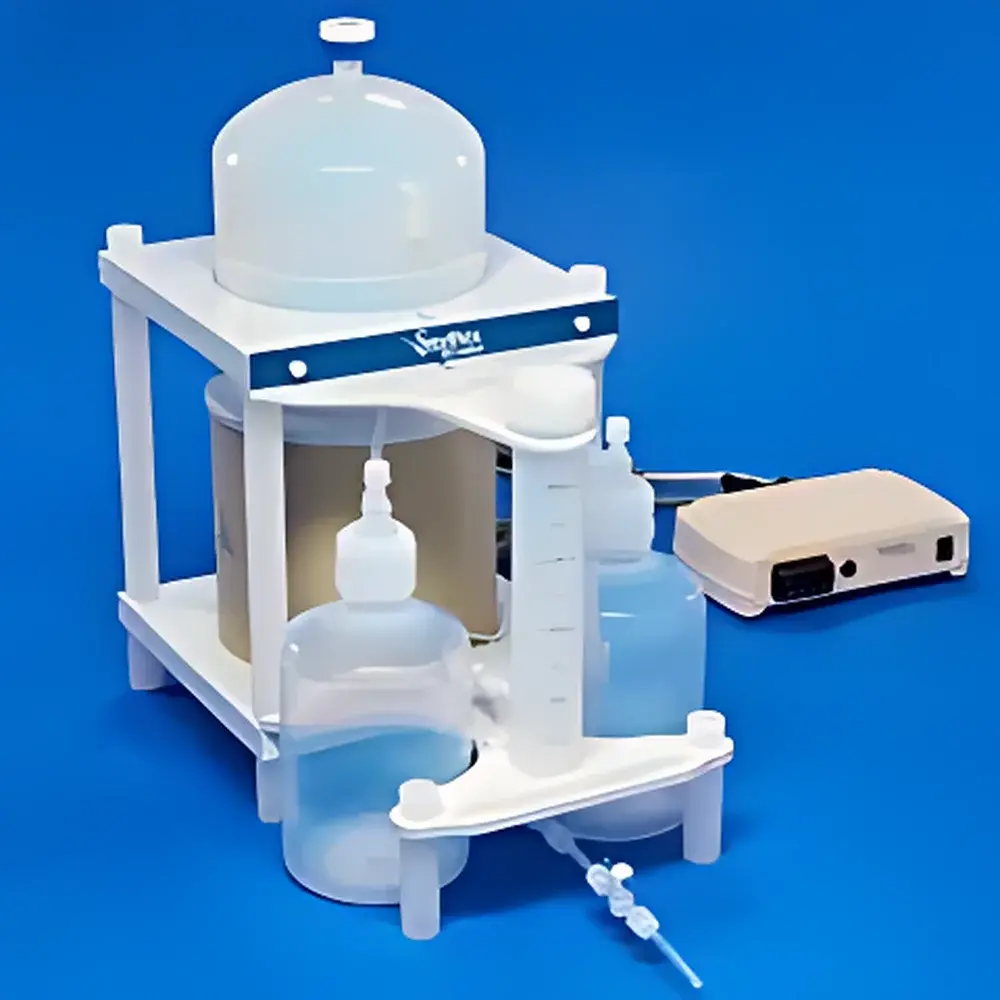
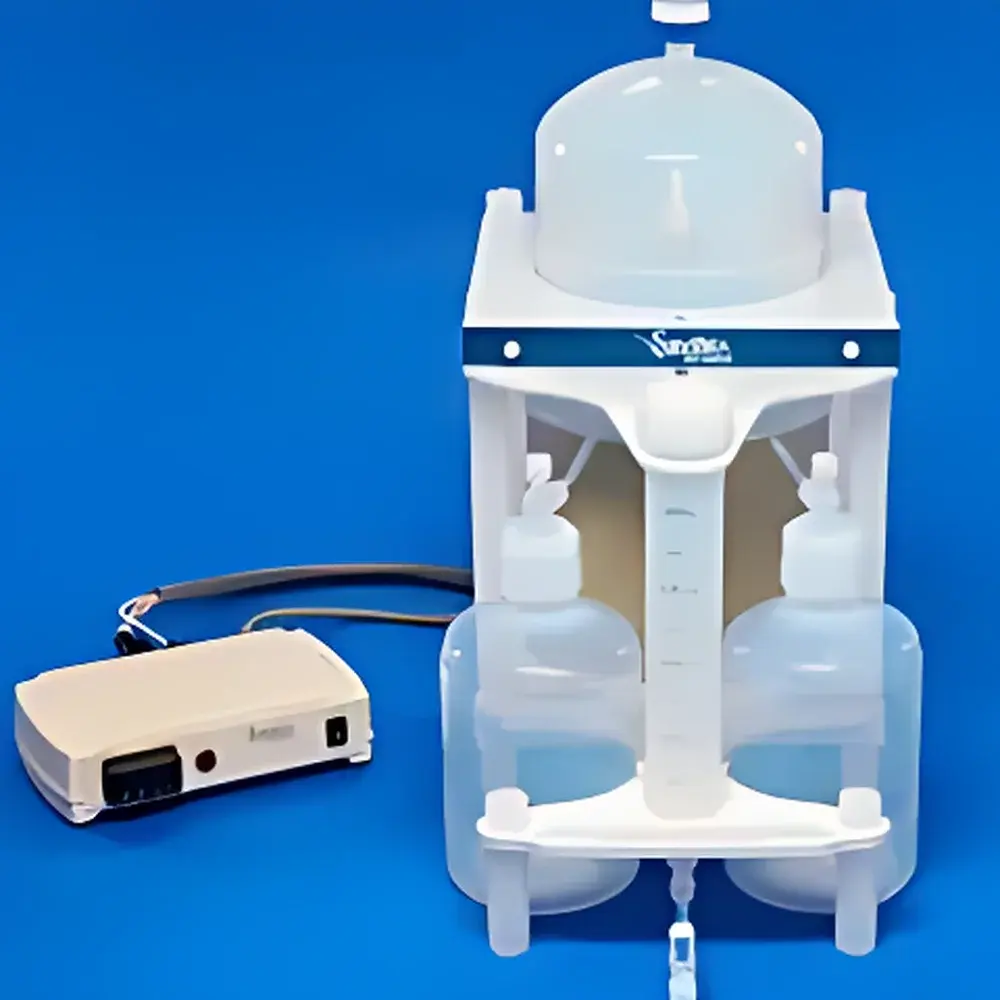
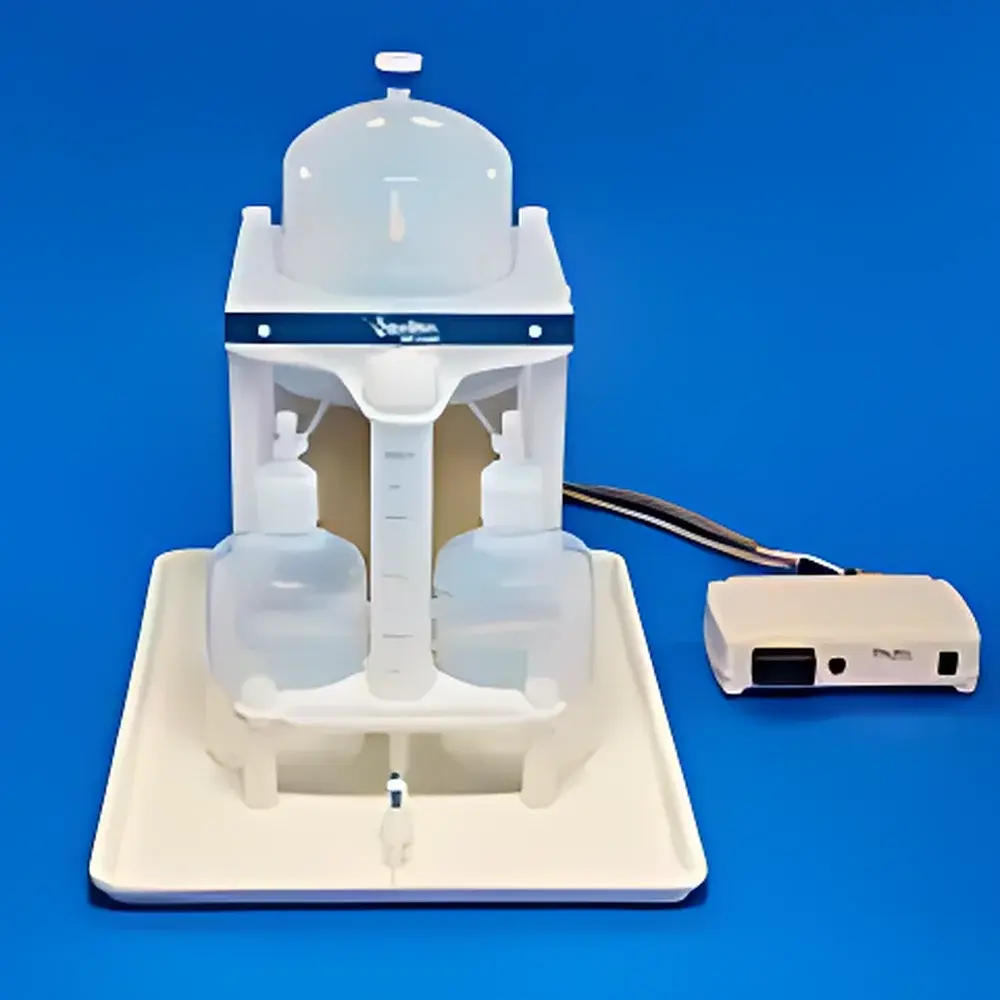
Savillex DST-4000 High-Capacity Sub-Boiling Acid Distillation System
| Brand | Savillex |
|---|---|
| Origin | USA |
| Model | DST-4000 |
| Instrument Type | Sub-boiling Distiller |
| Heating Method | Resistive Heating (Corrosion-Resistant Heater Sleeve) |
| Cooling Method | Passive Air Cooling |
| Endpoint Control | Automatic |
| Heating Element | PFA-Encapsulated Resistive Heater in Corrosion-Resistant Protective Sleeve |
| Power Supply | 230 VAC ±10%, 50/60 Hz |
| Power Consumption | 70 W |
| Dimensions (L×W×H) | 20 cm × 20 cm × 43 cm (excluding funnel) |
| Weight | 4.6 kg |
| Capacity | 125 mL – 1 L |
| Material of Wetted Parts | Molded PFA (Perfluoroalkoxy Alkane) |
Overview
The Savillex DST-4000 is a high-capacity, fully integrated sub-boiling acid distillation system engineered for trace-metal analysis laboratories requiring ultra-pure mineral acids—particularly for ICP-MS, ICP-OES, and high-sensitivity atomic absorption applications. Unlike conventional boiling-point distillation, the DST-4000 operates via controlled sub-boiling evaporation: heat is applied uniformly to the outer surface of a PFA evaporator vessel at temperatures deliberately maintained below the atmospheric boiling point of the target acid (e.g., ~118 °C for HNO₃ at 1 atm). This minimizes volatile impurity carryover—including metal chlorides, siloxanes, and particulate contaminants—while maximizing vapor-phase purity through selective condensation in a vertically oriented, gravity-fed PFA condenser column. The system’s near-hermetic architecture eliminates ambient contamination ingress, and its self-contained design ensures reproducible distillate purity at ≤1 pg/g (ppt) levels for key elements such as Al, Fe, Cr, Ni, and Cu—meeting stringent requirements for EPA Method 200.8, ISO/IEC 17025-accredited labs, and GLP-compliant sample preparation workflows.
Key Features
- Monolithic PFA construction for all wetted surfaces—resistant to aggressive media including HF, HNO₃, HCl, and aqua regia across full concentration ranges and elevated temperatures
- Integrated resistive heating sleeve with embedded temperature regulation—eliminates external lamps or hot plates prone to corrosion and thermal instability
- No water cooling required: passive air-cooling condenser enables flexible benchtop placement, reduces lab utility load, and avoids cross-contamination risks from recirculating coolant systems
- Automatic endpoint detection via thermal monitoring—halts distillation when residual volume reaches preset threshold, preventing dry-out and ensuring consistent batch yield
- Modular drain channel with gravity-assisted waste collection—no peristaltic pumps or vacuum lines; compatible with standard acid waste containers
- Adjustable power output (via front-panel variable temperature control) allows fine-tuning of distillation rate—critical for balancing throughput against purity retention in multi-acid protocols
- Compact footprint (≤0.04 m²) optimized for fume hood integration—meets ANSI/AIHA Z9.5 ventilation safety standards without compromising accessibility or serviceability
Sample Compatibility & Compliance
The DST-4000 is validated for sub-boiling purification of nitric acid (up to 70%), hydrochloric acid (up to 37%), hydrofluoric acid (up to 49%), and mixed acids including aqua regia and reverse aqua regia. All process-contact components comply with USP Class VI biocompatibility testing and meet ASTM D2672 specifications for fluoropolymer purity. The system supports audit-ready documentation workflows aligned with FDA 21 CFR Part 11 (when paired with validated LIMS or ELN software), and its operational consistency satisfies ISO 17025 clause 5.4.2 for method validation of reagent-grade material preparation. Routine use requires no operator certification beyond standard lab safety training; however, HF handling must follow OSHA 1910.1200 and local institutional chemical hygiene plans.
Software & Data Management
The DST-4000 operates as a stand-alone analog-controlled instrument with no embedded firmware or digital interface. Temperature setpoint and status indication are managed via a calibrated analog potentiometer and LED indicator—designed to eliminate electromagnetic interference, firmware obsolescence, and cybersecurity vulnerabilities common in networked lab equipment. For laboratories requiring electronic recordkeeping, optional third-party data loggers (e.g., Omega OM-DAQPRO-5300 series) may be connected to the heater’s thermocouple output (Type K) for time-stamped thermal profiling. All operational parameters—including batch ID, acid type, volume charged, start/stop timestamps, and final distillate mass—are manually recorded in paper-based or validated electronic lab notebooks compliant with ALCOA+ principles.
Applications
- Preparation of ultrapure diluents and calibration standards for ICP-MS multi-element analysis (e.g., NIST SRM 3100 series traceability)
- Blank reduction in environmental water testing (EPA Methods 1638, 200.8) and semiconductor rinse water qualification (SEMI F57)
- Acid digestion matrix conditioning prior to microwave-assisted digestion of geological, biological, and polymer samples
- Reagent recertification in accredited reference material production facilities (ISO Guide 34)
- On-demand generation of low-background acids for radiometric assays and low-level radiochemistry (e.g., U/Pb geochronology)
FAQ
What acids can be purified using the DST-4000?
Nitric acid (≤70%), hydrochloric acid (≤37%), hydrofluoric acid (≤49%), and aqua regia. Other oxidizing or highly reducing acids require prior compatibility verification with Savillex technical support.
Is the DST-4000 compatible with HF?
Yes—its molded PFA evaporator, condenser, and collection vessel are chemically inert to HF at concentrations up to 49% and temperatures up to 190 °C, per ASTM D1711 testing.
Does the system require external cooling water?
No—passive air cooling eliminates dependency on chilled water circuits, reducing infrastructure complexity and avoiding potential condensate contamination.
How is distillation endpoint determined?
Through real-time monitoring of heater surface temperature; the controller automatically de-energizes the heating element when residual liquid volume drops below the minimum safe threshold, preventing overheating of dry PFA surfaces.
Can multiple DST-4000 units operate in parallel?
Yes—each unit functions independently with no shared utilities or control networks, enabling scalable acid purification capacity within constrained fume hood space.
Related Products



