
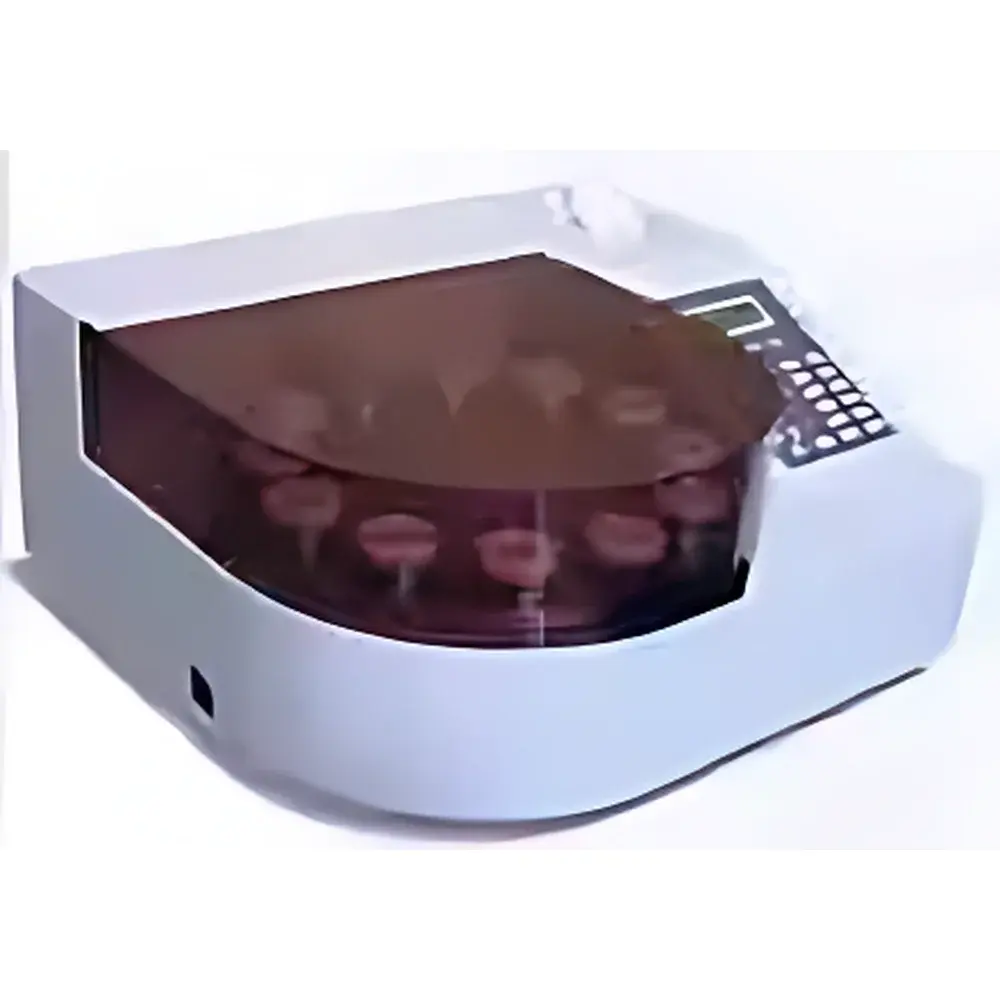
CHINYEE RX-620 X-ray Fluorescence Sulfur Analyzer
| Brand | CHINYEE |
|---|---|
| Origin | Japan |
| Model | RX-620 |
| Measurement Principle | Energy-Dispersive X-ray Fluorescence (ED-XRF) |
| Standards Compliance | ASTM D4294, ISO 8754, JIS K2541, JIS B7995 |
| Sample Types | Kerosene, Naphtha, Diesel, Crude Oil, Heavy Fuel Oil |
| Measurement Range | 0.003–6.00 wt% S |
| Sample Volume | 3–5 mL |
| Detection Limit | 5–200 ppm |
| C/H Ratio Correction | 0.003 wt%/unit C/H ratio (at 1 wt% S) |
| Calibration | Auto 1-, 2-, or 3-point |
| Sample Changer | 12-position turret with acrylic dust cover |
| Detector System | Single reusable PTFE sample cup with polyester film window (sole consumable) |
| X-ray Leakage | ≤0.6 µSv/h at instrument surface |
| Safety | Interlocked mechanical shutter and door sensor |
| Display | 4-line × 20-character LCD |
| Printer | Integrated dot-matrix printer |
| Interface | RS-232C (1 port) |
| Power | DC 12 V (vehicle battery compatible) |
| Weight | 12 kg |
| Enclosure | Integrated console with display, keypad, and printer |
Overview
The CHINYEE RX-620 X-ray Fluorescence Sulfur Analyzer is a compact, benchtop energy-dispersive X-ray fluorescence (ED-XRF) instrument engineered for precise, non-destructive sulfur quantification in liquid hydrocarbon fuels. Designed specifically for coal-derived liquids, refinery streams, and petroleum products—including kerosene, naphtha, diesel, crude oil, and heavy fuel oil—the RX-620 operates on the fundamental principle of characteristic X-ray emission following primary X-ray excitation. When the sample is irradiated by a low-power X-ray tube, sulfur atoms emit fluorescent X-rays at a distinct energy peak (~2.3 keV), which are resolved and quantified by a high-stability Si-PIN detector. The system’s optimized geometry, PTFE-based sample cell, and polyester film window ensure minimal spectral interference and consistent excitation efficiency across the full 0.003–6.00 wt% measurement range. Its integrated architecture—combining display, keypad, thermal printer, and electronics within a single enclosure—eliminates external cabling and simplifies deployment in field labs, QC rooms, or mobile testing units.
Key Features
- Integrated 12-position automated turret sample changer with acrylic dust cover, enabling unattended sequential analysis while permitting manual sample insertion/removal during operation
- Reusable PTFE sample cup with single-use polyester film window—minimizing consumable cost and eliminating solvent cleaning or cup degradation concerns
- Onboard auto-calibration routines supporting 1-, 2-, or 3-point standardization, plus programmable multi-point calibration (up to 12 points) for extended linearity validation
- DC 12 V power input compatible with vehicle batteries, facilitating on-site use at mine sites, rail terminals, or barge loading facilities without AC infrastructure
- Mechanical interlock system with dual-sensor door monitoring and fail-safe shutter control, ensuring compliance with IEC 61010-1 and national radiation safety regulations
- Real-time C/H ratio correction algorithm (0.003 wt% S per unit C/H ratio at 1 wt% S baseline), compensating for matrix-induced fluorescence attenuation in variable-composition samples
Sample Compatibility & Compliance
The RX-620 is validated for direct analysis of low-viscosity liquid hydrocarbons with minimal pretreatment. Samples require only homogenization and transfer into the PTFE cup beneath the polyester film—no digestion, dilution, or chemical reagents are needed. It meets the analytical performance criteria defined in ASTM D4294 (Standard Test Method for Sulfur in Petroleum and Petroleum Products by Energy-Dispersive X-ray Fluorescence Spectrometry), ISO 8754 (Petroleum Products — Determination of Sulfur Content — Energy-Dispersive X-ray Fluorescence Spectrometry), and JIS K2541 (Crude Oil and Petroleum Products — Determination of Sulfur Content). Instrument design adheres to IEC 62471 (Photobiological Safety) and conforms to Japanese Industrial Standard JIS B7995 for X-ray analytical equipment safety. Radiation exposure at the instrument surface remains ≤0.6 µSv/h under all operating conditions, verified per JIS Z 4301.
Software & Data Management
Firmware supports GLP-compliant data handling with timestamped measurement logs, operator ID entry (via keypad), and audit-trail-capable calibration history storage. All results—including raw counts, net peak area, background-subtracted intensity, and corrected concentration—are stored internally and exportable via RS-232C to LIMS or spreadsheet software. The built-in dot-matrix printer produces hard-copy reports containing sample ID, measurement date/time, calibration status, C/H correction factor applied, and final sulfur result with uncertainty estimate. No external PC or proprietary software is required for routine operation, though ASCII-formatted output enables integration with existing laboratory informatics systems.
Applications
- Coal liquefaction product quality control: rapid verification of sulfur removal efficiency post-hydrotreating
- Refinery blending optimization: real-time sulfur profiling of feedstocks and cut points to meet pipeline or marine fuel specifications (e.g., IMO 2020 <0.50 wt% S)
- Regulatory compliance testing at coal-to-liquids (CTL) facilities subject to EPA 40 CFR Part 60 or EU Directive 2009/30/EC
- Field-based screening of bunker fuels prior to vessel bunkering to prevent non-compliance penalties
- Research applications involving sulfur speciation modeling where total S content serves as boundary condition input
FAQ
Is the RX-620 suitable for solid coal samples?
No. The RX-620 is designed exclusively for liquid hydrocarbon matrices. Solid coal requires ashing, fusion, or pressed pellet preparation incompatible with its sample cup geometry and film-based detection window.
What is the minimum detectable sulfur level for diesel fuel?
Under typical measurement conditions (60 s counting time, 1 wt% S reference), the instrument achieves a practical detection limit of 5 ppm, consistent with ASTM D4294 precision requirements for mid-range concentrations.
Can calibration standards be prepared in-house?
Yes—certified reference materials traceable to NIST SRM 2724 or equivalent are recommended, but laboratories may prepare secondary standards using high-purity organosulfur compounds (e.g., dibenzothiophene in iso-octane) provided they are validated against primary standards and monitored for stability.
Does the system support 21 CFR Part 11 compliance?
The RX-620 firmware does not include electronic signature, role-based access control, or full audit trail functionality required for FDA-regulated environments. It is intended for industrial QA/QC—not pharmaceutical or clinical diagnostics use.
How often must the polyester film be replaced?
Film replacement is required per sample, or immediately after any visible puncture, clouding, or tension loss. Under normal operation with clean, filtered fuels, one roll (100 films) supports approximately 80–90 analyses.




