
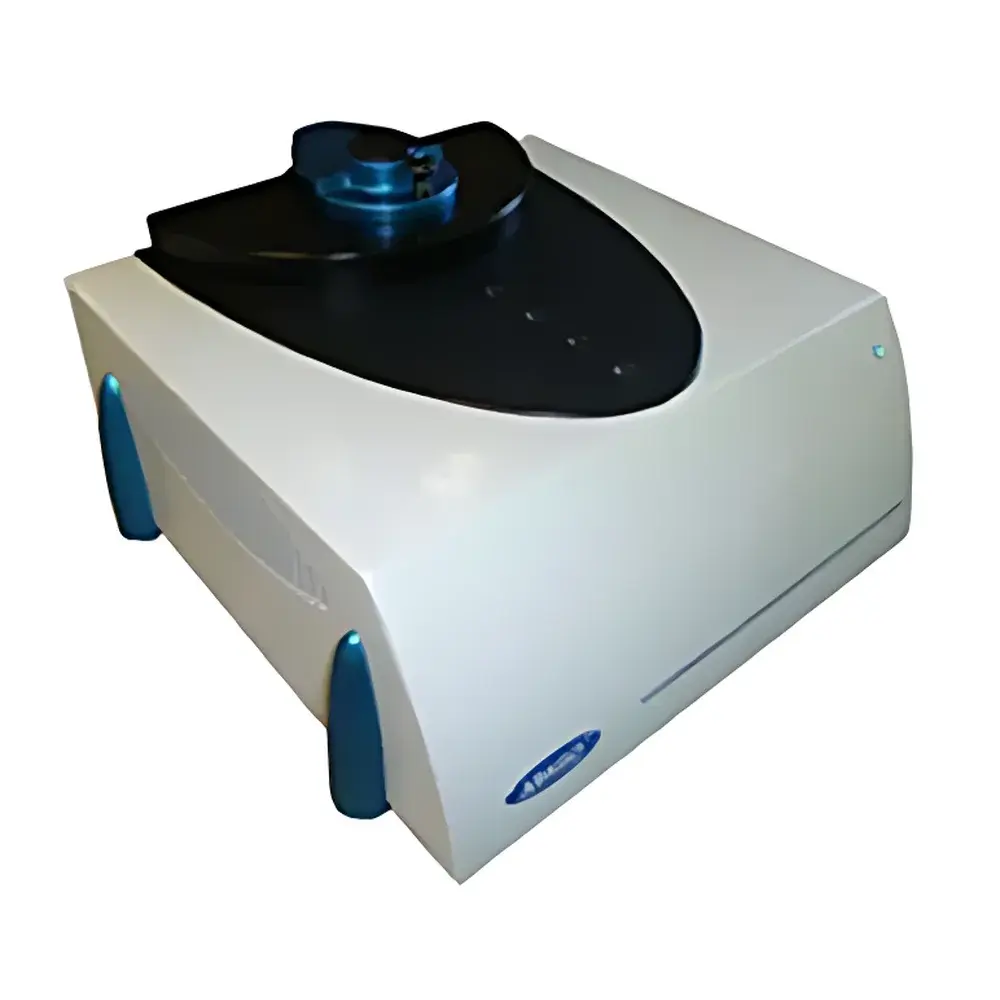
Cordouan-Arago ω Precision Digital Refractometer
| Origin | France |
|---|---|
| Manufacturer Type | Authorized Distributor |
| Origin Category | Imported Instrument |
| Model | Cordouan-Arago ω Refractometer |
| Quotation | Upon Request |
| Measurement Principle | Critical Angle Determination via Total Internal Reflection at Prism-Sample Interface |
| Measuring Range (nD) | 1.20–3.10 |
| Resolution (nD) | ±0.000001 |
| Accuracy (nD) | ±0.00001 |
| Temperature Control | Peltier-Regulated, 15–80 °C |
| Prism Material | Sapphire |
| Wavelength | 658 nm (Stabilized Laser Diode) |
| Sample Cell Options | 316 Stainless Steel or Inconel Alloy |
| Interface | USB 2.0 (Bidirectional PC Communication) |
| Power Supply | 100–240 V AC, 50/60 Hz, 10–50 W |
| Dimensions | 10 × 24 × 27 cm |
| Weight | 8 kg |
| Display & Control | Integrated Touchscreen or PC Software (English/French GUI) |
| Brix Range | 0–95 %, Brix Accuracy: ±0.002 %, Repeatability: ±0.01 % |
| Safety | Automatic Laser Shutoff, Integrated Sample Chamber Shield |
| Compliance | Designed for GLP/GMP environments |
Overview
The Cordouan-Arago ω Precision Digital Refractometer is a high-resolution, temperature-controlled critical-angle refractometer engineered for laboratory and industrial quality control applications requiring traceable, repeatable refractive index (nD) measurements across an exceptionally broad range—from 1.20 to 3.10 nD. Unlike conventional Abbe-type instruments, the Arago ω employs a stabilized 658 nm laser diode and sapphire prism assembly to achieve sub-microrefractive resolution (±0.000001 nD) and metrological-grade accuracy (±0.00001 nD). Its measurement principle relies on precise detection of the critical angle of total internal reflection at the sapphire–sample interface, processed using advanced Fresnel approximation algorithms that remain valid even at near-zero incidence angles—enabling reliable quantification of highly absorbing, turbid, or deeply colored samples without dilution or filtration. The integrated Peltier thermal module maintains sample temperature stability within ±0.1 °C across a 15–80 °C operating range, eliminating ambient drift and ensuring compliance with ISO 21748, ASTM D1218, and USP refractometry guidelines.
Key Features
- Ultra-wide refractive index range (1.20–3.10 nD), accommodating low-index hydrocarbons and high-index polymers, molten salts, and concentrated ionic liquids
- Sapphire prism with exceptional chemical inertness, scratch resistance, and thermal stability—ideal for aggressive solvents and high-temperature process streams
- Automated laser safety interlock system compliant with IEC 60825-1 Class 1 requirements; laser deactivates instantly upon chamber opening
- Modular sample cell design available in electropolished 316 stainless steel or Inconel 625 for corrosion-resistant handling of halogenated, acidic, or high-salinity media
- Integrated thermal shield and insulated sample chamber minimize evaporation and thermal gradient artifacts—critical for volatile solvents (e.g., acetone, ethanol, MTBE)
- Touchscreen HMI with multi-language support (English/French) and optional full remote operation via USB-connected PC with deterministic latency
- Zero-crossing optical alignment algorithm ensures long-term calibration stability without mechanical recalibration
- Low-power architecture (10–50 W dynamic draw) optimized for continuous 24/7 operation in QC laboratories and inline pilot systems
Sample Compatibility & Compliance
The Arago ω refractometer accepts liquid, semi-liquid, and viscous samples—including dark petroleum fractions (e.g., vacuum gas oil, bitumen cutbacks), oxidized edible oils, pharmaceutical syrups, honey blends, and polymer solutions—without signal attenuation or measurement bias. Its sapphire–sample interface tolerates suspended particulates up to 50 µm and optical densities exceeding OD658nm = 4.0. All firmware and data handling routines are structured to support Good Laboratory Practice (GLP) and Good Manufacturing Practice (GMP) workflows: user access levels, electronic signatures, full audit trails, and time-stamped raw-data export (CSV, XML) meet FDA 21 CFR Part 11 requirements when deployed with validated software configurations. Instrument qualification documentation (IQ/OQ/PQ templates) and traceable NIST-calibrated reference standards (certified sucrose and bromonaphthalene solutions) are provided with each unit.
Software & Data Management
The bundled AragoControl™ software (v4.2+) provides real-time visualization of refractive index, temperature, Brix, and derived concentration values (e.g., % w/w glycerol, % v/v ethanol). It supports automated method sequencing, statistical process control (SPC) charting (X̄–R, Cpk), and batch-level reporting compliant with ISO/IEC 17025. Raw photodiode voltage traces, temperature logs, and critical-angle fit residuals are stored with metadata (operator ID, timestamp, instrument serial, environmental conditions). Export formats include CSV (for LIMS integration), PDF reports with digital signatures, and encrypted SQLite databases for secure archival. Optional API access enables integration with MES (Manufacturing Execution Systems) and SCADA platforms via RESTful endpoints.
Applications
- Petroleum refining: Real-time nD verification of naphtha cuts, reformate blending, and aromatic purity (benzene/toluene/xylene) per ASTM D1218 and IP 170
- Edible oil authentication: Detection of adulteration in olive, sesame, and palm oils through deviation from species-specific nD–temperature curves
- Pharmaceutical excipients: Concentration monitoring of propylene glycol, glycerin, and polysorbate solutions during formulation
- Fruit juice & beverage QC: Soluble solids (°Brix) determination per AOAC 932.12, with automatic temperature compensation to 20 °C or 25 °C
- Honey grading: Compliance testing against Codex Alimentarius Standard 12-1981 (moisture content estimation via nD correlation)
- Chemical synthesis: Reaction endpoint detection in esterification, polymerization, and halogenation processes where nD shifts correlate with conversion
FAQ
What calibration standards are recommended for routine verification?
NIST-traceable sucrose solutions (10–60 % w/w) and certified bromonaphthalene (nD = 1.6583 @ 20 °C) are supplied with initial validation. Daily verification may use aqueous KCl standards (nD = 1.3330 @ 20 °C).
Can the instrument measure samples below 15 °C?
No—the Peltier stage is rated for 15–80 °C. Sub-ambient measurements require external chiller integration via optional thermoelectric expansion port.
Is cleaning the sapphire prism compatible with organic solvents?
Yes—sapphire is inert to acetone, chloroform, THF, and concentrated HNO3. Use lint-free wipes and avoid abrasive pastes.
Does the software support multi-user permission tiers?
Yes—administrator, analyst, and viewer roles with configurable edit rights, signature requirements, and session timeout policies.
How is measurement repeatability verified during PQ?
Per ISO 5725-2:2019, 10 consecutive readings on homogeneous sucrose standard yield RSD ≤ 0.002 % for nD and ≤ 0.005 % for °Brix under controlled lab conditions.




