
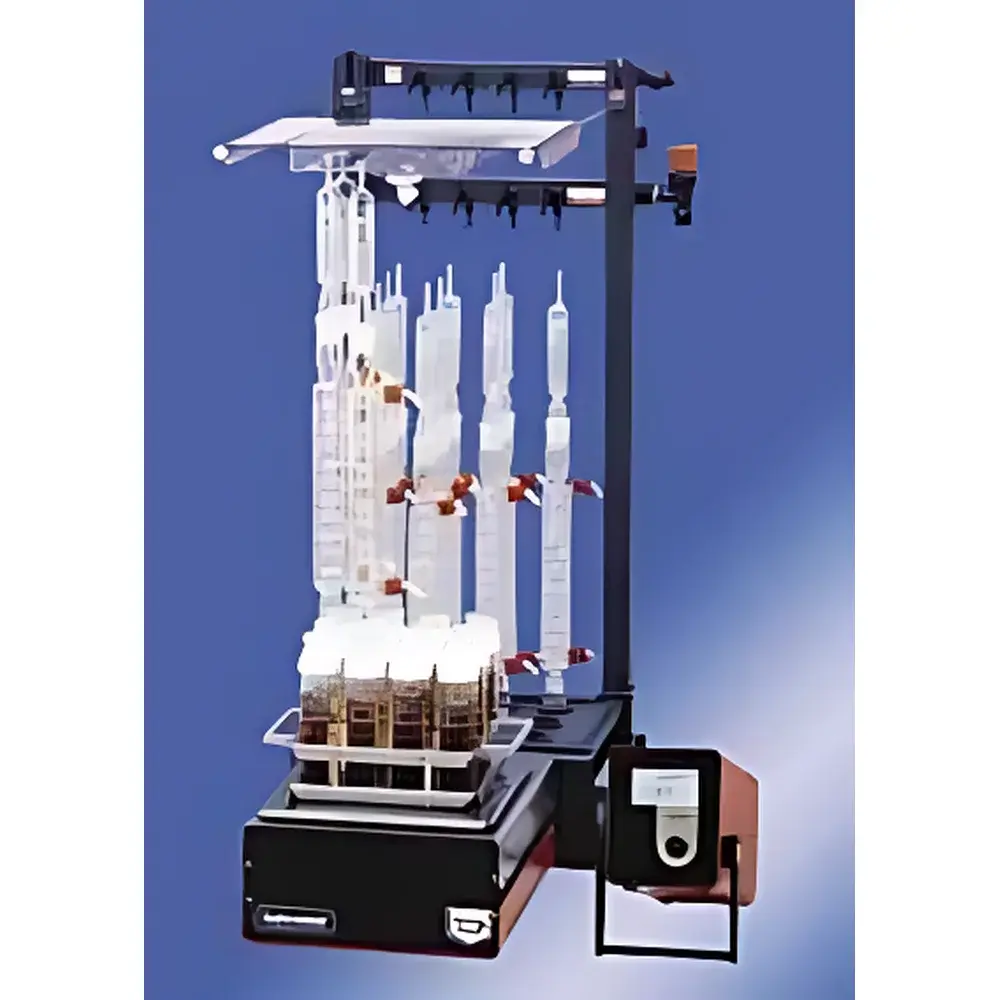
Behr SMA-ARM Heavy Metal Digestion System
| Origin | Germany |
|---|---|
| Manufacturer Type | Authorized Distributor |
| Origin Category | Imported |
| Model | Behr SMA-ARM |
| Instrument Type | Electric Heating Digestion System |
| Voltage | 230 V~ |
| Part Numbers | 80 48 80011 (6-position), 80 48 80012 (12-position) |
| Weight | ~35 kg (6-pos), ~44 kg (12-pos) |
| Dimensions (W × D × H) | ~45 × 65 × 100 cm |
| Temperature Range | 20–399 °C |
| Time Setting | 1–999 min |
| Programmable Steps | Up to 10 temperature/time ramps |
| Controller | TRS300 external microprocessor unit (replaces ET2) |
| Sample Capacity | 6 or 12 positions |
| Accessories | PTFE-sealed glassware support frame (SG/B), transport & prep rack (TS) with integrated coolant distributor and condenser support, nitrogenous fume hood (AH) for 6/12 samples |
Overview
The Behr SMA-ARM Heavy Metal Digestion System is a precision-engineered electric heating digestion workstation designed for trace-level heavy metal analysis in environmental, food, pharmaceutical, and regulatory testing laboratories. Built upon the established Behrotest SMA platform, the SMA-ARM integrates advanced thermal control architecture with comprehensive fume management to support rigorous, reproducible sample preparation—particularly for aqua regia and other aggressive acid digestions targeting elements such as Pb, Cd, Cr, As, Hg, and Ni. Its operation is grounded in controlled conductive heating of reaction vessels within a thermally stable stainless-steel frame, enabling precise ramp-and-hold thermal profiles essential for complete matrix decomposition while minimizing analyte volatility loss or cross-contamination. The system complies with core methodological requirements outlined in EPA Method 3050B, ISO 11466, and ASTM D396, serving as a critical front-end component in ICP-MS, ICP-OES, and AAS workflows where digestion completeness directly impacts measurement accuracy and detection limit reliability.
Key Features
- TRS300 external microprocessor controller with intuitive interface, replacing legacy ET2 units and supporting full audit-trail-capable operation under GLP/GMP conditions;
- Programmable multi-step digestion protocols—up to 10 independent temperature/time ramps per run—for method optimization across diverse sample matrices (soils, sediments, biological tissues, sludges);
- Precise temperature control from 20 °C to 399 °C with real-time on-screen comparison of setpoint vs. actual vessel temperature and elapsed time;
- Dual configuration options: 6-position (SMA-ARM 6, Art.-No. 80 48 80011) and 12-position (SMA-ARM 12, Art.-No. 80 48 80012) platforms, both featuring identical thermal uniformity and control fidelity;
- Integrated AH fume hood assembly engineered for quantitative capture and safe exhaust of nitrogen oxides and other acidic vapors generated during aqua regia digestion;
- Stainless-steel SG/B insertion frame with PTFE gasketing ensures leak-tight sealing for borosilicate or quartz digestion tubes; TS transport rack includes built-in coolant distribution manifold and condenser support posts for post-digestion cooling stability;
- Robust mechanical construction (35–44 kg mass) and compact footprint (~45 × 65 × 100 cm) enable reliable benchtop deployment in ISO Class 5–7 laboratory environments.
Sample Compatibility & Compliance
The SMA-ARM accommodates standard 50 mL and 100 mL digestion tubes—including those compliant with DIN EN ISO 17294-2—and supports both open-vessel reflux and semi-closed configurations. Its design facilitates seamless integration with downstream instrumentation requiring certified digestate clarity and particulate-free solutions. The system meets mechanical and electrical safety standards per IEC 61010-1 and carries CE marking for use in EU-based accredited laboratories. When operated with validated SOPs, it supports compliance with FDA 21 CFR Part 11 data integrity expectations via TRS300’s timestamped parameter logging and non-modifiable run records. Routine performance verification aligns with ISO/IEC 17025 clause 5.5.2 for equipment calibration and suitability assessment.
Software & Data Management
The TRS300 controller provides local parameter storage (≥100 methods), password-protected user levels (operator, supervisor, administrator), and RS232/USB output for export of time-stamped temperature/time logs in CSV format. No proprietary software installation is required: raw data files are compatible with LIMS import modules and statistical process control (SPC) tools. Audit trails include operator ID, method name, start/stop timestamps, deviation alerts (e.g., >±2 °C from setpoint), and power interruption events—fully traceable for internal audits or regulatory inspections. Optional firmware updates maintain alignment with evolving CLIA and ILAC-G8 documentation requirements.
Applications
- Regulatory compliance testing: heavy metal screening in drinking water, wastewater, and industrial effluents per EPA 200.8 and ISO 17294;
- Food safety analysis: Cd and Pb quantification in cereals, seafood, and infant formula following EU Commission Regulation (EU) No 1881/2006;
- Geochemical characterization: total recoverable metals in soils and sediments using aqua regia extraction (ISO 11466);
- Pharmaceutical excipient testing: residual catalyst metals (e.g., Pd, Pt) in active pharmaceutical ingredients (APIs) per USP and ;
- Research-grade method development: optimization of digestion kinetics, oxidant selection, and hold-time validation for novel matrices.
FAQ
What distinguishes the SMA-ARM from the SMA-ARB model?
The SMA-ARM replaces the ET2 controller with the TRS300 microprocessor unit, adds real-time setpoint/actual temperature and time display, enables up to 10 programmable ramps, and integrates the AH fume hood as standard.
Is the system compatible with quartz digestion vessels?
Yes—when used with the SG/B stainless-steel frame and appropriate PTFE gaskets, quartz tubes up to 100 mL are fully supported under controlled ramp conditions up to 399 °C.
Does the TRS300 controller support electronic signature functionality?
While the TRS300 does not implement biometric or digital certificate signing, its role-based access control, immutable run logs, and timestamped parameter recording satisfy foundational 21 CFR Part 11 requirements for attributed electronic records.
Can the cooling system be connected to facility chilled water?
The TS transport rack’s coolant distributor accepts standard 6–8 mm OD tubing and is rated for continuous flow at 0.5–2.0 bar; connection to centralized lab chillers requires optional pressure-regulating adapters.
What maintenance intervals are recommended for long-term operational reliability?
Biannual verification of thermal uniformity (per ASTM E220), annual calibration of the PT100 sensor array, and quarterly inspection of PTFE gasket integrity and fume duct seals constitute the manufacturer-recommended preventive maintenance schedule.



