
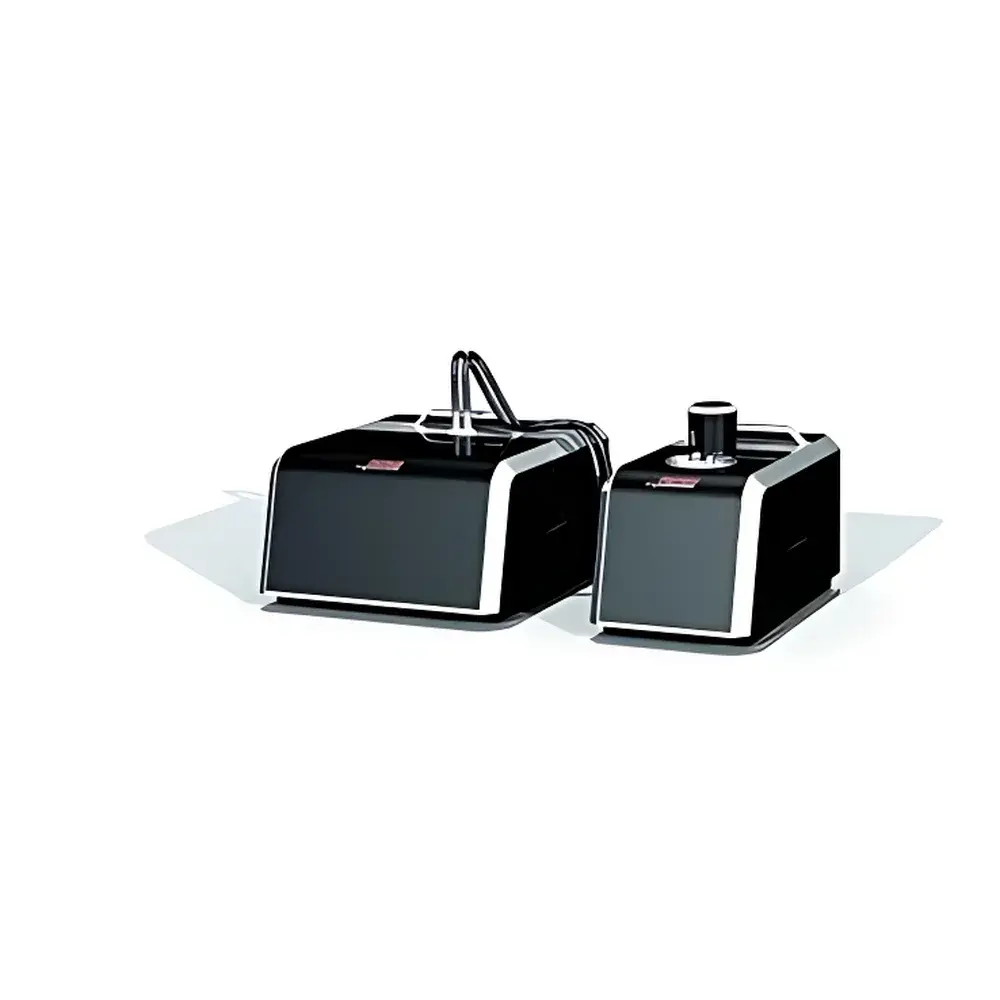
FRITSCH ANALYSETTE 22 Micro Tec² Laser Particle Size Analyzer
| Origin | Germany |
|---|---|
| Manufacturer Type | Authorized Distributor |
| Import Status | Imported |
| Model | Micro Tec² |
| Pricing | Available Upon Request |
Overview
The FRITSCH ANALYSETTE 22 Micro Tec² is a high-precision laser diffraction particle size analyzer engineered for reliable, reproducible measurement of particle size distribution (PSD) in liquid suspensions, emulsions, and dry powders. Based on ISO 13320-compliant laser diffraction principles, the instrument employs dual-wavelength laser illumination (532 nm green, 940 nm infrared) and an inverted Fourier optical design to maximize detection sensitivity—particularly for submicron particles down to 0.08 µm. Its compact, space-optimized architecture integrates patented optical path folding via precision refractive optics, reducing footprint without compromising optical integrity. Designed for routine QC, R&D, and process development labs, the Micro Tec² delivers rapid, standardized measurements with full traceability and compliance-ready documentation.
Key Features
- Inverted Fourier optical configuration with motorized, auto-positioning sample cell—ensures complete scattering angle coverage and enhanced resolution for fine particles.
- Dual-laser system: Class 1 safety-certified (EN 60825-1 / IEC 60285) lasers at 532 nm (7 mW) and 940 nm (9 mW) for optimized signal-to-noise ratio across broad PSD ranges.
- 57-channel bidirectional detector array: vertically and horizontally polarized photodiode segments enable robust Mie and Fraunhofer modeling with adaptive optical parameter selection.
- Automatic laser beam alignment and real-time background correction—minimizes operator dependency and ensures measurement stability across environmental fluctuations.
- Modular dispersion unit architecture: supports optional wet dispersion (ultrasonic, peristaltic pump, stirrer) and dry dispersion (gravity-fed or pressurized) modules—each independently configurable via SOP-driven workflows.
- Integrated self-cleaning cycle with programmable rinse protocols; compatible with deionized water, tap water, or organic solvents—no ultra-pure water requirement.
Sample Compatibility & Compliance
The Micro Tec² accommodates diverse sample matrices including aqueous suspensions, non-aqueous colloids, polymer emulsions, ceramic slurries, pharmaceutical suspensions, and free-flowing dry powders. Its wet dispersion module meets ISO 13320 requirements for dispersion energy control, while the dry dispersion option complies with ISO 9276-2 for aerodynamic sizing and achieves ISO 14644-1 Class H cleanroom compatibility (equivalent to ISO Class 5). All measurement sequences support GLP/GMP-aligned audit trails, electronic signatures, and 21 CFR Part 11–ready software validation packages upon request. Calibration verification follows NIST-traceable reference standards (e.g., NIST SRM 1963, 2800 series).
Software & Data Management
Operating on FRITSCH’s proprietary WinFritsch software (Windows-based), the system provides intuitive SOP-driven operation with fully customizable report templates—including graphical PSD overlays, cumulative distributions, D10/D50/D90 statistics, span, and relative standard deviation. Each SOP encapsulates instrument parameters, dispersion settings, optical models, and post-processing filters—enabling method transfer between instruments and laboratories. Raw scattering data is stored in vendor-neutral ASCII format; database export supports CSV, Excel, and XML for LIMS integration. Software modules include automatic outlier rejection, multi-sample batch processing, trend analysis, and comparative statistical testing (t-test, ANOVA) for QC release decisions.
Applications
The Micro Tec² serves critical roles across regulated and industrial sectors: formulation optimization of nanosuspensions in biopharmaceuticals; quality control of pigment dispersions in coatings and inks; PSD monitoring during crystallization and milling in fine chemical synthesis; characterization of catalyst supports and battery electrode slurries; and raw material acceptance testing for ceramics, food powders, and additive manufacturing feedstocks. Its dual-laser capability enables accurate sizing of polydisperse systems containing both nano- and micron-scale components—such as liposomal drug carriers or hybrid composite fillers—without sample fractionation.
FAQ
What is the minimum detectable particle size for wet dispersion mode?
The lower detection limit is 0.08 µm under optimized ultrasonic dispersion and refractive index matching conditions.
Does the instrument support automated cleaning between measurements?
Yes—integrated programmable rinse cycles using user-defined solvents ensure cross-contamination prevention and system readiness for next-run analysis.
Can SOPs be exported and shared across multiple Micro Tec² units?
Absolutely—SOP files are portable binary configurations with embedded calibration metadata, enabling consistent method deployment across distributed lab networks.
Is the software compliant with FDA 21 CFR Part 11 requirements?
WinFritsch offers optional 21 CFR Part 11 validation packages, including electronic signature enforcement, audit trail logging, and role-based access control—fully documented for regulatory submission.
What maintenance intervals are recommended for long-term operational reliability?
Annual optical alignment verification and quarterly detector gain calibration are advised; all service procedures are supported by FRITSCH-certified field engineers with full traceable calibration records.



