
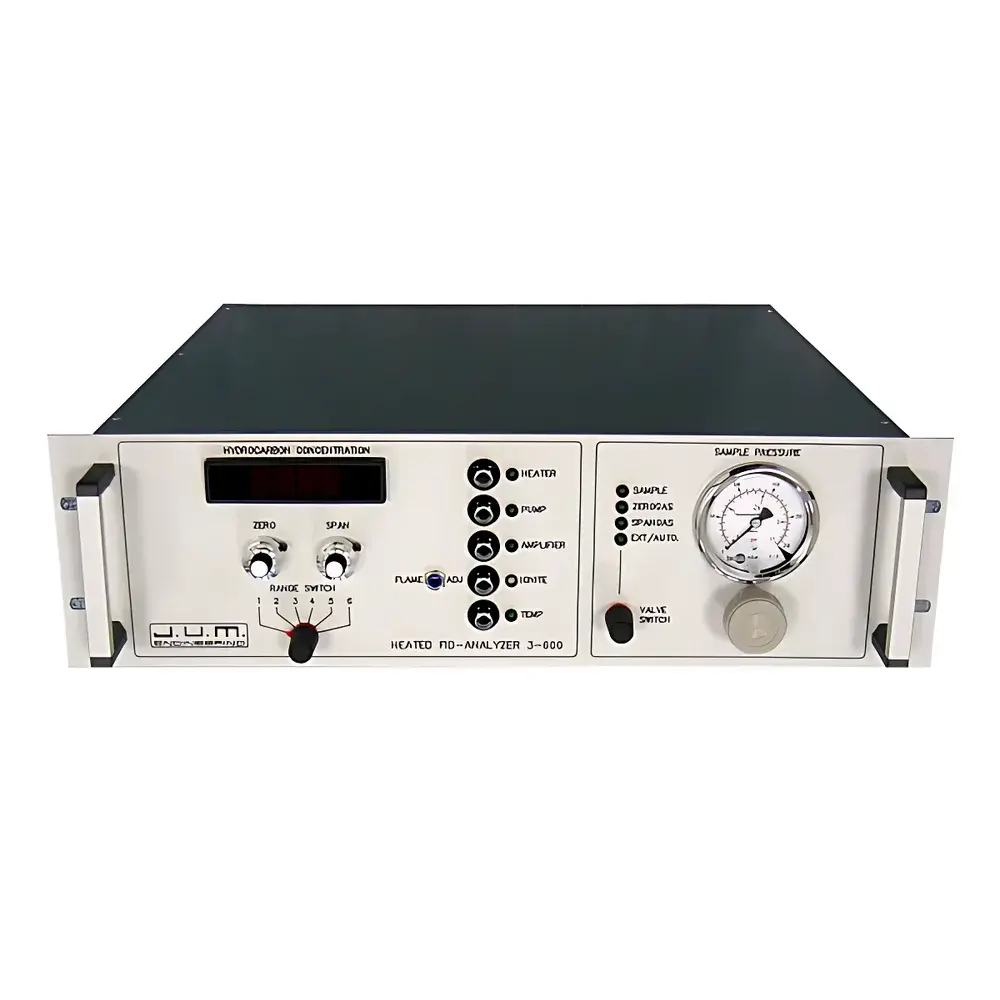
J.U.M. 3-600 Automotive VOC Emission Test Chamber
| Brand | J.U.M. |
|---|---|
| Origin | Germany |
| Instrument Type | Online Analyzer |
| Detection Principle | Flame Ionization Detection (FID) |
| Detection Range | 0–1000 ppm |
| Resolution | 0.1 ppm |
| Accuracy | ±5% of reading |
| Response Time | <60 s |
| Typical Configuration | Total VOC (TVOC) Monitoring System |
| Heating Chamber Temperature | 190 °C |
| Detector Sensitivity | ≤1 ppm (CH₄ full scale) |
| Combustion Air Supply | Integrated, self-contained |
Overview
The J.U.M. 3-600 Automotive VOC Emission Test Chamber is a certified online analytical system engineered for precise, real-time quantification of total volatile organic compounds (TVOC) and non-methane hydrocarbons (NMHC) in exhaust gas streams from automotive components, powertrain systems, and emission control devices. Built upon flame ionization detection (FID) technology—a reference method recognized for its linear response across hydrocarbon species—the system delivers high reproducibility and low detection limits without cross-sensitivity to water vapor or CO₂. Unlike extractive sampling setups requiring complex conditioning, the 3-600 integrates a heated sample path (190 °C) and catalytic methanizer (optional), ensuring complete oxidation of non-methane organics while preserving methane integrity for NMHC calculation per EN 12619 and EPA Method 25A protocols.
Key Features
- Robust FID detector with CH₄-equivalent sensitivity ≤1 ppm at full scale, optimized for dynamic range extension up to 100,000 ppm via auto-ranging
- Heated sample transport line and reaction chamber maintained at 190 °C to prevent condensation and adsorption losses of semi-volatile VOCs (e.g., C₈–C₁₂ aromatics, aldehydes)
- Integrated zero-air generator and combustion air supply—eliminating external compressed air dependencies and reducing calibration drift
- Modular architecture supporting dual-channel operation: simultaneous NMHC + CH₄ measurement or parallel TVOC + CO monitoring when interfaced with NDIR modules
- IP65-rated enclosure with explosion-proof optional configuration (ATEX Category 2G, IIB T4), compliant with industrial installation requirements in engine test cells and paint shop exhaust ducts
- Self-diagnostic firmware with continuous signal-to-noise ratio monitoring, flame status logging, and automatic baseline correction
Sample Compatibility & Compliance
The 3-600 is validated for use with hot, humid, and particulate-laden gas matrices typical of vehicle cold-start emissions, catalyst light-off testing, evaporative canister purging, and aftertreatment durability cycles. It meets regulatory equivalence under multiple international frameworks: German BImSchV Ordinances (13th and 17th) for stationary source monitoring; EN 12619 (determination of gaseous organic compounds in waste gases) and EN 13526 (performance criteria for FID-based analyzers); and U.S. EPA Methods 25A (total gaseous organic concentration) and 503 (calibration and verification of FID systems). Its data output structure supports audit-ready traceability per ISO/IEC 17025 and GLP-compliant laboratory environments.
Software & Data Management
The embedded controller runs J.U.M.’s proprietary VISION-FID software suite, providing configurable measurement cycles (1–60 s integration), real-time chromatogram-free peak integration, and automated span/zero validation sequences. Raw analog outputs (4–20 mA, 0–10 V) and digital interfaces (RS-485 Modbus RTU, optional Ethernet/IP) enable seamless integration into SCADA, DCS, or test-bench automation platforms (e.g., ETAS INCA, AVL PUMA). All calibration events, alarm logs, and sensor diagnostics are timestamped and stored locally for ≥30 days; exportable via USB or FTP in CSV/Excel format. The system supports 21 CFR Part 11-compliant user access control (role-based permissions), electronic signatures, and immutable audit trails when deployed in regulated R&D or certification labs.
Applications
- Real-time NMHC/TVOC monitoring during WLTC/RDE driving cycle simulations on chassis dynamometers
- In-line emission verification of evaporative systems (EVAP canisters, fuel caps, tank seals) per SAE J1711 and ISO 16000-6
- Catalyst aging studies tracking hydrocarbon slip across temperature ramps (200–600 °C)
- Exhaust gas recirculation (EGR) loop analysis for unburned fuel carryover under transient load conditions
- Validation of activated carbon filter efficiency in cabin air systems (ISO 12219-3)
- Process gas purity assurance in semiconductor tool purge lines (ASTM D7924 Class 1 hydrocarbon specification)
- LEL (lower explosive limit) safety monitoring during solvent recovery and paint booth exhaust treatment
FAQ
Does the 3-600 require external zero/span gas cylinders?
No—it features an integrated zero-air generator and programmable span injection valve compatible with certified standard gas mixtures (NIST-traceable, 1–1000 ppm CH₄ in air).
Can it measure individual VOC species like benzene or formaldehyde?
Not natively; it reports total ion current as CH₄-equivalent concentration. For speciated analysis, coupling with GC-FID or GC-MS is recommended.
Is the system suitable for unheated ambient air monitoring?
Yes, but with optional cooled inlet and moisture trap; the standard heated configuration is optimized for exhaust applications above 80 °C.
What maintenance intervals are recommended for routine operation?
FID jet cleaning every 500 operational hours; ceramic igniter replacement every 12 months; annual full calibration verification per ISO 17025 clause 6.5.
Related Products







