
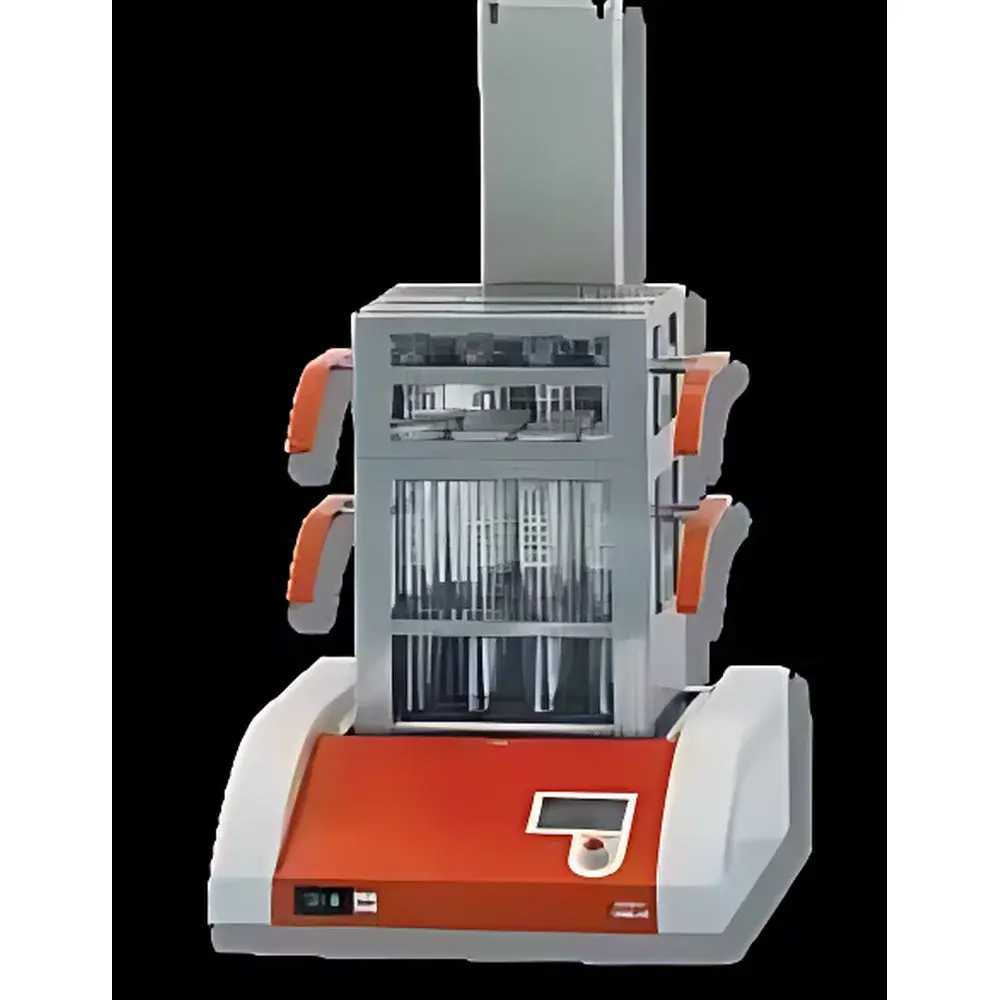
Behr K8/K12/K20 Standard Kjeldahl Digestion System
| Origin | Germany |
|---|---|
| Manufacturer Type | Authorized Distributor |
| Origin Category | Imported |
| Model | Behr K8 / K12 / K20 Standard Kjeldahl Digestion System |
| Price Range | USD 13,500 – 27,000 |
| Instrument Type | Kjeldahl Nitrogen Digestion System |
| Digestion Time Range | 1–99 minutes |
| Repeatability | ±0.5% RSD |
| Nitrogen Recovery Rate | >99.5% |
| Power Consumption | 750–1500 W |
Overview
The Behr K8/K12/K20 Standard Kjeldahl Digestion System is a precision-engineered, benchtop digestion platform designed for reliable and reproducible sample mineralization in classical Kjeldahl nitrogen analysis. Based on the well-established sulfuric acid digestion principle—where organic nitrogen is quantitatively converted to ammonium sulfate under catalytic heating—the system delivers consistent thermal performance across its modular configurations (8-, 12-, or 20-position). Each unit integrates a high-efficiency heating block constructed from premium-grade, acid-resistant stainless steel (AISI 316L), engineered to withstand prolonged exposure to concentrated H₂SO₄, K₂SO₄, and catalysts such as CuSO₄ or Se powder. The digestion process operates within a precisely controlled temperature range up to 450 °C, ensuring complete decomposition of complex matrices—including cereals, dairy products, meat, feedstuffs, and environmental sludges—without loss of volatile nitrogen species. Designed for integration into regulated laboratory workflows, the system complies with core methodological requirements of AOAC Official Method 984.13, ISO 5983-1:2009, and DIN EN ISO 14891, forming the first critical stage of total nitrogen determination prior to distillation and titration.
Key Features
- Modular sample capacity: Selectable configurations—K8 (8 positions), K12 (12 positions), or K20 (20 positions)—each accommodating standard 250 mL Kjeldahl digestion tubes; optional K8-B variant supports 500 mL tubes for high-volume or heterogeneous samples.
- Corrosion-resistant heating block: Machined from electropolished AISI 316L stainless steel with optimized thermal mass distribution for uniform heat transfer and long-term chemical stability.
- Programmable digestion control: Built-in microprocessor with 10 preconfigured temperature/time profiles; users may create, store, and recall up to 20 custom methods via intuitive membrane keypad interface.
- Integrated fume management: Equipped with a dedicated suction hood and connection port for external exhaust or recirculating scrubber systems (e.g., acid gas neutralization units), ensuring operator safety and lab compliance with OSHA 29 CFR 1910.1200 and local ventilation standards.
- Single-button operation with multilingual UI: Supports English, German, French, Spanish, and Chinese display languages; real-time status indicators for temperature, elapsed time, and active program phase.
- Energy-efficient power architecture: Variable wattage output (750–1500 W) dynamically matched to load size and setpoint, minimizing thermal inertia and reducing cycle time without compromising digestate homogeneity.
Sample Compatibility & Compliance
The Behr K8/K12/K20 system accommodates a broad spectrum of solid and semi-solid matrices compliant with standard Kjeldahl methodology. Validated applications include cereal grains (AOAC 991.20), milk powder (ISO 8968-1), animal feed (AOAC 981.10), wastewater solids (EPA 351.2), and botanical extracts. All models are CE-marked and conform to IEC 61010-1:2010 for electrical safety in laboratory equipment. When operated within validated SOPs—including use of certified reference materials (CRMs) and documented calibration of thermocouples—the system supports GLP and GMP environments. Full traceability is enabled through manual logbook entries; for 21 CFR Part 11 compliance, integration with LIMS or third-party electronic lab notebook (ELN) systems is recommended via RS232/USB data export.
Software & Data Management
While the K8/K12/K20 series operates via embedded firmware without proprietary PC software, it provides ASCII-formatted serial output (RS232) for timestamped logging of setpoints, actual temperatures, and cycle completion signals. This enables direct ingestion into laboratory information management systems (LIMS) or custom Python/Matlab scripts for automated reporting. Optional analog voltage output (0–10 V) allows real-time temperature monitoring by external chart recorders or PLC-based facility monitoring systems. Firmware updates are performed via USB flash drive using Behr’s secure, version-controlled update utility—fully auditable and compatible with change control documentation per ISO/IEC 17025:2017 Clause 7.7.
Applications
- Quality control laboratories in food & beverage manufacturing verifying protein content via nitrogen-to-protein conversion factors (e.g., 6.25 for dairy, 5.70 for wheat).
- Contract testing labs performing routine AOAC- or ISO-certified analyses for regulatory submissions (e.g., FDA Nutrition Facts labeling, EU Regulation (EC) No 152/2009).
- Agricultural research facilities assessing nitrogen use efficiency in fertilized crop trials.
- Environmental testing centers quantifying total Kjeldahl nitrogen (TKN) in municipal biosolids and industrial effluents per Standard Methods 4500-Norg B.
- Pharmaceutical excipient testing where residual nitrogen impurities must be verified against USP limits.
FAQ
What digestion tube sizes are supported?
Standard configuration uses 250 mL borosilicate glass Kjeldahl tubes (DIN 12150); the K8-B variant accepts 500 mL tubes for high-mass or low-density samples.
Is the system compatible with selenium-free catalysts?
Yes—optimized thermal profiles support both traditional Se-based and modern CuSO₄/K₂SO₄ catalyst systems without modification.
Can digestion parameters be exported for audit purposes?
Yes—via RS232 serial interface, all active method parameters and real-time temperature logs can be captured externally for QA documentation.
What maintenance is required for long-term accuracy?
Annual verification of block temperature uniformity (per ASTM E220) and thermocouple calibration using NIST-traceable reference sources is recommended.
Does Behr provide validation documentation?
Factory-issued IQ/OQ protocols and a Certificate of Conformance (CoC) are supplied; PQ support materials—including blank recovery studies and CRM-based precision testing templates—are available upon request.





