
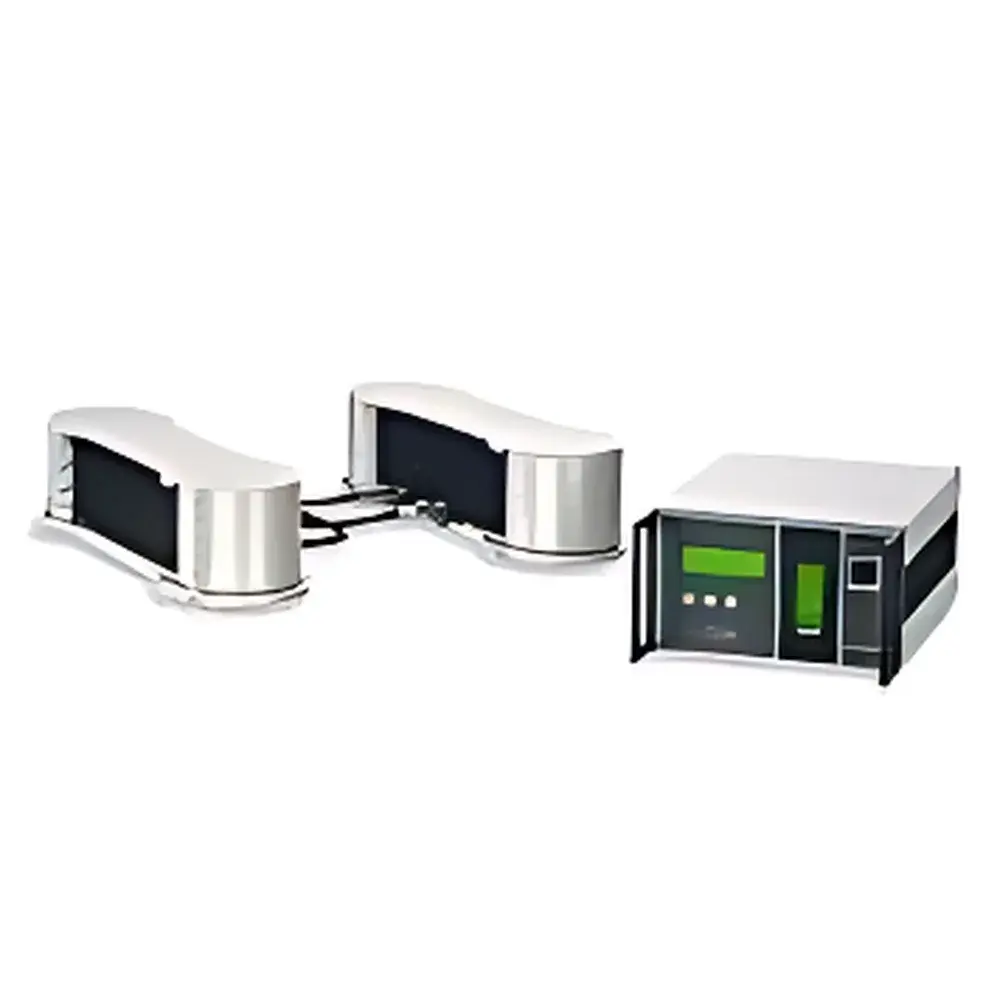
Halcyonics W.A.V.E. Vario Series Active Vibration Isolation Platform for Transmission Electron Microscopy (TEM)
| Brand | Halcyonics |
|---|---|
| Origin | Germany |
| Model | Vario Series |
| Application | TEM |
| Type | Active Vibration Isolation System |
| Compliance | Designed for Ultra-High-Resolution TEM Imaging |
| Certification | CE Marked, ISO 9001–Certified Manufacturing |
Overview
The Halcyonics W.A.V.E. Vario Series is a high-performance active vibration isolation platform engineered specifically for transmission electron microscopes (TEMs) operating at sub-angstrom resolution regimes. Unlike passive isolators—such as air tables or elastomeric mounts—the Vario Series employs real-time, multi-axis feedback control to sense and counteract ground-borne and facility-induced vibrations across a broad frequency spectrum (0.5–100 Hz), including low-frequency building sway, HVAC-induced resonances, and footfall disturbances. Its core architecture integrates inertial sensors, voice-coil actuators, and a deterministic digital control algorithm optimized for TEM stability requirements. This system is not a generic anti-vibration table; it is a purpose-built, metrology-grade platform that meets the stringent mechanical stability thresholds demanded by modern aberration-corrected TEMs—including those equipped with monochromators, energy filters, and direct electron detectors—where even nanometer-scale stage drift or specimen vibration degrades point resolution, contrast transfer function (CTF), and EELS/EDS spectral fidelity.
Key Features
- Real-time, six-degree-of-freedom (6-DOF) active vibration cancellation with sub-nanometer residual motion (<1 nm RMS below 10 Hz)
- Modular Vario Series architecture allows customization of payload capacity (up to 2,500 kg), footprint dimensions, and interface geometry to match OEM TEM base frames (e.g., Thermo Fisher Titan, JEOL ARM, Hitachi HF series)
- Integrated environmental monitoring: built-in temperature, humidity, and tilt sensors feed data into the control loop to compensate for thermal drift-induced instability
- Low-noise electromagnetic design: fully shielded actuators and differential sensor electronics minimize magnetic field leakage—critical for Lorentz microscopy and in-situ TEM applications
- Fail-safe mechanical backup: redundant pneumatic or spring-based passive support engages automatically during power loss or system fault, preserving TEM alignment and preventing mechanical shock
- Remote diagnostics and firmware-upgradable controller with Ethernet/IP and RS-485 interfaces for integration into lab-wide facility management systems
Sample Compatibility & Compliance
The Vario Series platform is compatible with all major commercial TEM systems requiring mechanical stability compliant with ASTM E2713-21 (Standard Practice for Evaluating Vibration Sensitivity of High-Resolution Electron Microscopes). It supports both room-temperature and cryo-TEM configurations, including Gatan Quantum ER, Ceta-D, and Falcon 4 detectors. The platform’s structural rigidity (modal frequency >120 Hz in all axes) prevents coupling with TEM column resonances. Halcyonics manufacturing adheres to ISO 9001:2015 quality management standards, and each unit undergoes factory validation per ISO 20816-4 (Mechanical vibration — Evaluation of machine vibration) using calibrated laser Doppler vibrometry. Documentation packages include full traceable calibration reports, EMC test summaries (EN 61326-1), and CE Declaration of Conformity—supporting GLP/GMP audit readiness and FDA-regulated materials characterization workflows.
Software & Data Management
The Vario Control Suite (v4.2+) provides intuitive, role-based access via web browser or dedicated Windows client. Operators can monitor real-time vibration spectra (FFT), adjust damping profiles per axis, and log performance metrics (e.g., RMS displacement, peak acceleration) in CSV or HDF5 format. Audit-trail functionality complies with FDA 21 CFR Part 11 requirements: all parameter changes are timestamped, user-authenticated, and non-erasable. For multi-instrument labs, the platform supports OPC UA integration, enabling centralized vibration health monitoring alongside other critical infrastructure (e.g., cooling water flow, vacuum status). Optional API access allows custom scripting for automated stability verification prior to high-resolution acquisition sequences or in-situ experiments.
Applications
- Atomic-resolution imaging of 2D materials (graphene, TMDs), catalyst nanoparticles, and battery electrode interfaces
- Time-resolved in-situ TEM studies under heating, biasing, or gas/liquid environments where mechanical drift compromises temporal fidelity
- Single-particle cryo-EM grid screening and high-magnification mapping requiring extended dwell times without image blur
- Quantitative EELS mapping and spectrum imaging where vibrational noise broadens core-loss edges and reduces signal-to-noise ratio
- Industrial QA/QC in semiconductor foundries performing defect analysis on advanced logic nodes (≤3 nm) and high-aspect-ratio EUV mask inspection
FAQ
Does the Vario Series require external compressed air or hydraulic supply?
No—it operates exclusively on standard 100–240 VAC power and internal electrodynamic actuation. No external utilities are needed.
Can it be retrofitted to an existing TEM installation without structural modification?
Yes. The Vario Series includes adjustable leveling feet, customizable mounting interfaces, and optional seismic anchoring kits compatible with standard raised-floor or concrete slab foundations.
How is performance validated after installation?
Halcyonics provides on-site commissioning with laser interferometry and reference accelerometer measurements, generating a site-specific stability report aligned with ISO 10816-4 and TEM manufacturer recommendations.
Is remote support available for troubleshooting?
Yes—secure remote access is enabled via TLS-encrypted connection, allowing Halcyonics engineers to diagnose control loop behavior, update firmware, and optimize parameters without onsite visits.
What is the typical lead time for a configured Vario Series system?
Standard configurations ship within 12–16 weeks from order confirmation; lead times for fully customized platforms (e.g., dual-column or ultra-high-payload variants) are confirmed during technical review.




