
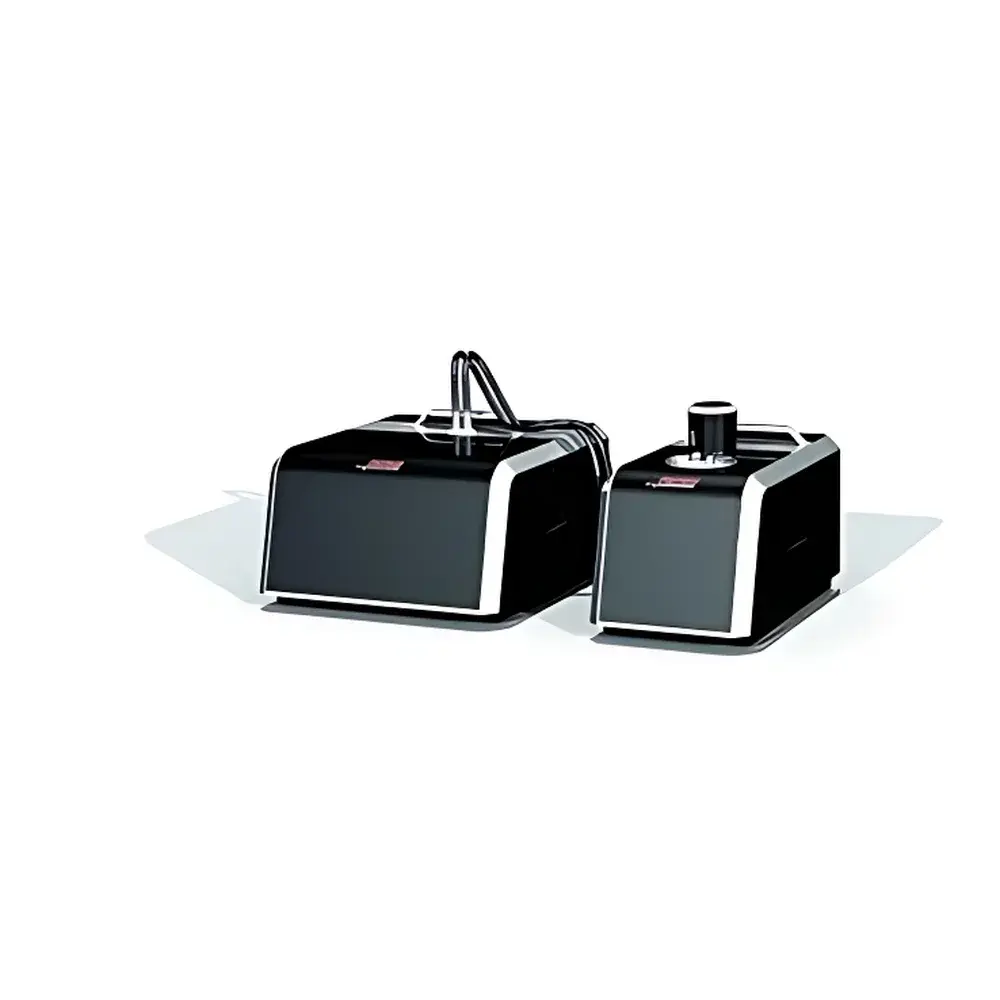
FRITSCH ANALYSETTE 22 Micro Tec² Laser Particle Size Analyzer
| Origin | Germany |
|---|---|
| Manufacturer Type | Authorized Distributor |
| Import Status | Imported |
| Model | Micro Tec² |
| Pricing | Upon Request |
Overview
The FRITSCH ANALYSETTE 22 Micro Tec² is a high-precision laser diffraction particle size analyzer engineered for reliable, reproducible measurement of particle size distribution (PSD) in dry powders, aqueous or organic suspensions, and emulsions. Based on the physical principle of Mie scattering theory—complemented by Fraunhofer approximation for coarse particles—the instrument delivers traceable, ISO 13320-compliant results across a broad dynamic range. Its optical architecture integrates two wavelength-stabilized lasers (532 nm green, 7 mW; 940 nm infrared, 9 mW), both certified to EN 60825-1 Class 1 laser safety standards. The patented inverse Fourier optical design ensures near-complete collection of forward-scattered light, significantly enhancing resolution for submicron particles (down to 0.08 µm) while maintaining robust performance up to 2000 µm. This configuration eliminates angular detection gaps common in conventional Fourier systems, yielding superior sensitivity in the critical 0.1–10 µm region where many pharmaceutical, catalyst, and pigment applications reside.
Key Features
- Inverse Fourier optical layout with motorized, auto-positioning sample cell—enabling full angular scattering capture and improved small-particle resolution
- Compact dual-laser system (532 nm + 940 nm) with automatic beam alignment and real-time power monitoring
- 57-channel dual-axis detector array: vertically and horizontally polarized photodiode segments optimized for anisotropic scattering discrimination
- Dedicated dry dispersion unit (optional) compliant with ISO 14644-1 Class H cleanroom requirements (≤100 particles/m³ ≥0.5 µm)
- Modular wet dispersion module with adjustable sonication, stirring speed, and flow rate—compatible with multiple solvent types and refractive index ranges
- Automated background acquisition and self-cleaning rinse cycle reduces carryover and operator dependency
- Class 1 laser safety certification (EN 60825-1) and CE marking per Machinery Directive 2006/42/EC and EMC Directive 2014/30/EU
Sample Compatibility & Compliance
The Micro Tec² supports diverse sample matrices without hardware modification: free-flowing dry powders (e.g., metal oxides, excipients), stable aqueous suspensions (e.g., silica nanoparticles, kaolin slurries), and oil-in-water emulsions (e.g., cosmetic actives, agrochemical formulations). Its dispersion units are designed to minimize particle breakage during handling—critical for fragile biopolymers or aggregated nanomaterials. All measurement protocols adhere to ISO 13320:2020 for laser diffraction methodology, including validation of optical model selection (Mie vs. Fraunhofer), refractive index input, and obscuration optimization. For regulated environments, the instrument supports audit-trail-enabled SOP execution, user-level access control, and electronic signature capability—facilitating compliance with FDA 21 CFR Part 11, EU Annex 11, and GLP/GMP documentation requirements.
Software & Data Management
Operating via FRITSCH’s proprietary WinFrit software (Windows 10/11 compatible), the Micro Tec² provides intuitive workflow navigation, customizable report templates (PDF, CSV, Excel), and embedded database management for long-term trend analysis. SOPs are structured as modular sequences—allowing independent activation/deactivation of sonication, pump speed, or dispersant dosing—without reconfiguring the entire method. Raw scattering patterns, Mie-calculated intensity distributions, and volume-based PSDs (D10, D50, D90, span) are stored with full metadata: timestamp, operator ID, environmental conditions (temperature, humidity), and calibration history. Data export supports LIMS integration via ODBC and conforms to ASTM E2918-22 for digital record integrity.
Applications
- Pharmaceutical development: API crystallinity assessment, inhaler formulation aerodynamic diameter verification, tablet excipient grading
- Materials science: Carbon black aggregate sizing, battery cathode powder classification, ceramic green-body homogeneity control
- Food & beverage: Starch granule distribution, milk protein micelle characterization, cocoa powder flowability correlation
- Environmental testing: Sediment grain-size analysis per ASTM D422, airborne particulate matter (PM₁₀/PM₂.₅) surrogate calibration
- Quality assurance labs: Batch-to-batch consistency checks, supplier qualification, stability-indicating methods for suspension concentrates
FAQ
Does the Micro Tec² require deionized water for wet measurements?
No—background correction algorithms compensate for minor impurities; tap water is acceptable for routine operation, though DI water is recommended for ultra-low-conductivity samples or regulatory submissions.
Can the same SOP be used interchangeably between dry and wet modules?
No—SOPs are hardware-contextual. Dry and wet dispersion units have distinct parameter sets (e.g., pressure, airflow vs. pump rate, sonication amplitude); separate SOPs must be created and validated for each configuration.
Is third-party software integration supported?
Yes—WinFrit provides COM/ActiveX interfaces and ASCII data export for integration with LabVantage, Thermo Fisher SampleManager, and custom Python/MATLAB analysis pipelines.
What maintenance is required for long-term accuracy?
Annual optical alignment verification and detector dark-current calibration are recommended; FRITSCH-certified service engineers perform traceable recalibration against NIST-traceable PSL standards (e.g., 100 nm, 1 µm, 10 µm).



