
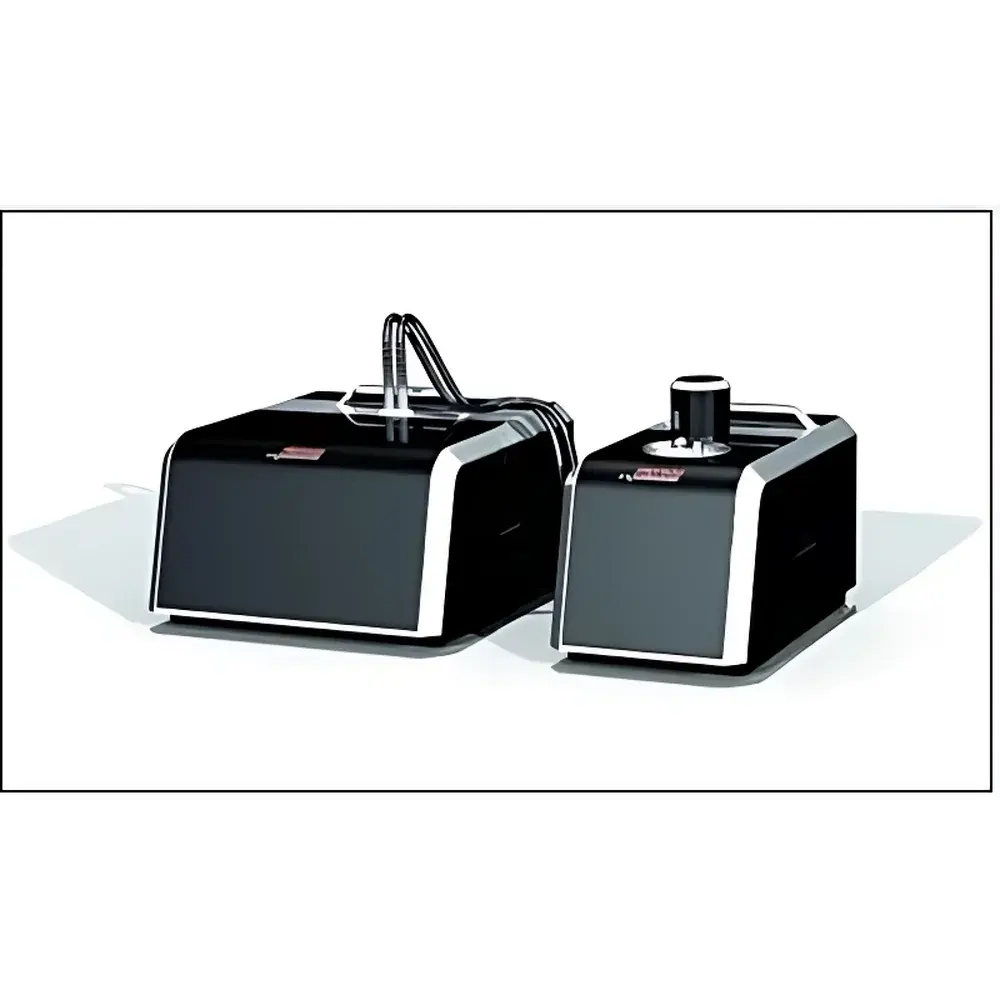
FRITSCH ANALYSETTE 22 Nano Tec Laser Particle Size Analyzer
| Brand | FRITSCH |
|---|---|
| Origin | Germany |
| Model | ANALYSETTE 22 Nano Tec |
| Measurement Range | 0.01–2000 µm |
| Laser Sources | Two green lasers (λ = 532 nm, 7 mW each) + one infrared laser (λ = 940 nm, 9 mW) |
| Laser Safety Class | EN 60825-1 compliant, Class 1 |
| Detector Channels | 520 (dual-polarization: vertical & horizontal), including forward and backscattering detection |
| Optical Design | Inverse Fourier configuration with motorized, wide-range sample cell positioning |
| Sample Handling | Modular dry- and wet-dispersion units (optional) |
| SOP Support | Fully configurable, modular Standard Operating Procedures per measurement step |
| Alignment | Automatic beam alignment system |
| Compliance | ISO 13320:2020 (Laser diffraction particle size analysis) |
| Software | FRITSCH ParticleSight™ with customizable reporting, audit trail, background subtraction, automated cleaning cycle, and user-defined dispersion protocols |
Overview
The FRITSCH ANALYSETTE 22 Nano Tec Laser Particle Size Analyzer is a high-precision, dual-mode (dry/wet) instrument engineered for rigorous particle size distribution (PSD) analysis across research, development, and quality control environments. Based on the physical principle of laser diffraction—governed by Mie and Fraunhofer scattering theory—the system delivers traceable, reproducible results in accordance with ISO 13320:2020. Its core innovation lies in an inverse Fourier optical architecture, which enables full angular detection of scattered light from sub-10 nm to 2 mm particles without mechanical reconfiguration. Unlike conventional designs, this arrangement eliminates blind angles by dynamically repositioning the sample cell across an extended linear range—ensuring all scattered intensities, including low-angle forward and high-angle backscattered signals, are captured by the primary detector array. The integration of three wavelength-stabilized lasers (two at 532 nm and one at 940 nm) enhances sensitivity to fine and ultrafine fractions, particularly below 100 nm, where backscattering contributions dominate. All lasers meet EN 60825-1 Class 1 safety requirements, permitting unrestricted operation in standard laboratory settings without interlocks or protective enclosures.
Key Features
- Inverse Fourier optical layout with motorized, wide-travel sample cell positioning—enabling continuous angular coverage from 0.01° to 179.9°
- Tri-wavelength laser system: dual 532 nm green lasers (7 mW each) for high signal-to-noise ratio in mid-to-fine ranges; dedicated 940 nm infrared laser optimized for enhanced backscatter detection of nanoparticles
- 520-channel dual-polarization detector array—comprising vertically and horizontally polarized photodiode segments—to resolve complex refractive index effects and improve accuracy for anisotropic or polydisperse samples
- Modular dispersion platform: field-upgradable dry dispersion unit (ISO 14644 Class H compatible) and independent wet dispersion module with integrated ultrasonic control, peristaltic pump, and adjustable stirrer speed
- Automated optical alignment routine—performed at startup and before each measurement—to maintain long-term optical fidelity and minimize operator dependency
- Background subtraction algorithm that accommodates tap water as dispersant in wet mode, reducing reliance on deionized water while preserving data integrity
- Self-cleaning cycle with programmable rinse sequence for both dry and wet pathways, minimizing carryover and ensuring measurement repeatability across batches
Sample Compatibility & Compliance
The ANALYSETTE 22 Nano Tec supports a broad spectrum of particulate materials—including metal powders, pharmaceutical actives, catalysts, ceramics, polymers, pigments, and emulsions—across solid, suspended, and colloidal states. Dry measurements adhere to ISO 13320 Annex B guidelines for pneumatic dispersion, with flow-controlled jet dispersion and optional cyclonic separation to mitigate agglomeration artifacts. Wet measurements follow ISO 13320 Annex A, incorporating programmable sonication duration, dispersant selection, and refractive index input for Mie-based inversion. Instrument firmware enforces compliance through built-in method validation checks, parameter locking per SOP, and electronic signature support for GLP/GMP workflows. Data files include embedded metadata (laser wavelengths, detector geometry, dispersion parameters, environmental conditions) required for regulatory submissions under FDA 21 CFR Part 11 and EU Annex 11.
Software & Data Management
ParticleSight™ software provides a validated, role-based interface with full audit trail functionality—including user logins, parameter changes, report generation events, and raw intensity file timestamps. SOPs are structured as hierarchical modules (e.g., “Dispersion”, “Measurement”, “Cleaning”), allowing granular editing without affecting unrelated steps. Reports are fully customizable via drag-and-drop layout editor and exportable in PDF, CSV, or XML formats—with optional inclusion of D10/D50/D90, span, relative standard deviation, and overlay comparisons. Raw scattering patterns and inversion matrices are stored alongside processed results, enabling retrospective reprocessing with updated optical models or refractive index values. Database management supports multi-user access control, project tagging, and versioned method libraries synchronized across networked instruments.
Applications
This analyzer is routinely deployed in advanced material science labs for nanoparticle synthesis optimization (e.g., TiO₂, SiO₂, liposomes), battery cathode powder characterization (Ni-rich NMC, LFP), inhalable drug aerosol assessment per USP , and additive manufacturing feedstock qualification (e.g., AlSi10Mg, Inconel 718). In QC environments, it verifies batch-to-batch consistency of excipients (lactose, microcrystalline cellulose), pigment dispersions for coatings, and ceramic slurries prior to tape casting. Its extended sub-100 nm capability makes it suitable for monitoring colloidal stability, aggregation kinetics, and surface modification efficacy—particularly when coupled with time-resolved measurement sequences.
FAQ
What is the smallest detectable particle size, and how is sub-100 nm resolution achieved?
The instrument achieves a lower limit of 0.01 µm (10 nm) using the 940 nm backscattering laser combined with high-sensitivity detection at large scattering angles and Mie theory-based inversion with user-input complex refractive index.
Can dry and wet modules be operated simultaneously on the same instrument?
No—dry and wet dispersion units are physically separate and require manual switching; however, both share the same optical bench and detector, ensuring identical calibration and data traceability.
Is the system compliant with FDA 21 CFR Part 11 for electronic records?
Yes—ParticleSight™ includes electronic signatures, audit trails, and data integrity controls validated per Annex 11 and aligned with ALCOA+ principles.
Does the instrument require external compressed air or vacuum for dry dispersion?
Yes—the dry module requires a clean, oil-free compressed air supply (4–6 bar) for jet dispersion; optional vacuum-assisted aspiration is available for low-cohesivity powders.
How frequently must the optical path be cleaned or recalibrated?
Automatic background measurement and cleaning cycles eliminate routine manual intervention; annual verification against NIST-traceable polystyrene latex standards is recommended for ISO/IEC 17025 accreditation.



