
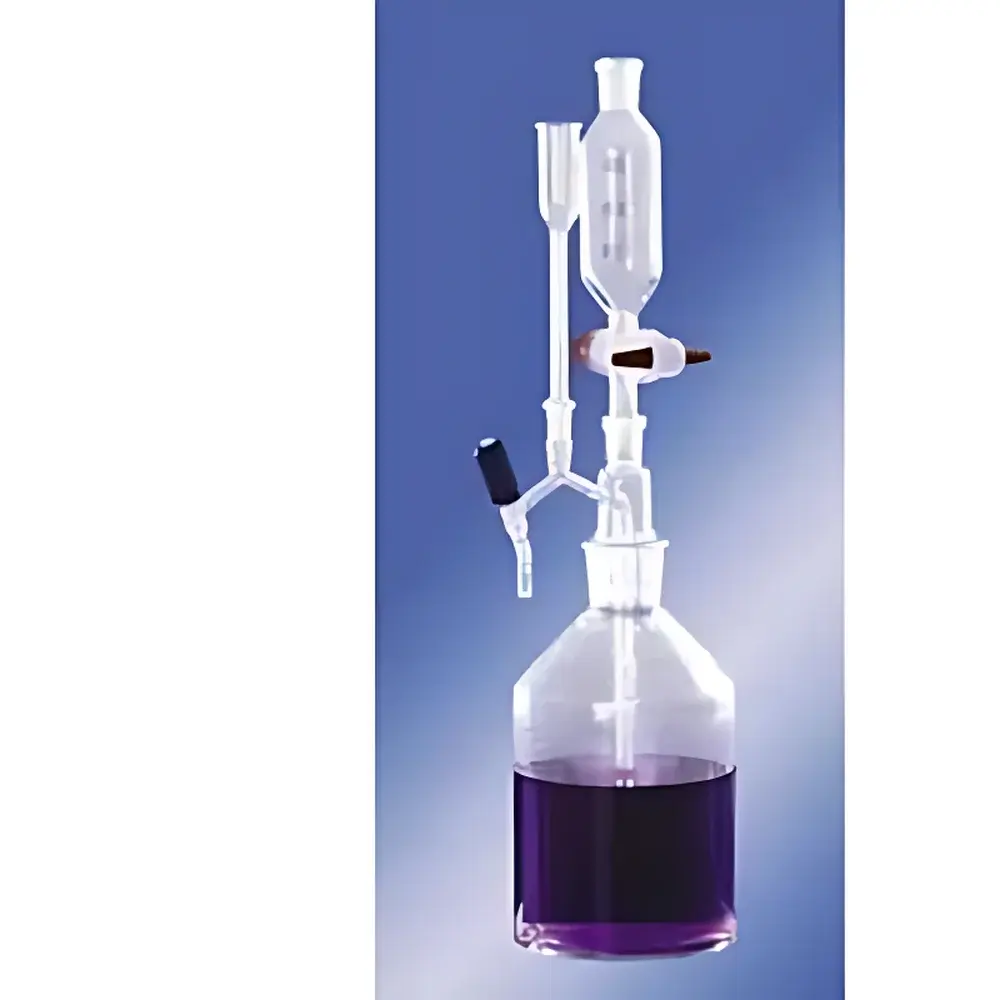
Behr EX1000 Extraction Unit
| Origin | Germany |
|---|---|
| Manufacturer Type | Authorized Distributor |
| Origin Category | Imported |
| Model | Behr EX1000 |
| Pricing | Upon Request |
Overview
The Behr EX1000 Extraction Unit is a precision-engineered, modular laboratory system designed for solvent-based liquid-liquid extraction in compliance with ISO 9377-2:2021 — Water quality — Determination of hydrocarbons — Part 2: Method using gas chromatography after liquid-liquid extraction. This unit implements a standardized, gravity-driven phase separation principle to isolate organic analytes (e.g., petroleum hydrocarbons, PAHs, chlorinated solvents) from aqueous environmental or food samples. Its core architecture centers on the PFL sampling bottle — a borosilicate glass vessel fitted with a ground-glass stopper — which serves as both sample containment and primary extraction chamber. The system leverages density differentials between immiscible phases to achieve clean, reproducible phase separation without mechanical agitation or centrifugation, minimizing emulsion formation and preserving analyte integrity.
Key Features
- Modular, tool-free disassembly: All functional components — including PFL sampling bottle, funnel separator, transfer adapter, and organic-phase outlet valve — are mechanically interlocked via standardized ground-glass joints (DIN 15886), enabling rapid configuration changes and full accessibility for cleaning or maintenance.
- PFL sampling bottle (Item No. 804800202): Manufactured from Class A borosilicate glass (Duran® or equivalent), resistant to thermal shock and chemical corrosion; features a precision-ground conical stopper ensuring leak-tight sealing during shaking and stable positioning during phase settling.
- Integrated funnel separator: Equipped with calibrated volume markings (±1 mL accuracy), transparent polypropylene body, and a low-profile drain spout optimized for controlled, drip-free transfer of the lower organic phase directly into SPE cartridges or GC vials.
- One-step phase transfer: Eliminates manual pipetting by aligning the organic layer interface with the separator’s discharge port, allowing gravity-driven, quantitative transfer without cross-contamination or operator variability.
- Chemical compatibility: All wetted parts (glass, PP, PTFE-sealed valves) are compatible with common extraction solvents including n-hexane, dichloromethane, diethyl ether, and petroleum ether (boiling range 40–60 °C).
Sample Compatibility & Compliance
The EX1000 supports aqueous matrices up to 1 L volume per cycle, including surface water, wastewater, leachates, milk homogenates, and homogenized food extracts. It is validated for use in accredited environmental testing laboratories operating under ISO/IEC 17025:2017 requirements. The design inherently supports traceability and audit readiness: each PFL bottle bears a permanent laser-etched batch number; glassware meets DIN EN ISO 4787 calibration standards for volumetric accuracy; and the entire workflow aligns with EPA Method 3510C (Liquid-Liquid Extraction) and ASTM D7066-04 (Standard Practice for Extraction of Hydrocarbons from Water). Optional documentation packages include Certificate of Conformance (CoC) and material declarations per REACH and RoHS directives.
Software & Data Management
The Behr EX1000 is a fully manual, hardware-only extraction platform with no embedded electronics or software interface. This architecture ensures long-term operational stability, eliminates firmware obsolescence, and simplifies qualification for regulated environments where electronic records are not required. Laboratories implementing GLP or GMP workflows may integrate the EX1000 into broader data ecosystems via standard lab notebooks, LIMS-compatible SOP templates (available upon request), and instrument-specific calibration logs. All user-facing documentation — including operation manuals, maintenance checklists, and ISO 9377-2 procedural annexes — is provided in English and conforms to FDA 21 CFR Part 11 principles for handwritten record integrity when used in conjunction with controlled document management systems.
Applications
- Determination of total petroleum hydrocarbons (TPH) in groundwater and soil leachates per ISO 9377-2 and ASTM D7066.
- Extraction of polycyclic aromatic hydrocarbons (PAHs) from municipal wastewater prior to HPLC-UV/fluorescence analysis.
- Fat and oil quantification in dairy products and infant formula using AOAC 991.36-compliant hexane extraction protocols.
- Isolation of organochlorine pesticides (e.g., DDT, lindane) from drinking water samples prior to GC-ECD detection.
- Preparative cleanup step in multi-residue pesticide methods (e.g., QuEChERS derivatives) requiring selective organic-phase recovery.
FAQ
Is the EX1000 suitable for automated high-throughput labs?
No — it is a manually operated, benchtop extraction system optimized for method fidelity and regulatory compliance rather than throughput. Automation-ready alternatives require integration with robotic liquid handlers and are not part of the EX1000 product line.
Can the PFL bottle be autoclaved?
Yes — the borosilicate glass PFL bottle and ground-glass stopper are autoclavable at 121 °C, 2 bar for 20 minutes. Polypropylene funnel separators must be sterilized via ethanol immersion or ethylene oxide; they are not autoclave-rated.
Does Behr provide validation support for ISO/IEC 17025 accreditation?
Yes — technical documentation packages include IQ/OQ test protocols, reference material traceability statements, and metrological verification reports for all supplied glassware and calibrated components.
What spare parts are recommended for routine maintenance?
Primary consumables include replacement PTFE-coated stopcock valves (Ref. 804800203), spare ground-glass stoppers (Ref. 804800204), and certified calibration syringes for volume verification (Ref. 804800205).
Is the EX1000 compliant with USP residual solvents testing?
While not specifically validated for USP , its solvent-handling architecture and material compatibility meet the general equipment suitability criteria outlined in USP — Verification of Compendial Procedures — when used with validated extraction protocols.



