
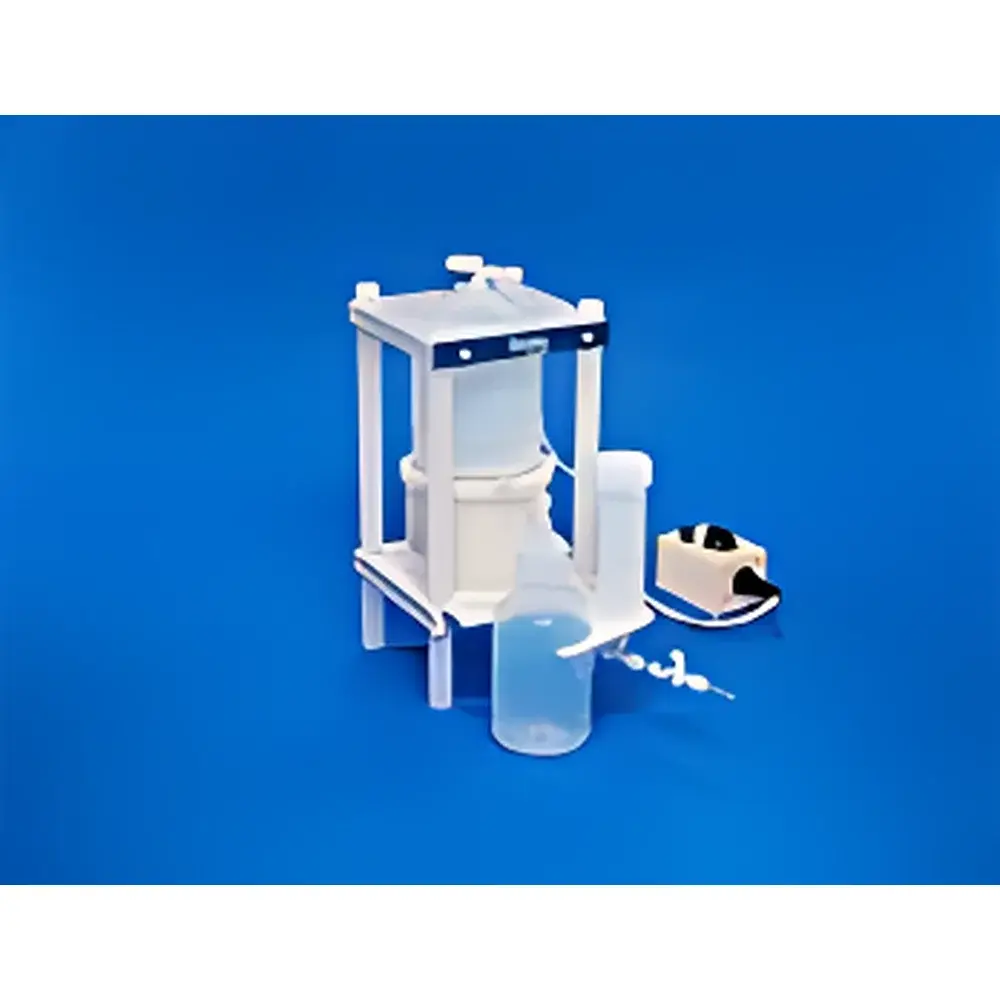
Savillex DST-1000N Sub-Boiling Acid Distillation System
| Brand | Savillex |
|---|---|
| Origin | USA |
| Model | DST-1000N |
| Instrument Type | Sub-boiling Distiller |
| Heating Method | Silicone Rubber Heating Mantle |
| Cooling Method | Natural Air Cooling |
| Distillation Rate | Up to 500 mL per 12 hours |
| Warm-up Time | 30 minutes |
| Endpoint Control | Temperature-based Setpoint Activation |
| Heating Element | Silicone Rubber Heating Mantle |
Overview
The Savillex DST-1000N is a precision-engineered sub-boiling acid distillation system designed for the production of ultra-high-purity acids—critical reagents in trace metal analysis, ICP-MS, ICP-OES, and semiconductor-grade sample preparation. Unlike conventional boiling distillation, the DST-1000N operates below the atmospheric boiling point of target acids (e.g., HNO₃, HCl, HF), minimizing volatile impurity carryover and eliminating aerosol entrainment. This thermodynamically controlled process ensures that only pure vapor phase components condense, yielding acids with metal impurity levels consistently below 10 ppt (parts-per-quadrillion) — a performance benchmark required for Class 1 cleanroom labs and EPA Method 200.8/6020B compliance. The system’s compact footprint (≤30 cm × 30 cm) enables seamless integration into fume hoods without external water or coolant connections, supporting unattended overnight operation under GLP-aligned conditions.
Key Features
- Fully PFA-wetted path construction—including distillation chamber, condenser column, collection funnel, and 1000 mL collection bottle—ensuring zero metallic leaching and compatibility with aggressive media (HF, hot HNO₃, aqua regia)
- Three-position digital temperature controller (low/medium/high) with adjustable setpoint and built-in thermal cutoff fuse for fail-safe operation
- Integrated pressure-equalization tube maintains stable vapor-phase dynamics throughout distillation, preventing bumping or pressure-induced contamination
- Optimized arc-shaped condenser dome enhances surface-area-to-volume ratio for efficient vapor-to-liquid transition under passive air cooling
- Graduated feed tube with visual level indicators enables precise loading of up to 1 L of crude acid; residual volume detection (~50–100 mL) triggers manual shutdown recommendation
- Dual particulate filtration on both inlet and vent ports (0.2 µm hydrophobic PTFE membrane) prevents ambient airborne contamination during extended runs
- Quick-change collection bottle with dual-function cap: seals during distillation while allowing controlled air displacement upon filling completion
Sample Compatibility & Compliance
The DST-1000N is validated for sub-boiling distillation of nitric acid (HNO₃), hydrochloric acid (HCl), and hydrofluoric acid (HF) at concentrations typical for analytical digestion protocols (e.g., 69% HNO₃, 37% HCl, 49% HF). It meets material compatibility requirements per ASTM D1193 Type I water specifications when used with certified starting reagents. All PFA components comply with USP Class VI and FDA 21 CFR 177.1550 standards for fluoropolymer contact surfaces. The system supports audit-ready documentation workflows aligned with ISO/IEC 17025 and FDA 21 CFR Part 11 when paired with laboratory information management systems (LIMS) via manual log entry protocols.
Software & Data Management
The DST-1000N operates as a stand-alone analog-controlled instrument with no embedded firmware or digital interface. Temperature settings, runtime tracking, and endpoint confirmation are managed manually using the front-panel selector switch and calibrated dial thermometer. For quality assurance purposes, users are advised to maintain a distilled batch log including: date/time stamp, acid type and lot number, starting volume, setpoint position, actual runtime, final collected volume, and post-distillation ICP-MS verification data (e.g., Cr, Fe, Ni, Cu, Zn spikes at 10 pg/mL spike level). This paper-based or LIMS-integrated record satisfies GLP traceability requirements for regulated environmental and pharmaceutical testing laboratories.
Applications
- Preparation of matrix-matched calibration standards for multi-element ICP-MS quantification in geological, environmental, and clinical samples
- Generation of blank-reduced reagents for low-background uranium/thorium isotopic ratio measurements (TIMS, MC-ICP-MS)
- Acid purification prior to microwave-assisted digestion of high-purity silicon wafers and photovoltaic materials
- Trace-level mercury speciation analysis requiring sub-ppt HCl blanks for Hg²⁺/CH₃Hg⁺ separation by HPLC-ICP-MS
- Supporting ISO 17294-2:2016 compliant water analysis where reagent blank contributions must remain <5% of regulatory reporting limits
FAQ
What acids can be purified using the DST-1000N?
Nitric acid (HNO₃), hydrochloric acid (HCl), and hydrofluoric acid (HF) are fully supported. Sulfuric and perchloric acids are not recommended due to thermal instability and safety risks under sub-boiling conditions.
Does the DST-1000N require external cooling water?
No. It relies exclusively on natural convection air cooling via its optimized PFA condenser geometry—eliminating plumbing complexity and reducing operational overhead.
How does sub-boiling distillation improve purity versus conventional boiling?
By maintaining liquid-phase temperature significantly below boiling (e.g., ~110°C for HNO₃ vs. 121°C boiling point), the system suppresses formation of micro-droplets and non-volatile salt aerosols that co-distill in boiling systems—resulting in lower blank values for transition metals.
Is the DST-1000N suitable for GMP-regulated environments?
Yes, when operated within documented SOPs and accompanied by batch records, it fulfills core equipment qualification expectations for reagent purification in pharmaceutical QC labs adhering to ICH Q2(R2) and USP <1058>.
Can multiple DST-1000N units be operated simultaneously in one fume hood?
Yes—provided total heat load remains within hood face velocity specifications (≥0.5 m/s) and exhaust capacity accommodates cumulative off-gas volume from all units.



