
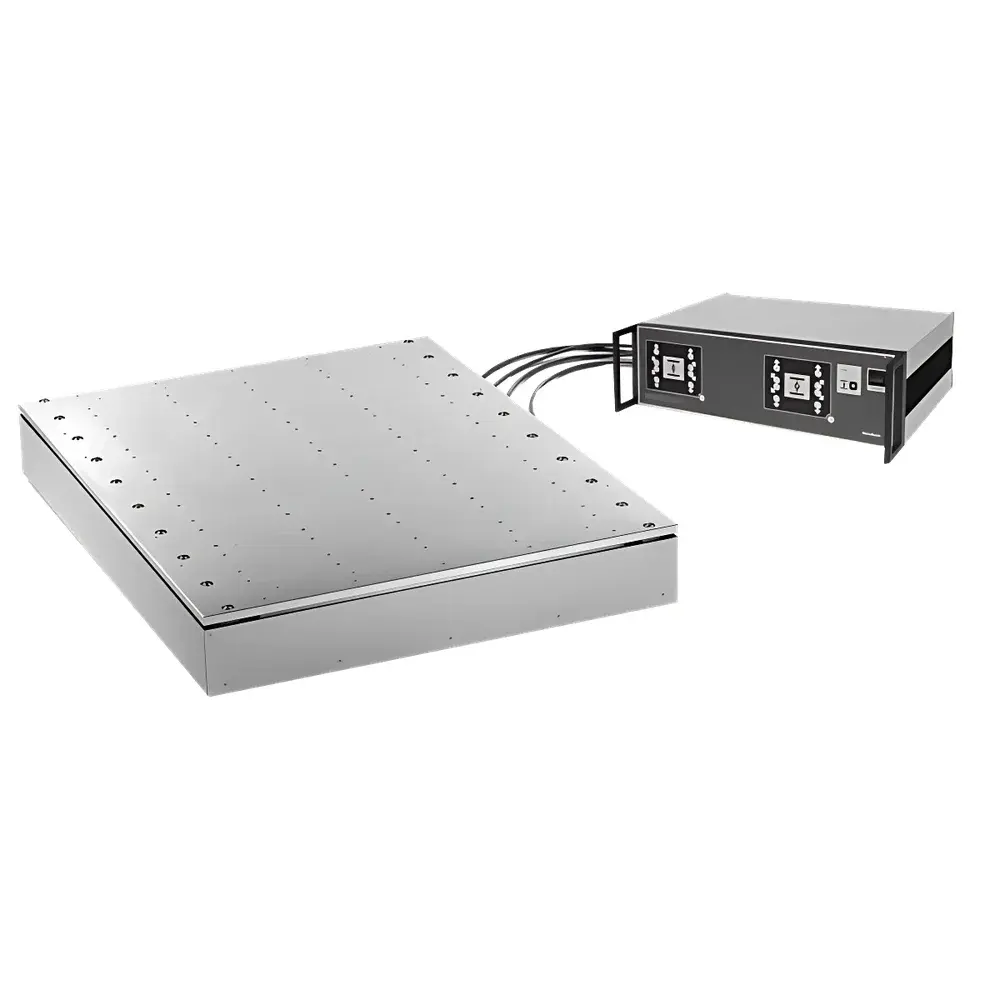
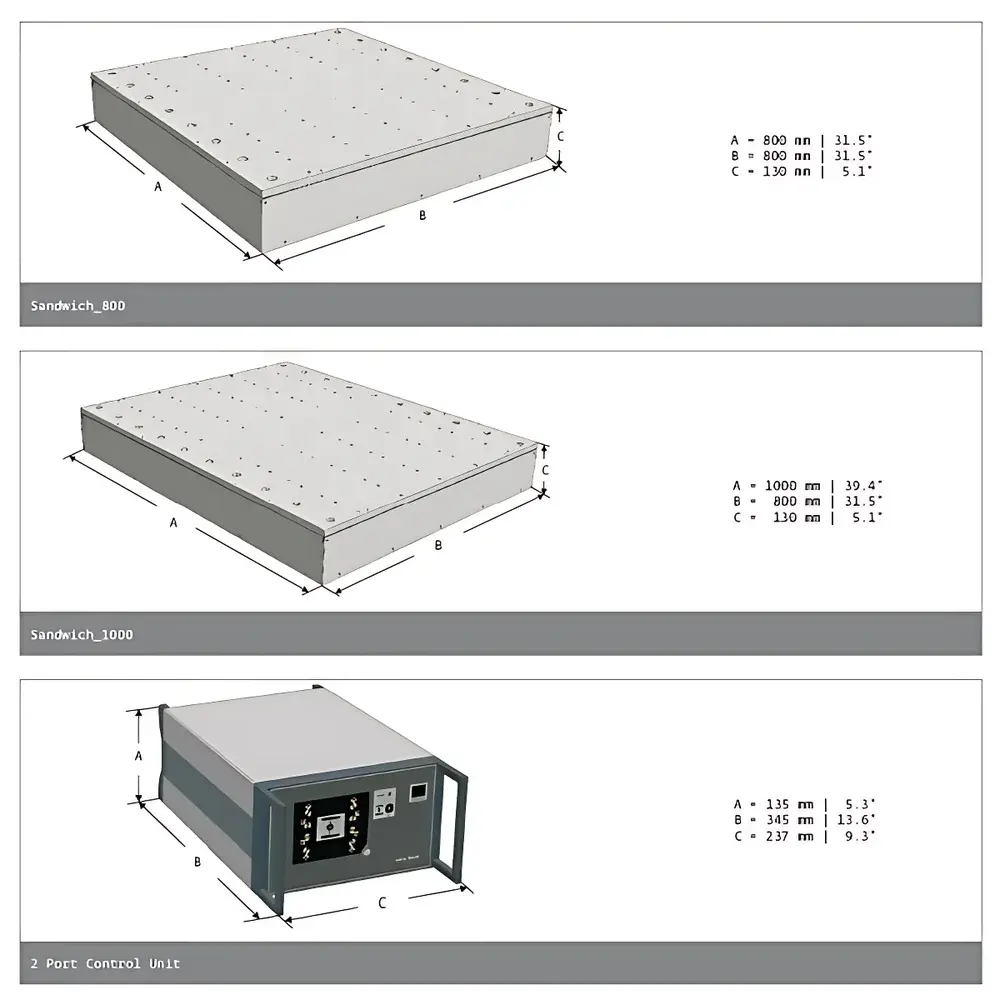
Accurion SW1000-8.0 Active Vibration Isolation Platform for Electron Microscopy
| Brand | Accurion |
|---|---|
| Origin | Germany |
| Model | SW1000-8.0 |
| Active Isolation Principle | Piezoelectric Accelerometer-Based Real-Time Feedback Control |
| Degrees of Freedom | 6-DOF (XYZ translational + rotational compensation) |
| Isolation Frequency Range | 1–200 Hz |
| Vertical Isolation Performance | >25 dB at 5 Hz (94.4% attenuation), >35 dB at 10 Hz (98.2% attenuation) |
| Max. Active Compensation Force | ±32 N (vertical), ±16 N (horizontal) |
| Max. Displacement Compensation | 350 µm/s at 9 Hz |
| Settling Time | 300 ms |
| Payload Capacity | 0–1200 kg |
| Table Surface Dimensions | 800 × 1000 mm |
| Operating Temperature | 10–40 °C |
| Relative Humidity | 0–60 % RH |
| Power Supply | Standard AC Mains (No Custom PSU Required) |
| Load Adjustment | Manual Mechanical Balancing |
Overview
The Accurion SW1000-8.0 is a high-performance active vibration isolation platform engineered specifically for ultra-sensitive electron optical instruments—including scanning electron microscopes (SEM), transmission electron microscopes (TEM), and focused ion beam (FIB) systems—where sub-nanometer stability is non-negotiable. Unlike passive damping solutions, the SW1000-8.0 employs a real-time, closed-loop control architecture based on piezoelectric accelerometers and dynamic electromagnetic actuators. This enables continuous, six-degree-of-freedom (6-DOF) compensation across translational (X, Y, Z) and rotational (pitch, yaw, roll) axes. The system detects incoming ground-borne or structural vibrations—whether from building HVAC, footfall, nearby machinery, or low-frequency ambient seismic noise—and generates counteracting forces within 300 milliseconds. Its operational bandwidth spans 1–200 Hz, delivering >25 dB attenuation at 5 Hz and >35 dB at 10 Hz—critical thresholds where conventional passive tables exhibit resonance or insufficient suppression. Designed and manufactured in Germany, the platform integrates seamlessly into cleanroom and regulated laboratory environments without requiring custom power infrastructure.
Key Features
- True 6-DOF active isolation with independent real-time feedback per axis
- No inherent mechanical resonance—eliminates low-frequency amplification common in pneumatic or spring-based passive tables
- Standard AC mains compatibility; no external DC power supply or dedicated circuit required
- Manually adjustable payload balancing mechanism supporting 0–1200 kg load range
- Robust aluminum honeycomb tabletop (800 × 1000 mm) with precision-machined M6 threaded array for secure instrument mounting
- Compact footprint optimized for integration beneath space-constrained SEM/TEM columns
- Environmental operation range: 10–40 °C and 0–60 % RH—validated for long-term stability in ISO Class 7–8 cleanrooms
Sample Compatibility & Compliance
The SW1000-8.0 is validated for use with major OEM electron microscopy platforms including Zeiss Gemini, JEOL JSM-IT series, Hitachi SU-series, Thermo Fisher Scientific Apreo and Talos systems, and TESCAN MIRA and LYRA platforms. Its vibration attenuation profile meets the mechanical stability requirements specified in ASTM E2522-19 (Standard Practice for Evaluating Vibration Sensitivity of Electron Microscopes) and supports compliance with ISO 14644-1 (cleanroom air cleanliness) when deployed in controlled environments. While not a medical device, its design adheres to IEC 61000-6-2 (immunity) and IEC 61000-6-4 (emission) standards for laboratory-grade electronic equipment. No proprietary software licensing or FDA 21 CFR Part 11 validation package is included; however, the platform’s deterministic response and audit-ready hardware logs facilitate integration into GLP/GMP workflows where vibration stability documentation is required.
Software & Data Management
The SW1000-8.0 operates autonomously via embedded firmware—no host PC or driver installation is necessary for basic operation. Status indicators (LEDs) provide immediate visual confirmation of system readiness, actuator engagement, and fault conditions. For advanced diagnostics, optional USB-to-serial interface enables connection to third-party data acquisition systems for time-synchronized logging of accelerometer outputs, actuator voltage signals, and settling behavior. Raw sensor data streams are provided in ASCII format at 1 kHz sampling rate, compatible with MATLAB, Python (NumPy/Pandas), or LabVIEW environments. Firmware updates are delivered via secure offline binary files; no cloud connectivity or remote access capability is implemented—ensuring full network isolation for security-sensitive facilities.
Applications
- Stabilization of high-resolution SEM/TEM systems operating at <1 nm probe size
- Supporting atomic-resolution imaging and EDS/EELS mapping where drift must remain <0.1 nm/min
- Enabling stable nanoindentation and in-situ mechanical testing inside electron microscopes
- Isolating ultra-low-vibration optical interferometers, AFM controllers, and quantum sensing setups
- Mitigating floor-borne vibration in multi-story academic or industrial lab buildings lacking dedicated slab foundations
- Facilitating reliable nanofabrication process monitoring using beam-sensitive resist materials
FAQ
Does the SW1000-8.0 require compressed air or hydraulic lines?
No—this is an all-electric active platform with no pneumatic or fluidic components.
Can it be used with existing passive optical tables?
Yes; the SW1000-8.0 is designed as a standalone base unit and may be placed directly on standard concrete floors, raised access floors, or inertial optical tables.
Is manual load adjustment sufficient for dynamic payloads such as stage-mounted manipulators?
Manual balancing is intended for static or quasi-static configurations. For applications involving rapid lateral mass shifts (e.g., large motorized stages), consult Accurion engineering for optional dynamic load-sensing upgrade paths.
What maintenance is required over its service life?
No scheduled maintenance is specified. Piezoelectric sensors and electromagnetic actuators are solid-state components rated for >10 years of continuous operation under nominal conditions.
Is electromagnetic interference (EMI) from the actuators a concern near sensitive detectors?
EMI emissions comply with CISPR 11 Group 1 Class B limits. Shielded cabling and proper grounding—per IEC 61000-6-3—are recommended when deploying within 1 m of electron multipliers or SQUID sensors.
Related Products



