
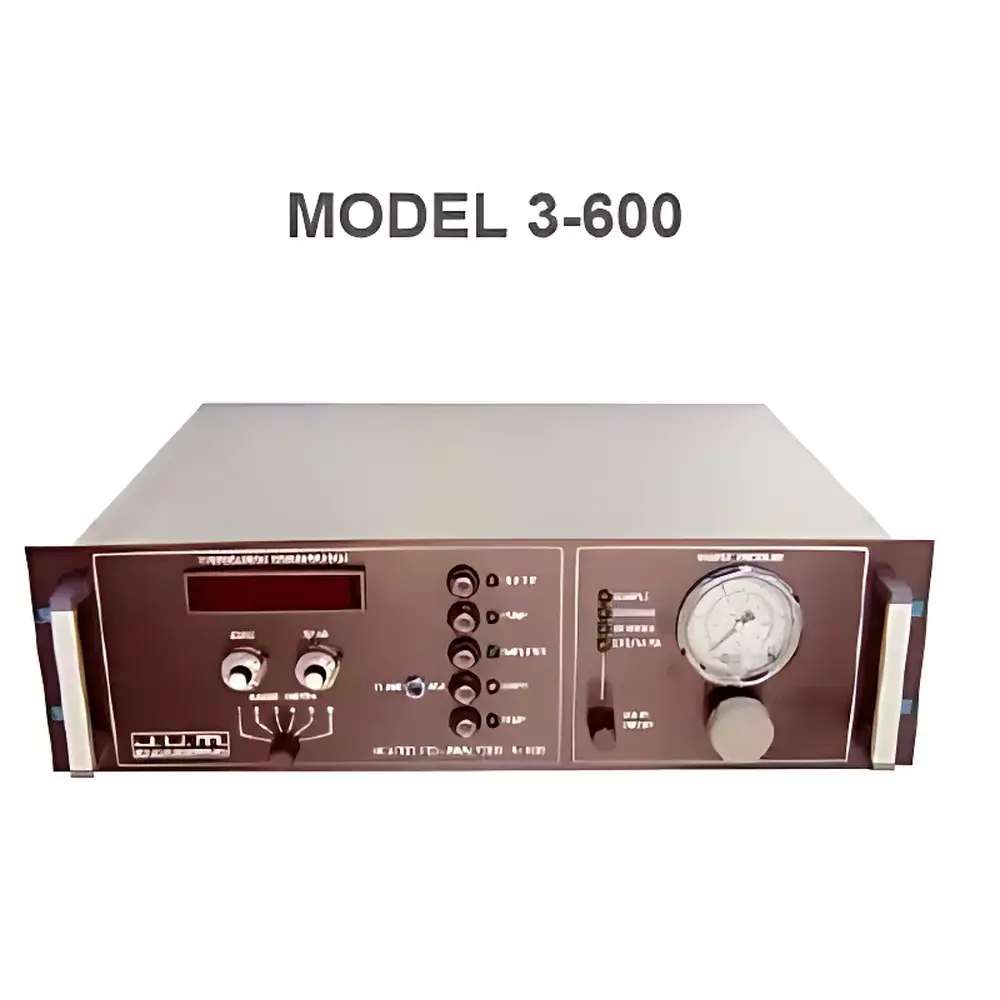
J.U.M. 3-600 Online Total Hydrocarbon Analyzer with FID Detection
| Brand | J.U.M. |
|---|---|
| Origin | Germany |
| Model | 3-600 |
| Detection Principle | Flame Ionization Detection (FID) |
| Measurement Range | ppm-level total hydrocarbons (THC), non-methane hydrocarbons (NMHC), and ethane-adjusted NMHC |
| Operating Temperature | Heated FID chamber (typically 180–220 °C) |
| Sample Flow Stability | Precision back-pressure regulator integrated |
| Combustion Air Supply | Internal zero-air generator |
| Compliance | Designed for continuous emission monitoring (CEM) in industrial and environmental applications |
Overview
The J.U.M. 3-600 Online Total Hydrocarbon Analyzer is a robust, field-proven gas-phase analytical instrument engineered for continuous, real-time quantification of total hydrocarbons (THC), non-methane hydrocarbons (NMHC), and ethane-corrected NMHC in industrial process streams and ambient or stack emissions. Built upon flame ionization detection (FID) — a reference-grade technique standardized in EPA Method 25A, ASTM D6348, and ISO 12913-1 — the system delivers trace-level sensitivity with high reproducibility across variable sample matrices. Unlike catalytic or photoionization-based alternatives, the FID principle ensures near-uniform response factors for most volatile organic compounds (VOCs), making it especially suitable for regulatory compliance reporting where carbon-mass equivalence is required. The analyzer operates continuously without drift-prone optical components or consumable sensors, relying instead on stable thermal management and electrostatic charge collection within a precisely controlled hydrogen/air flame.
Key Features
- FID detector housed in a thermostatically regulated furnace (180–220 °C), minimizing condensation of higher molecular weight hydrocarbons and preventing signal attenuation during low-temperature or high-humidity sampling.
- Integrated zero-air generation system eliminates dependency on external compressed air cylinders or purifiers, reducing operational overhead and ensuring consistent combustion stoichiometry.
- Proprietary high-precision back-pressure regulator maintains constant sample flow rate (<±0.5% variation) under fluctuating line pressure — critical for maintaining calibration integrity in unregulated ducts or exhaust stacks.
- Modular mechanical architecture supports multiple installation configurations: wall-mounted, rack-integrated, or suspended deployment — compatible with ISO 14644 cleanroom-rated enclosures and hazardous area classifications (ATEX Zone 2 / Class I Div 2 optional).
- Low hydrogen consumption design (<30 mL/min) extends cylinder life and reduces storage and safety requirements in confined or remote installations.
Sample Compatibility & Compliance
The 3-600 accepts gaseous samples from ambient air, flue gas, biogas, landfill off-gas, and petrochemical process vents. It tolerates particulate loadings up to 10 mg/m³ (with optional heated particulate filter) and water vapor concentrations up to 40% RH (non-condensing). Calibration is traceable to NIST-certified methane-in-nitrogen standards; routine verification follows EPA Performance Specification 8 (PS-8) protocols for FID-based CEMS. The analyzer meets EN 15267-3 (QAL1 certification readiness), supports GLP/GMP audit trails via optional data logging firmware, and is configurable for 21 CFR Part 11-compliant electronic records when paired with J.U.M.’s certified control software.
Software & Data Management
Instrument operation and diagnostics are managed through J.U.M.’s web-native HMI interface (HTTPS-enabled, responsive HTML5), accessible via Ethernet or optional cellular modem. Real-time concentration outputs (ppm C₁–C₁₀ equivalent), detector status, flame stability metrics, and flow/pressure logs are timestamped and exportable in CSV or Modbus TCP format. Optional cloud synchronization enables centralized fleet monitoring across multi-site deployments. Firmware updates are delivered via secure SFTP; all configuration changes are logged with user ID, timestamp, and pre-/post-value deltas — satisfying data integrity requirements for ISO/IEC 17025-accredited laboratories and EU Industrial Emissions Directive (IED) reporting.
Applications
- Continuous emission monitoring (CEM) of THC/NMHC at municipal wastewater treatment plants, incinerators, and chemical manufacturing facilities.
- Process optimization and leak detection in semiconductor fab exhaust abatement systems and pharmaceutical solvent recovery units.
- Biogas quality assurance in anaerobic digestion facilities prior to upgrading or flare injection.
- Compliance verification for VOC abatement system efficiency (e.g., thermal oxidizers, carbon adsorbers) per TA Luft and BREF guidelines.
- Research-grade hydrocarbon speciation support when coupled with optional GC pre-separation modules (not included).
FAQ
What is the detection limit for methane using the 3-600?
The system achieves a method detection limit (MDL) of ≤0.1 ppm C₁ (as methane) under standard operating conditions, verified per EPA 40 CFR Part 60, Appendix A-1.
Can the analyzer differentiate between methane and non-methane hydrocarbons?
Yes — when configured with a catalytic methanizer and dual-FID channel (optional hardware upgrade), it supports simultaneous THC and NMHC measurement per EPA Method 25A.
Is third-party certification available for regulatory use?
The 3-600 is QAL1-ready per EN 15267-3; site-specific certification must be performed by an accredited body in accordance with local permitting authority requirements.
Does the unit require periodic calibration gas exposure?
Daily zero/span verification is recommended; full multi-point calibration is typically performed weekly or after maintenance, using certified calibration gases traceable to national metrology institutes.
What maintenance intervals are specified for the FID jet and collector electrode?
Under typical industrial conditions, the FID nozzle and electrode require cleaning every 3–6 months; full detector inspection is advised annually or following exposure to silicones, halogenated compounds, or heavy condensables.
Related Products







