
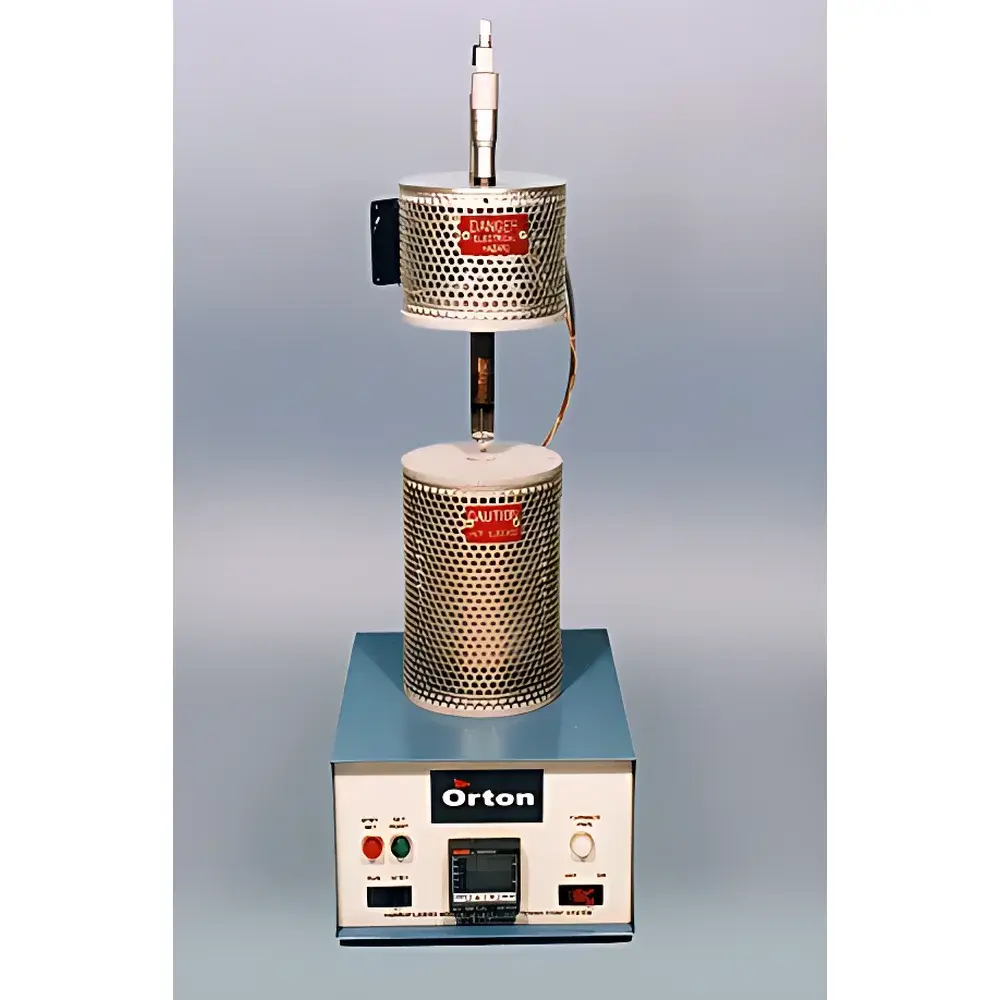
Orton SP-3A Approximate Softening Point Tester
| Brand | Orton |
|---|---|
| Origin | USA |
| Manufacturer Type | Authorized Distributor |
| Origin Category | Imported |
| Model | SP-3A |
| Pricing | Upon Request |
| Max Temperature | 1000 °C |
| Temperature Accuracy | ±1 °C |
| Heating Rate | 25 °C/min |
| Probe Travel Range | 0–3 mm |
| Probe Resolution | 0.0025 mm |
Overview
The Orton SP-3A Approximate Softening Point Tester is a precision-engineered thermal analysis instrument designed for rapid, reproducible determination of the approximate softening point of solid glass specimens—without requiring fiber drawing. It operates on a modified parallel-plate viscometric principle: a standardized stainless-steel sphere (1/8″ diameter) is placed atop a flat, rectangular glass sample mounted on a refractory alumina-coated stainless-steel holder. As the furnace heats at a controlled rate of 25 °C/min, the glass transitions from rigid solid to viscous deformable state. At the point where the combined weight of the probe rod and sphere induces a predefined penetration depth (detected by a microswitch), power to the heating element is automatically cut off. The temperature at interruption is recorded as the instrument’s output value—the “approximate softening point.” This method correlates empirically with the ASTM C338-defined Littleton softening point (the temperature at which a standard glass fiber elongates at 1 mm/min under specified load), though it measures displacement onset rather than strain rate. The SP-3A thus delivers a robust, QC-oriented surrogate metric suitable for routine compositional monitoring in glass manufacturing, research, and quality assurance laboratories.
Key Features
- Engineered for high repeatability: Fixed heating rate (25 °C/min) and constant applied load (via standardized sphere mass and geometry) eliminate two major variables; operator control over specimen thickness ensures third-variable consistency.
- Simple, walk-away operation: After initial setup—including precise micrometer adjustment of probe contact pressure and placement of the alumina-dusted sample—the user initiates the test with a single button press. The system autonomously executes heating, detection, and temperature capture.
- Direct solid-sample testing: Eliminates the need for labor-intensive and compositionally sensitive glass fiber drawing—critical for devitrifying, phase-separating, or highly viscous melts that cannot be drawn reliably.
- High-resolution mechanical sensing: Probe travel range of 0–3 mm with 0.0025 mm resolution enables precise threshold detection of deformation onset.
- Thermal stability and accuracy: Furnace rated to 1000 °C with ±1 °C temperature accuracy across the operational range (typically 500–850 °C for soda-lime and borosilicate glasses).
- Legacy design heritage: Developed by Dr. Dominick Labino—a pioneering figure in glass science—based on empirical correlation studies validating its alignment with ASTM C338 methodology when corrected using traceable reference materials.
Sample Compatibility & Compliance
The SP-3A accepts flat, rectangular glass specimens with tightly controlled dimensions—particularly thickness (most critical), followed by length and width. Specimens must be free of surface defects, annealed to remove residual stress, and uniformly polished on the top face contacting the sphere. Alumina powder (applied as a thin, even layer to the holder) prevents adhesion during softening. While not a primary compliance device, the SP-3A supports GLP/GMP-aligned QC workflows: its fixed protocol parameters, manual operator logging, and deterministic endpoint detection enable full traceability. When used with NIST-traceable reference glasses (e.g., NIST SRM 710 series), it facilitates calibration against certified Littleton softening points, supporting ISO/IEC 17025-compliant uncertainty budgets. It does not meet FDA 21 CFR Part 11 requirements out-of-the-box but may be integrated into validated systems with supplementary procedural controls.
Software & Data Management
The SP-3A is a stand-alone analog-digital hybrid instrument with no embedded software or network interface. Temperature is displayed on a front-panel digital indicator with hold function; readings are manually recorded. For laboratory information management system (LIMS) integration or electronic recordkeeping, users typically log results in spreadsheets or validated electronic lab notebooks (ELNs). To ensure data integrity, SOPs should mandate concurrent documentation of specimen ID, thickness measurement (using calibrated micrometers), operator name, date/time, and raw instrument reading—followed by application of the site-specific correction factor. Traceability to reference standards and periodic verification of furnace calibration (per ASTM E220 or ISO 17025 Annex A.3) are recommended best practices.
Applications
- Routine compositional QC in float glass, container glass, and fiberglass production lines—detecting batch-to-batch deviations before costly downstream processing.
- Development of novel glass formulations where fiber drawing is impractical (e.g., high-alumina, lithium-aluminosilicate, or opal glass systems).
- Academic and industrial research on glass transition kinetics, especially where comparative softening behavior—not absolute viscosity—is the primary metric.
- Verification of thermal history effects (e.g., annealing efficiency, heat treatment validation) via softening point shifts.
- Supplier qualification testing where rapid pass/fail decisions are required without access to full ASTM C338 infrastructure.
FAQ
How does the SP-3A differ from the ASTM C338 Littleton method?
The SP-3A measures the temperature at which a defined mechanical deformation occurs under constant load, whereas ASTM C338 measures the temperature at which a glass fiber elongates at a fixed strain rate (1 mm/min). They are complementary—not identical—methods; correlation requires empirical correction using reference materials.
Why is specimen thickness the most critical dimension?
Thickness directly governs thermal gradient uniformity and mechanical resistance to sphere penetration. Variations >±0.02 mm introduce measurable scatter; all other dimensions exert secondary influence.
Can the SP-3A be used for non-glass materials?
It is calibrated and validated exclusively for oxide-based silicate, borosilicate, and aluminosilicate glasses. Use with polymers, metals, or low-melting-point ceramics is not supported and may damage the furnace or probe mechanism.
What is the typical test duration?
From start-button activation to endpoint recording averages 25–32 minutes, depending on initial ambient temperature and target softening range.
Is operator training required?
Yes—consistent micrometer preload adjustment and specimen preparation (especially alumina dusting and thickness measurement) require documented training and periodic competency assessment to maintain inter-operator reproducibility.
Related Products



