
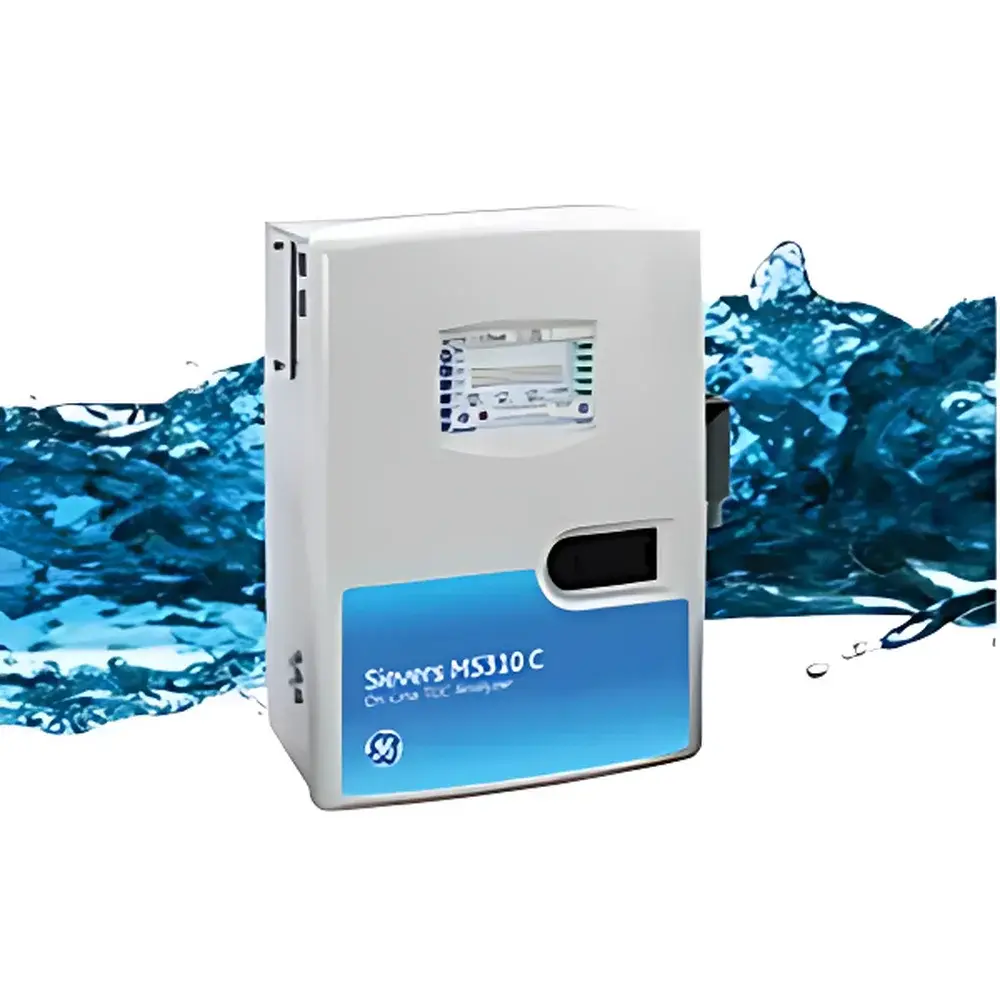
Sievers M5310C Online Total Organic Carbon (TOC) Analyzer
| Brand | Sievers (Veolia) |
|---|---|
| Origin | USA |
| Model | M5310C Online |
| Detection Principle | Membrane Conductivity Detection |
| Oxidation Method | UV/Persulfate |
| Measurement Range | 4 ppb – 50 ppm |
| Accuracy | ±2% or ±0.5 ppb (whichever is greater) |
| Resolution | 0.01 ppb |
| Detection Limit | 4 ppb |
| Repeatability | ≤1% RSD |
| Analysis Time | 2 minutes |
| Calibration Interval | 12 months |
| Compliance | US EPA Method 415.3 & Standard Methods 5310 C |
| Instrument Type | Online TOC Analyzer |
Overview
The Sievers M5310C Online Total Organic Carbon (TOC) Analyzer is an engineered solution for continuous, real-time monitoring of organic contamination in municipal drinking water distribution systems and treatment plant effluents. It employs a dual-stage oxidation process—combining ultraviolet (UV) light with sodium persulfate—to fully mineralize non-purgeable organic carbon (NPOC) into carbon dioxide. The resulting CO₂ is selectively stripped from the aqueous matrix via gas-permeable membrane and quantified using high-stability, temperature-compensated membrane conductivity detection. This methodology ensures minimal interferences from inorganic carbon species, chloride, or background electrolytes—critical for low-ppb-level fidelity in chlorinated potable water streams. Designed specifically for regulatory-grade compliance in public water systems, the M5310C delivers trace-level sensitivity and metrological rigor aligned with USEPA Method 415.3 and Standard Methods 5310 C.
Key Features
- Robust online architecture enabling uninterrupted 24/7 operation with <2-minute analysis cycle time
- Automated reagent dosing system that dynamically adjusts persulfate flow rate based on sample TOC concentration—reducing chemical consumption and waste generation
- Integrated touchscreen HMI with intuitive dashboard interface for real-time trend visualization, alarm configuration, and diagnostic status monitoring
- Self-diagnostic firmware with contextual error logging and step-by-step troubleshooting prompts—minimizing operator dependency and downtime
- Modular design supporting flexible deployment: direct inline installation into pressurized distribution lines or discrete sampling loop integration with optional peristaltic pump and auto-sampler
- Temperature-stabilized conductivity cell with active thermal compensation to maintain measurement integrity across ambient fluctuations (10–40°C operating range)
Sample Compatibility & Compliance
The M5310C is validated for use with finished drinking water, filtered surface water, groundwater, and low-conductivity treated effluents. Its oxidation and detection architecture eliminates interference from common disinfection byproducts (e.g., chloramines), residual chlorine (<5 mg/L), and dissolved inorganic carbon (DIC) up to 100 ppm as CaCO₃. The analyzer meets full regulatory alignment with U.S. Environmental Protection Agency (EPA) Method 415.3 and Standard Methods for the Examination of Water and Wastewater (23rd ed.) 5310 C. Data integrity is reinforced through audit-trail-enabled firmware compliant with GLP and 21 CFR Part 11 requirements—including user authentication, electronic signatures, and immutable event logging.
Software & Data Management
Embedded firmware supports structured local data storage with relational database architecture optimized for rapid querying by time stamp, batch ID, or alarm condition. Raw conductivity signals, oxidation efficiency metrics, calibration history, and QC check results are archived with ISO 8601 timestamping. Optional Ethernet/IP or Modbus TCP connectivity enables seamless integration into SCADA, LIMS, or centralized asset management platforms. Remote access—via secure HTTPS or TLS-encrypted protocols—permits offsite validation, method updates, and performance verification without physical intervention. All data exports conform to ASTM E2500-13 for analytical instrument qualification documentation.
Applications
- Continuous TOC surveillance at drinking water treatment plant final effluent points
- Early-warning detection of organic breakthrough in granular activated carbon (GAC) or ozone-biofiltration trains
- Verification of membrane integrity in advanced treatment facilities (e.g., RO/NF permeate monitoring)
- Compliance reporting for state primacy agencies and EPA SDWA Tier 2 reporting requirements
- Source water quality trending to support watershed protection initiatives and seasonal treatment optimization
- Validation of UV-AOP (advanced oxidation process) reactor performance through pre- and post-oxidation TOC differentials
FAQ
What regulatory methods does the M5310C validate against?
The M5310C is type-approved for USEPA Method 415.3 and Standard Methods 5310 C, and its performance specifications satisfy the minimum requirements for routine compliance monitoring under the U.S. Safe Drinking Water Act.
Can the analyzer operate unattended for extended periods?
Yes—designed for autonomous operation over 12-month calibration intervals, with onboard diagnostics, automatic zero/span verification, and configurable alert thresholds for drift, pressure loss, or reagent depletion.
Is the system compatible with existing plant SCADA infrastructure?
All M5310C units ship with native Modbus TCP and Ethernet/IP protocol stacks; OPC UA gateway integration is supported via optional firmware modules.
How is data integrity ensured for audit purposes?
The embedded database enforces write-once archival, time-stamped event logs, role-based access control, and cryptographic hashing of critical configuration changes—fully traceable for FDA 21 CFR Part 11 or EU Annex 11 assessments.
Does the analyzer require daily maintenance or manual intervention?
No routine daily tasks are required; preventive maintenance is limited to quarterly reagent cartridge replacement and annual sensor cleaning—documented in the integrated maintenance scheduler.
Related Products







