
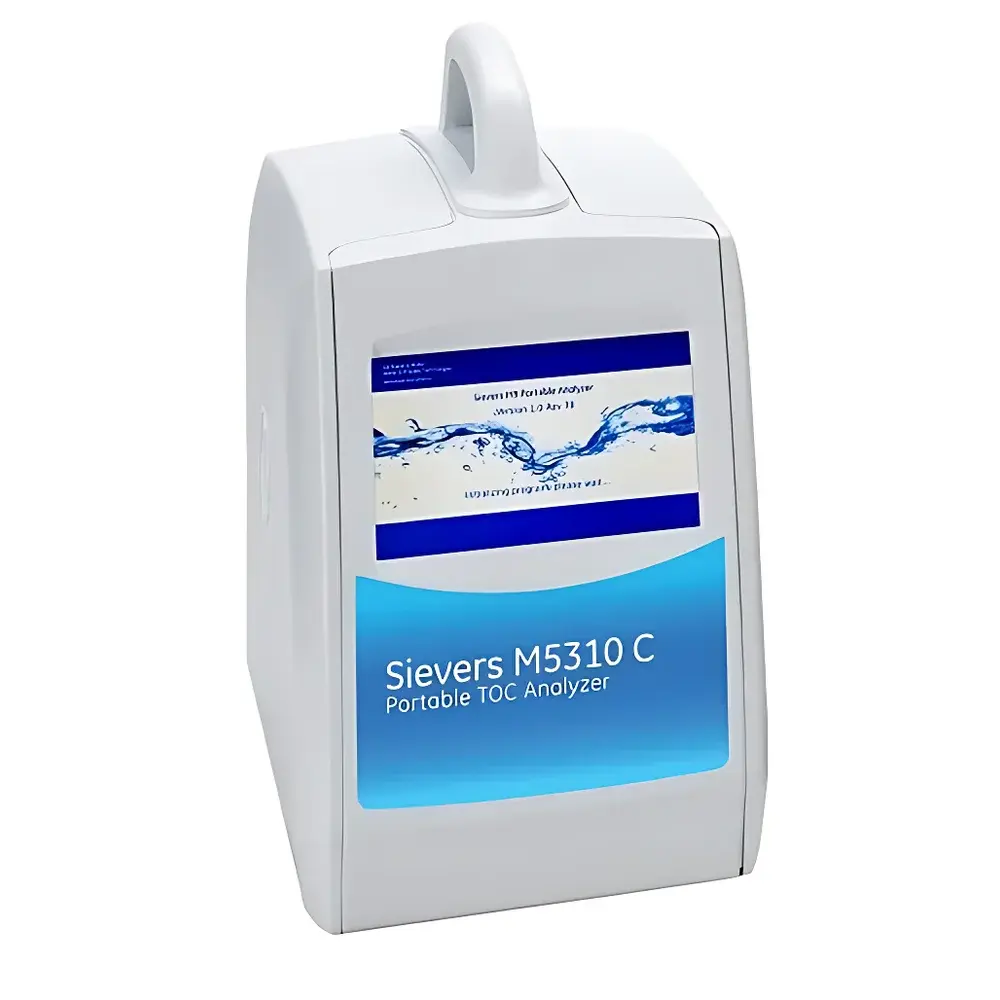
Sievers M5310C Portable Total Organic Carbon (TOC) Analyzer
| Brand | Sievers (Veolia) |
|---|---|
| Origin | USA |
| Model | M5310C Portable |
| Detection Principle | Membrane Conductivity Detection |
| Oxidation Method | UV/Persulfate |
| Measurement Range | 4 ppb – 50 ppm |
| Accuracy | ±2% or ±0.5 ppb (whichever is greater) |
| Resolution | 0.01 ppb |
| Detection Limit | 4 ppb |
| Repeatability | ≤1% RSD |
| Analysis Time | 2 minutes |
| Calibration Interval | 12 months |
| Compliance | US EPA Method 415.3 & Standard Methods 5310 C |
Overview
The Sievers M5310C Portable Total Organic Carbon (TOC) Analyzer is an engineered solution for real-time, field-deployable organic carbon quantification in drinking water distribution systems, treatment plant effluents, and source water monitoring applications. It employs a dual-oxidation strategy—combining ultraviolet (UV) radiation with sodium persulfate—to fully mineralize non-purgeable organic carbon (NPOC) into carbon dioxide. The resulting CO₂ is selectively stripped from the aqueous matrix and measured via high-sensitivity membrane-conductivity detection—a technique offering inherent immunity to ionic interferences and stable baseline performance across variable conductivity backgrounds. Designed specifically for regulatory compliance and operational intelligence in municipal water utilities, the M5310C delivers trace-level sensitivity (4 ppb LOD) and measurement integrity aligned with US EPA Method 415.3 and Standard Methods 5310 C, supporting both discrete grab sampling and semi-continuous monitoring workflows.
Key Features
- Portable, battery-operated platform enabling on-site deployment without external power or gas supply
- Integrated UV/persulfate oxidation module with programmable intensity and reaction time optimization
- Membrane-conductivity CO₂ sensor with temperature-compensated electronics and auto-zero stabilization
- Touchscreen interface with intuitive dashboard navigation, real-time trend visualization, and context-aware error logging
- Automated reagent delivery system that dynamically adjusts persulfate dosage based on sample TOC concentration and matrix conductivity
- Onboard calibration management with audit-trail-enabled auto-calibration scheduling (12-month interval per USP and EPA guidance)
- Ruggedized housing rated IP65 for operation in humid, outdoor, or utility vault environments
Sample Compatibility & Compliance
The M5310C accepts untreated, filtered, or chlorinated drinking water samples without pretreatment. It maintains accuracy across conductivity ranges of 10–1,500 µS/cm and pH 5.5–8.5, accommodating raw surface water, finished potable water, and distribution loop samples. All measurement data are timestamped, user-annotated, and stored with full electronic signature support compliant with FDA 21 CFR Part 11 requirements when paired with validated LIMS integration. The analyzer satisfies GLP/GMP data integrity expectations through immutable audit trails, change control logs, and secure user role permissions (Admin, Operator, Viewer). Its methodology is formally recognized under US EPA Drinking Water Laboratory Certification Program criteria and referenced in AWWA Standard G300 for TOC instrumentation validation.
Software & Data Management
Embedded firmware includes a relational database architecture supporting >10,000 sample records with indexed search by date, location, operator ID, or custom batch tag. Export formats include CSV, PDF reports (with embedded calibration certificates), and XML for direct ingestion into enterprise SCADA or LIMS platforms. Remote diagnostics and firmware updates are supported via encrypted Wi-Fi or USB tethering. Data security adheres to NIST SP 800-53 controls, including AES-256 encryption at rest and TLS 1.2+ for network transfers. Audit logs capture all critical events—including method changes, calibration overrides, and sensor diagnostics—with hash-verified integrity verification.
Applications
- Regulatory compliance monitoring for TOC in finished drinking water per US EPA Stage 2 Disinfectants and Disinfection Byproducts Rule (Stage 2 DBPR)
- Source water characterization and watershed organic load assessment
- Performance verification of granular activated carbon (GAC) and ozone-biofiltration units
- Early detection of organic breakthrough in distribution system storage tanks or dead-end mains
- Validation of membrane integrity in advanced treatment trains (e.g., NF/RO feed monitoring)
- Support for ISO 24510 and ISO 24512 asset management frameworks through quantitative organic carbon trending
FAQ
Does the M5310C require daily calibration or standardization?
No—calibration is required only once every 12 months under normal operating conditions, as verified by internal reference standards and documented in accordance with Standard Methods 5310 C.
Can the instrument operate unattended for extended periods?
Yes; when connected to AC power and configured for continuous mode, it supports automated 2-minute cycle sampling with alarm-triggered data logging and SMS/email alerts via optional gateway integration.
Is method validation documentation available for regulatory submission?
Yes—Veolia provides a complete IQ/OQ/PQ protocol package, including system suitability tests, limit of detection verification, and linearity assessment across the full 4 ppb–50 ppm range.
How does the analyzer handle high-chloride or high-bromide matrices?
The membrane-conductivity detection cell is chemically isolated from the sample stream; chloride and bromide ions do not interfere with CO₂ quantification, eliminating need for post-oxidation quenching steps.
What cybersecurity safeguards are implemented in the firmware?
Firmware v3.2+ enforces password complexity policies, session timeouts, disabled default credentials, and secure boot verification—certified against IEC 62443-3-3 SL2 requirements for industrial control systems.







