
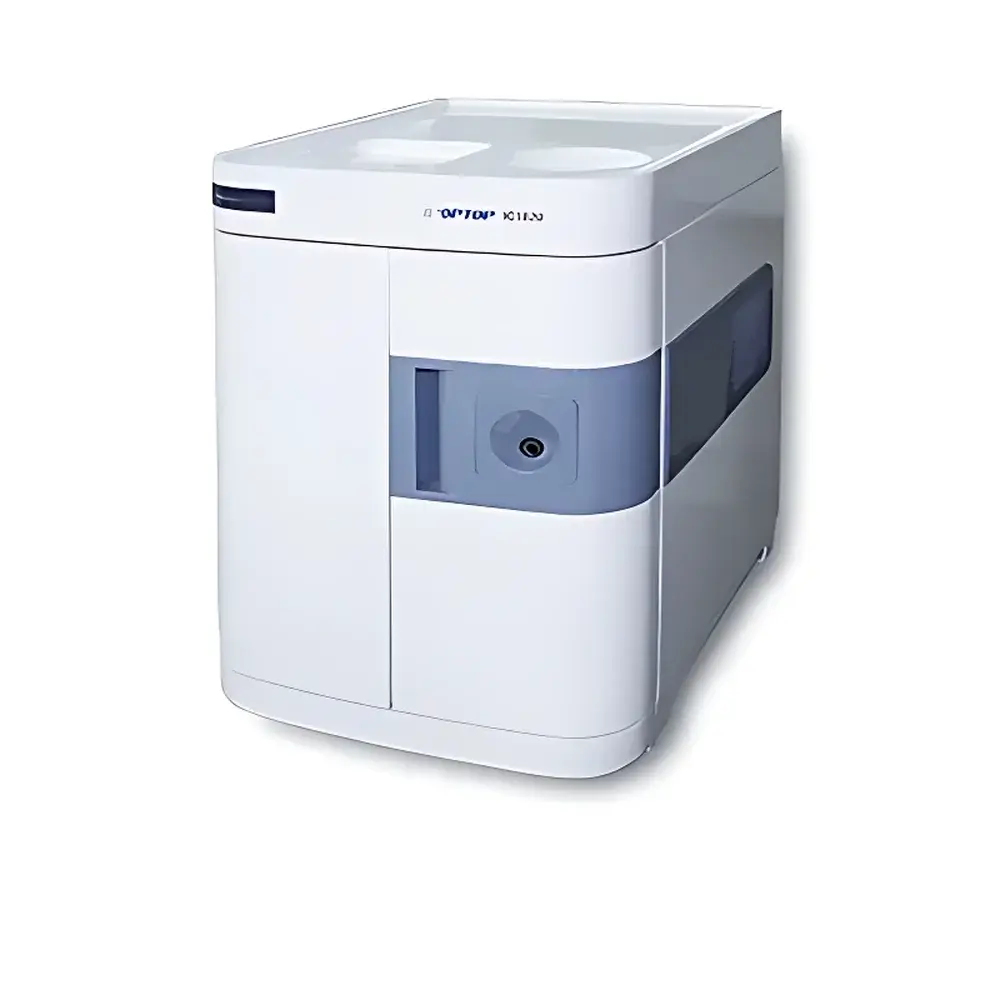
Sunny Hengping IC1820 Ion Chromatograph
| Brand | Sunny Hengping Instrument |
|---|---|
| Origin | Shanghai, China |
| Manufacturer Type | Direct Manufacturer |
| Region of Origin | Domestic (China) |
| Model | IC1820 |
| Instrument Type | Laboratory Benchtop |
| Maximum Pump Pressure | 35 MPa |
| Flow Rate Range | 0–9.999 mL/min |
| Eluent Flow Rate | 1.5 mL/min |
| Max Operating Pressure | 15 MPa |
| Column Oven Temperature Range | 25–60 °C |
| Temperature Stability | ±0.5 °C |
| Eluent Concentration Range | 0–100 mM (OH⁻ or CO₃²⁻/HCO₃⁻) |
Overview
The Sunny Hengping IC1820 Ion Chromatograph is a high-performance, laboratory-grade analytical system engineered for precise, reproducible separation and quantitative detection of inorganic anions and cations in complex aqueous matrices. Based on suppressed conductivity detection and high-efficiency ion-exchange chromatography, the IC1820 employs dual-piston parallel constant-flow pumping, electrochemical eluent generation (EDG), and continuous automatic regeneration micro-membrane suppression to deliver robust, low-drift baseline performance with minimal manual intervention. Designed specifically for routine compliance testing in environmental, food & beverage, pharmaceutical, and industrial quality control laboratories, it meets core operational requirements for regulatory workflows aligned with ISO 10304-1, ASTM D4327, EPA Method 300.0/317.0, and USP . Its fully PEEK-wetted flow path—compatible with high-pH hydroxide eluents and low-pH acidic eluents—ensures long-term chemical inertness and resistance to corrosion from aggressive mobile phases.
Key Features
- Modular, integrated mainframe architecture with plug-and-play component recognition—no manual configuration required for detector, pump, or suppressor modules.
- Dual-piston parallel constant-flow pump delivering flow accuracy ≤±0.1% RSD at 1.5 mL/min and pressure stability up to 35 MPa (5000 psi), suitable for high-resolution capillary and standard-bore column applications.
- Air-circulating 3D thermostatic column oven (25–60 °C, ±0.5 °C stability) ensuring retention time reproducibility and peak shape consistency across multi-hour sequences.
- Electrodialytic eluent generator (EDG) for on-demand OH⁻ eluent production—eliminates manual preparation, reduces CO₂ contamination, and enables gradient elution without physical mixing.
- Automatically regenerating anion micro-membrane suppressor (dead volume <50 µL) with digitally adjustable current (0–350 mA, 0.1 mA increments), enabling rapid equilibration and stable background conductivity (<0.1 µS).
- Integrated online degasser using gas–liquid membrane separation technology with miniature vacuum pump (0.05 MPa vacuum); built-in, maintenance-free operation with no external gas supply needed.
- Full-plasticized fluidic path (PEEK pump head, PEEK tubing, PEEK valves) resistant to oxidation, hydrolysis, and metal leaching—validated for ≥2 years continuous operation under GLP-compliant conditions.
Sample Compatibility & Compliance
The IC1820 supports direct injection of filtered aqueous samples—including drinking water, wastewater, soft drinks, beer, dairy extracts, semiconductor rinse water, and battery electrolyte solutions—without derivatization. Its low system dispersion (<10 µL total extra-column volume) preserves resolution for early-eluting ions (e.g., F⁻, Cl⁻, NO₂⁻). The instrument complies with data integrity requirements per FDA 21 CFR Part 11 when operated with validated software (e.g., IC Navigator v3.2+), supporting electronic signatures, audit trails, and role-based access control. All hardware components are CE-marked and conform to IEC 61010-1 safety standards for laboratory electrical equipment.
Software & Data Management
Controlled via IC Navigator software (Windows 10/11, 64-bit), the IC1820 provides method development tools including gradient editor, peak integration optimizer, and real-time conductivity baseline monitoring. Raw data files (.icd) are stored in vendor-neutral format with embedded metadata (instrument ID, operator, timestamp, sequence ID, calibration history). Software supports automated report generation compliant with ISO/IEC 17025 documentation requirements, including uncertainty estimation per EURACHEM/CITAC guidelines. Audit trail logs record all parameter changes, sequence modifications, and user logins with immutable timestamps—fully traceable during GMP/GLP inspections.
Applications
- Environmental: Quantification of fluoride, chloride, nitrate, sulfate, phosphate, and perchlorate in surface water, groundwater, and treated effluent per EPA Method 300.1.
- Food & Beverage: Anion profiling in beer (SO₄²⁻, Cl⁻), soft drinks (benzoate, sorbate), infant formula (I⁻, SCN⁻), and brewing water (alkalinity speciation).
- Pharmaceutical: Counter-ion analysis (Na⁺, K⁺, Ca²⁺) in APIs and excipients; residual acetate or citrate in biologics formulations.
- Industrial QA: Monitoring of halides and carboxylates in lithium-ion battery electrolytes; chloride ingress testing in concrete pore water.
- Academic Research: Speciation studies of transition metal complexes via anion-exchange coupled with post-column reaction detection.
FAQ
Does the IC1820 support both anion and cation analysis?
Yes—the system is configurable for either mode via interchangeable columns, suppressors, and eluent chemistries. Anion analysis uses KOH or Na₂CO₃/NaHCO₃ eluents with ASRS-ULTRA suppressor; cation analysis employs methanesulfonic acid (MSA) with CSRS-ULTRA suppressor.
Is the EDG module compatible with gradient elution?
Yes—IC Navigator enables programmable current ramping across run time, allowing linear or stepwise OH⁻ concentration gradients (e.g., 5–50 mM in 20 min) for improved resolution of complex anion mixtures.
What is the minimum detectable concentration for common anions?
At optimal signal-to-noise (S/N ≥ 3), typical LODs are: F⁻ = 0.1 µg/L, Cl⁻ = 0.2 µg/L, NO₃⁻ = 0.3 µg/L, SO₄²⁻ = 0.5 µg/L—achievable using 25 µL loop injection and 4-mm analytical columns.
Can the IC1820 be integrated into a LIMS environment?
Yes—via ODBC-compliant database export and HL7/ASTM E1384 message support. Raw data and processed results can be pushed directly to enterprise LIMS platforms with configurable field mapping.
What maintenance intervals are recommended for the suppressor and EDG cell?
The suppressor requires no consumables and operates continuously for ≥2 years under normal use (≤100 injections/day). The EDG cell is rated for ≥5000 hours of operation; periodic cleaning with 0.1 M HNO₃ is advised every 6 months for high-matrix samples.






