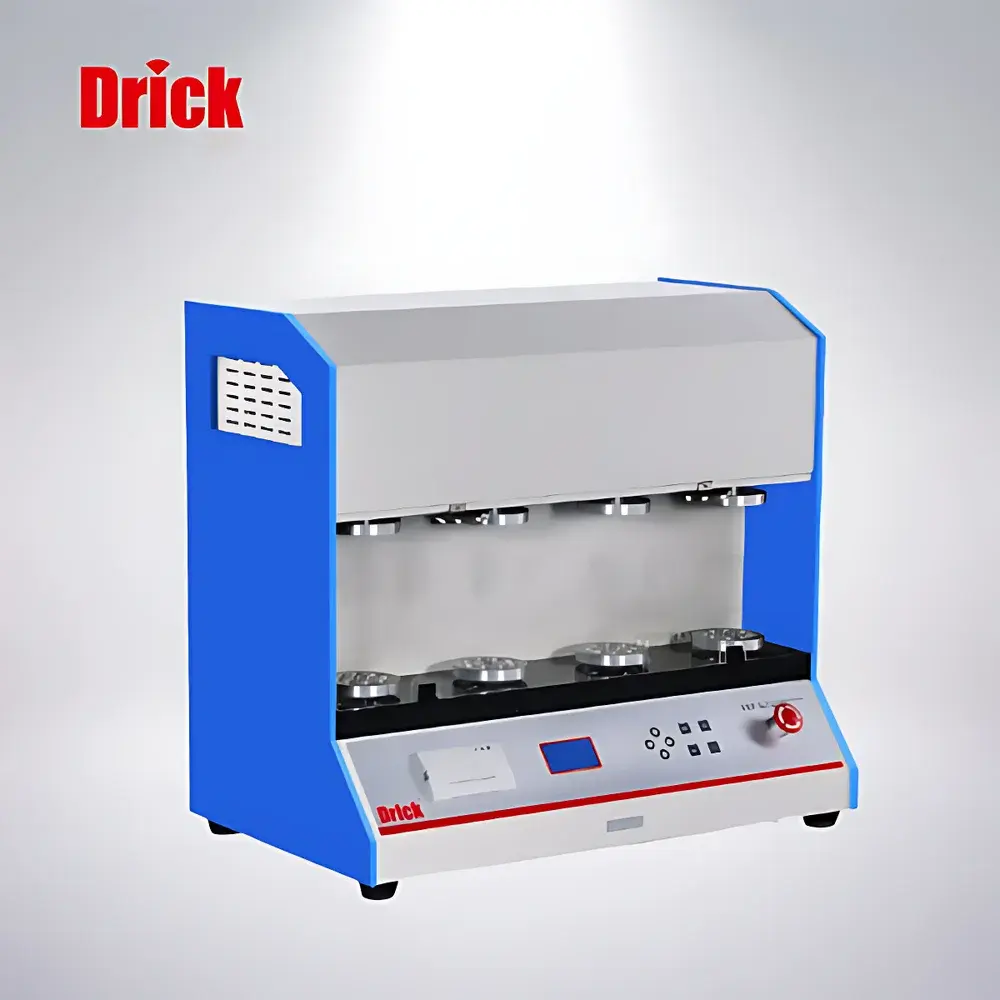
Drick DRK162 Four-Station Tumble Resistance Tester for Packaging Films
| Brand | Drick |
|---|---|
| Origin | Shandong, China |
| Manufacturer Type | Manufacturer |
| Country of Origin | China |
| Model | DRK162 |
| Price | USD 7,000 (FOB Qingdao) |
| Standard Compliance | ASTM F392 |
| Tumbling Frequency | 45 cycles/min |
| Tumbling Angle | 440° or 400° |
| Horizontal Stroke | 155 mm or 80 mm |
| Sample Thickness Limit | ≤2.5 mm (custom fixtures available for thicker specimens) |
| Sample Dimensions | 280 mm × 200 mm |
| Number of Stations | 4 |
| Sample Capacity | 1–4 specimens per test |
| Power Supply | AC 220 V ±5%, 50 Hz |
| Net Weight | 110 kg |
| Host Dimensions | 800 mm (L) × 450 mm (W) × 605 mm (H) |
| Control System | Microprocessor-based with LCD interface and PVC membrane keypad |
| Safety Features | Dual hardware/software interlocks + automatic reset function |
| Optional Accessories | Sample cutter, stainless-steel hose clamps (91–114 mm) |
Overview
The Drick DRK162 Four-Station Tumble Resistance Tester is an engineered solution for evaluating the mechanical durability of flexible packaging materials under repeated flexing, folding, and torsional stress—conditions routinely encountered during manufacturing, filling, transport, and end-user handling. Based on the principle of controlled cyclic tumbling motion defined in ASTM F392 “Standard Test Method for Flexing Endurance of Flexible Barrier Materials,” the instrument subjects four specimens simultaneously to standardized angular displacement, horizontal stroke, and rotational torque. Each station operates independently with synchronized kinematics, enabling comparative assessment across variable material formulations, layer architectures, or surface treatments. The system replicates real-world degradation mechanisms—including microcrack formation, delamination at interfacial layers, coating abrasion, and barrier integrity loss—making it essential for R&D validation, QC release testing, and shelf-life modeling in pharmaceutical blister packaging, food pouch development, and medical device sterile barrier systems.
Key Features
- Four independent test stations allow parallel evaluation of up to four specimens under identical or differentiated parameter sets—significantly reducing cumulative test time versus single-station alternatives.
- Five pre-programmed test modes (including fixed-angle, variable-stroke, accelerated-cycle, low-torque, and high-frequency configurations) support method flexibility aligned with internal SOPs or regulatory expectations.
- Quick-switch mechanism enables seamless transition between long-stroke (155 mm) and short-stroke (80 mm) configurations without tooling—optimized for both thin-film flutter analysis and rigid-laminate fatigue simulation.
- Servo-driven actuation ensures precise angular positioning (±0.5° repeatability) and consistent cycle timing (1.33 s/cycle nominal), minimizing inter-run variability and enhancing data reproducibility across laboratories.
- Integrated dual-layer safety architecture includes hardware-based emergency stop circuitry, software-monitored motor current thresholds, and automatic mechanical reset upon cycle completion—ensuring operator protection and equipment longevity.
- Intuitive human-machine interface features a backlit LCD display, tactile PVC keypad, and hierarchical menu navigation—designed for rapid method selection, real-time parameter monitoring, and error-code diagnostics without requiring PC connectivity.
Sample Compatibility & Compliance
The DRK162 accommodates a broad spectrum of flexible substrates conforming to ASTM F392 scope: plastic films (e.g., PET, OPP, PE, PVDC-coated), laminates (aluminum foil composites, metallized CPP), coated papers, synthetic leathers (per GB/T 8948 reference application), and functional barrier structures used in pharmaceutical unit-dose packaging. Specimens up to 280 mm × 200 mm and 2.5 mm thick are supported in standard configuration; optional custom fixtures extend compatibility to thicker composites or irregular geometries. All operational parameters—including angular displacement (400°/440°), stroke length, and cycle count—are fully programmable and auditable. The instrument meets mechanical and electrical safety requirements per IEC 61000-6-2 (EMC immunity) and IEC 61000-6-4 (EMC emissions), and its firmware supports traceable calibration logs required under GLP and ISO/IEC 17025-accredited environments.
Software & Data Management
While the DRK162 operates as a stand-alone unit with embedded microcontroller logic, its digital architecture permits integration into centralized lab informatics platforms via RS-232 or optional USB-to-serial interface. Test parameters, cycle counts, and pass/fail status are stored in non-volatile memory with timestamping. The built-in thermal printer outputs hard-copy reports containing specimen ID, test mode, total cycles completed, and operator signature field—supporting 21 CFR Part 11-compliant record retention when paired with secure user login protocols (via external authentication gateway). Audit trails for parameter changes, firmware updates, and calibration events can be exported in CSV format for quality system review.
Applications
- Pharmaceutical packaging: Validation of blister foil integrity after simulated carton vibration and pallet stacking stresses.
- Food packaging R&D: Correlation of tumble resistance with oxygen transmission rate (OTR) and water vapor transmission rate (WVTR) post-abrasion.
- Medical device packaging: Assessment of seal strength retention in Tyvek®/PET pouches following ISTA 2A transport simulation sequences.
- Adhesive performance: Quantification of cohesive failure onset in pressure-sensitive laminates under repeated shear-flex combinations.
- Recycled content qualification: Benchmarking mechanical robustness of PCR-based films against virgin-material baselines under identical tumbling profiles.
FAQ
What standards does the DRK162 comply with?
ASTM F392 is the primary referenced standard; additional alignment with ISO 11607-2 Annex B (for medical packaging) and JIS Z 1707 (Japanese packaging durability testing) is achievable through parameter customization.
Can the instrument be used for non-packaging materials such as textiles or gaskets?
Yes—provided specimens fall within dimensional and thickness limits and exhibit sufficient flexibility to undergo 400°+ angular deformation without catastrophic rupture; empirical method validation is recommended prior to routine use.
Is remote monitoring or data export supported?
Real-time serial output enables connection to SCADA or LIMS systems; raw cycle data and event logs are exportable via terminal emulation software or optional Windows-based companion application.
How is calibration verified?
Calibration is performed using traceable angular encoders and linear displacement sensors; annual verification kits—including certified angle gauge blocks and stroke verification templates—are available directly from Drick Calibration Services.
What maintenance intervals are recommended?
Lubrication of guide rails and inspection of drive belt tension every 500 operational hours; servo motor encoder alignment check every 2,000 hours or annually—whichever occurs first.