
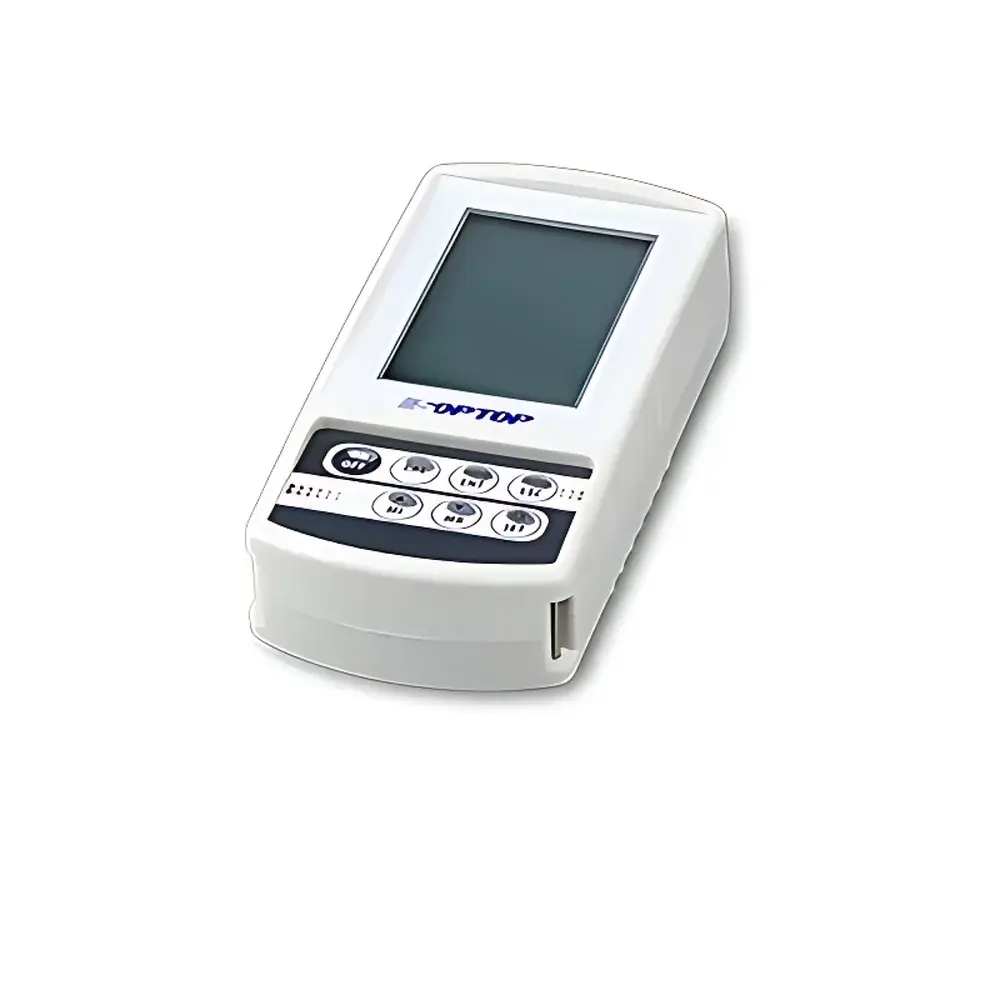
SOP TOP CON6301 Portable Conductivity Meter
| Brand | SOP TOP |
|---|---|
| Model | CON6301 |
| Conductivity Range | 0–5.000 µS/cm, 0–50.00 µS/cm, 0–500.0 µS/cm, 0–5000 µS/cm, 0–50.00 mS/cm, 0–500.0 mS/cm |
| TDS Range | 0–500 ppt |
| Salinity Range | 0–325 ppt |
| Conductivity Resolution | 0.001–1 µS/cm, 0.01 mS/cm |
| Conductivity Accuracy | ±1% of Full Scale |
| Resistivity Range | 0.00–18.30 MΩ·cm |
| Resistivity Resolution | 0.01 MΩ·cm |
| Temperature Range | −5.0–120.0 °C (23.0–248.0 °F) |
| Temperature Accuracy | ±0.3 °C, ±0.5 °F |
| Temperature Resolution | 0.1 °C / 0.1 °F |
| Temp. Compensation | Auto/Manual |
| Reference Temp. | 15.0–30.0 °C (factory set at 25.0 °C) |
| Temp. Coefficient | 0.00–9.99% (factory default 2.00%) |
| TDS Factor | 0.40–1.00 (factory default 0.50) |
| Salinity Factor | 0.65 |
| Cell Constant Options | 0.01, 0.1, 1.0, 10.0 cm⁻¹ |
| IP Rating | IP67 |
| Data Storage | 100 measurement records |
| Power | 2 × 1.5 V AA batteries |
| Auto-Off | Configurable (default: 10 min idle) |
Overview
The SOP TOP CON6301 Portable Conductivity Meter is a field-deployable, laboratory-grade electrochemical instrument engineered for precise and reliable measurement of electrical conductivity, total dissolved solids (TDS), salinity, and resistivity in aqueous solutions. Based on the fundamental principle of two-electrode or four-electrode conductometric measurement—where conductivity is derived from the reciprocal of electrical resistance normalized by cell geometry—the CON6301 delivers high reproducibility across six selectable conductivity ranges spanning from ultra-pure water (0.001 µS/cm) to highly concentrated brines (500.0 mS/cm). Its rugged, IP67-rated enclosure ensures operational integrity in demanding environments including wastewater treatment plants, environmental monitoring sites, aquaculture facilities, and industrial process streams. Designed for compliance with routine quality control workflows, the meter supports traceable measurements under ISO/IEC 17025-aligned practices when used with calibrated electrodes and documented temperature compensation protocols.
Key Features
- Rugged IP67-rated housing for dust-tight and immersion-resistant operation (1 m for 30 min)
- Large 3.2-inch multi-line LCD display with anti-scratch surface and user-adjustable high-brightness backlight
- Simultaneous real-time display of conductivity, TDS, salinity, resistivity, and temperature
- Auto-ranging and manual range selection with automatic unit conversion (µS/cm, mS/cm, ppm, ppt)
- Configurable temperature compensation (linear, non-linear, or disabled) with adjustable reference temperature (15.0–30.0 °C) and temperature coefficient (0.00–9.99 %/°C)
- Integrated electrode health diagnostics—including conductivity cell constant verification and contact integrity alerts
- Programmable auto-off function (1–60 min idle timeout) and battery-saving low-power architecture
- Dual power mode: standard 2×AA alkaline batteries (typical life >200 hours) with optional USB-powered operation via external adapter
- Onboard data logging of up to 100 timestamped measurements with manual or auto-triggered storage
Sample Compatibility & Compliance
The CON6301 is compatible with standardized conductivity cells featuring cell constants of 0.01, 0.1, 1.0, and 10.0 cm⁻¹—enabling accurate measurement across diverse sample matrices, including deionized water, potable water, seawater, industrial effluents, and nutrient solutions. It meets general requirements for field-portable instrumentation per ASTM D1125 (Standard Test Methods for Electrical Conductivity and Resistivity of Water) and supports calibration traceability to NIST-traceable KCl standards. While not certified for regulated GMP/GLP environments out-of-the-box, its stable analog front-end, linear response, and audit-ready data export capability (via optional USB interface) enable integration into validated workflows compliant with FDA 21 CFR Part 11 when paired with appropriate software controls and procedural documentation.
Software & Data Management
The CON6301 supports optional PC-based data acquisition through a dedicated USB communication interface and proprietary SOP TOP DataLink software (included on CD-ROM). The software enables real-time streaming, batch export to CSV/Excel, graphical trend visualization, calibration report generation, and user-defined annotation fields. All stored measurements retain embedded metadata—including date/time stamp, temperature reading, selected cell constant, and compensation settings—ensuring full measurement provenance. For laboratories operating under GLP or ISO 17025, the software can be configured to enforce electronic signatures, version-controlled calibration logs, and immutable audit trails when deployed on secure networked workstations.
Applications
- Environmental field testing: river, lake, and groundwater quality assessment per EPA Method 120.1
- Pharmaceutical water system monitoring (PW, WFI) during routine checks and sanitization validation
- Aquaculture and hydroponics: nutrient solution strength verification and osmotic balance tracking
- Food & beverage production: rinse water conductivity verification, CIP cycle endpoint detection
- Academic teaching labs: hands-on instruction in solution chemistry, electrolyte behavior, and colligative properties
- Industrial boiler feedwater and cooling tower management per ASME PTC 19.11 guidelines
FAQ
What cell constants are supported by the CON6301?
The instrument accepts conductivity cells with standardized cell constants of 0.01 cm⁻¹ (for ultrapure water), 0.1 cm⁻¹ (low-conductivity samples), 1.0 cm⁻¹ (general-purpose use), and 10.0 cm⁻¹ (high-salinity or viscous media). Each requires corresponding manual entry or auto-recognition via encoded plug-in connectors.
Does the CON6301 comply with USP or EP 2.2.38 for conductivity testing?
While the hardware meets baseline accuracy and temperature compensation requirements outlined in these pharmacopeial chapters, full compliance necessitates use of a USP-certified cell, documented calibration against certified KCl standards, and adherence to defined system suitability tests—procedures supported but not automated by the device.
Can measurement data be exported in a format suitable for LIMS integration?
Yes—CSV exports generated via SOP TOP DataLink include all raw and compensated values, timestamps, and instrument configuration parameters, enabling direct ingestion into most LIMS platforms via standard import modules or API middleware.
Is the IP67 rating maintained when the USB port cover is open?
No—the IP67 rating applies only when all protective caps and covers are fully sealed. The USB port cover must be closed during immersion or high-humidity exposure.
How is temperature compensation applied during measurement?
The CON6301 applies linear temperature correction using the formula: σT = σmeas / [1 + α(T − Tref)], where α is the configurable temperature coefficient, T is measured temperature, and Tref is the user-selected reference temperature (default 25.0 °C).





