
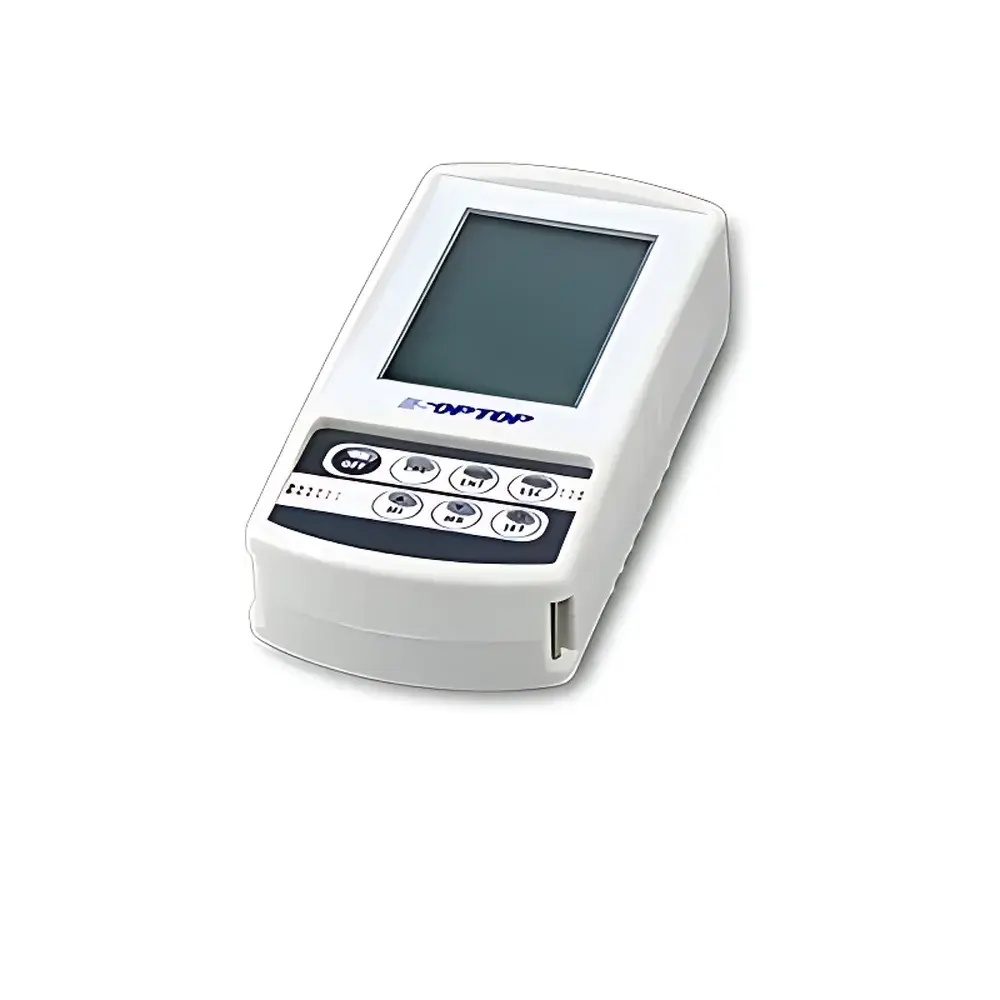
SOPOTOP DO6401 Portable Dissolved Oxygen Meter
| Brand | SOPOTOP |
|---|---|
| Origin | Shanghai, China |
| Model | DO6401 |
| Measurement Range | 0.00–40.00 mg/L and 0.0–400.0% saturation |
| Resolution | 0.01 mg/L, 0.1% |
| Accuracy | ±1.5% F.S. |
| Temperature Range | −5.0 to 120.0 °C (23.0 to 248.0 °F) |
| Temp. Resolution | 0.1 °C / 0.1 °F |
| Temp. Accuracy | ±0.3 °C / ±0.5 °F |
| Salinity Compensation | 0.0–45.0 ppt |
| Pressure Compensation | 450–800 mmHg or 0.500–1.100 bar |
| Pipe Pressure Compensation | 0.00–1.00 kg |
| Depth Compensation | 0.0–10.0 m |
| IP Rating | IP67 |
| Data Storage | 100 sets |
| Auto Power-Off | Configurable (default: 10 min inactivity) |
| Display | 3.2-inch multi-line LCD with anti-scratch coating |
| Power | 2 × 1.5 V AA batteries |
| Electrode Diagnostics | Offset & Slope display, self-diagnostic status |
| Connectivity | Optional USB interface |
| Software | Optional data acquisition software with PC compatibility |
Overview
The SOPOTOP DO6401 Portable Dissolved Oxygen Meter is an electrochemical field instrument engineered for high-reliability measurement of dissolved oxygen (DO) concentration in aqueous media using polarographic (Clark-type) sensor technology. It operates on the principle of oxygen reduction at a cathode immersed in an electrolyte-filled membrane cell, generating a current proportional to the partial pressure of dissolved O₂. Designed for environmental monitoring, wastewater treatment, aquaculture, and laboratory fieldwork, the DO6401 delivers stable, temperature-compensated readings across a broad operational range while maintaining compliance with standard electrochemical measurement practices defined in ASTM D888 and ISO 5814. Its ruggedized housing and IP67-rated enclosure ensure uninterrupted performance in humid, dusty, or splash-prone environments—including riverbanks, effluent channels, and industrial process points.
Key Features
- Polarographic DO sensing with replaceable Clark-type membrane electrode—compatible with standard 12-mm shaft electrodes (e.g., SOPOTOP DOE-12 series)
- Dual-unit display: simultaneous mg/L and % saturation readouts with real-time unit switching
- Integrated multi-parameter compensation engine: automatic temperature, salinity, barometric pressure, pipe pressure, and depth correction algorithms per ISO 5814 Annex B
- High-contrast 3.2-inch LCD with anti-scratch surface and user-selectable backlight intensity—optimized for outdoor visibility under direct sunlight
- Electrode health diagnostics: real-time display of slope (%/decade), offset (nA), and membrane integrity flag based on calibration validation criteria
- Configurable auto-power-off (1–60 minutes), manual hold function, and audible keypress feedback for glove-compatible operation
- Built-in temperature sensor with ±0.3 °C accuracy and 0.1 °C resolution; supports both Celsius and Fahrenheit output
- Non-volatile memory stores up to 100 timestamped measurement records with associated environmental parameters (T, S, P, depth)
Sample Compatibility & Compliance
The DO6401 is validated for use with natural waters (freshwater, seawater, estuarine), municipal and industrial effluents, cooling tower fluids, and bioreactor broths. It meets IEC 61000-6-2 (immunity) and IEC 61000-6-3 (emission) standards for portable instrumentation. While not certified for intrinsic safety in hazardous areas, its low-power design (≤10 mA operating current) and absence of internal rechargeable batteries render it suitable for Zone 2/Class I, Division 2 environments when used with appropriate external barriers. Calibration traceability aligns with NIST-traceable DO standards (e.g., Winkler titration reference or certified zero-oxygen and air-saturated water solutions). The device supports GLP-compliant workflows via optional audit-ready data export (CSV/TXT) and timestamped calibration logs.
Software & Data Management
An optional Windows-compatible data acquisition suite enables synchronized logging of DO, temperature, salinity, pressure, and depth parameters at user-defined intervals (1 sec–60 min). Raw data exports include metadata headers compliant with ASTM E1447 for electronic lab notebook integration. USB communication uses CDC ACM class protocol—no proprietary drivers required. Software features include calibration curve visualization, drift trend analysis over time, and automated report generation (PDF/Excel) with configurable templates. All exported files retain embedded timestamps, instrument ID, and operator annotations—supporting FDA 21 CFR Part 11 requirements when deployed with institutional electronic signature policies.
Applications
- Field-based assessment of stream and lake DO profiles for EPA Section 303(d) TMDL development
- Real-time monitoring of activated sludge tanks and anaerobic digesters in WWTPs
- Aquaculture pond management—correlating DO levels with feeding cycles and biomass density
- Pharmaceutical clean-in-place (CIP) rinse validation where residual oxygen must remain below 0.1 mg/L
- Educational labs requiring robust, student-safe instrumentation for electrochemical principles instruction
- Environmental consulting projects requiring rapid deployment and regulatory-grade documentation
FAQ
What electrode types are compatible with the DO6401?
The instrument accepts standard 12-mm diameter polarographic DO electrodes with integrated thermistors (e.g., SOPOTOP DOE-12, YSI 58-type equivalents). Membrane replacement kits and electrolyte solutions are available as consumables.
Does the DO6401 support two-point calibration?
Yes—it supports both zero-point (sodium sulfite solution) and span-point (air-saturated water or saturated aqueous salt solution) calibration protocols per ISO 5814 Clause 7.2.
Can depth compensation be disabled for surface measurements?
Yes—depth compensation is fully optional and may be set to “0.0 m” or disabled via the setup menu without affecting other compensation functions.
Is the device suitable for continuous submerged operation?
No—the IP67 rating covers temporary immersion (up to 1 m for 30 minutes), not continuous submersion. For long-term in-situ deployment, a dedicated fixed-mount DO transmitter is recommended.
How is traceability maintained during field calibrations?
Calibration events are logged with date/time stamp, electrode ID, slope/offset values, and ambient conditions—exportable for QA review and audit trails in regulated environments.




