
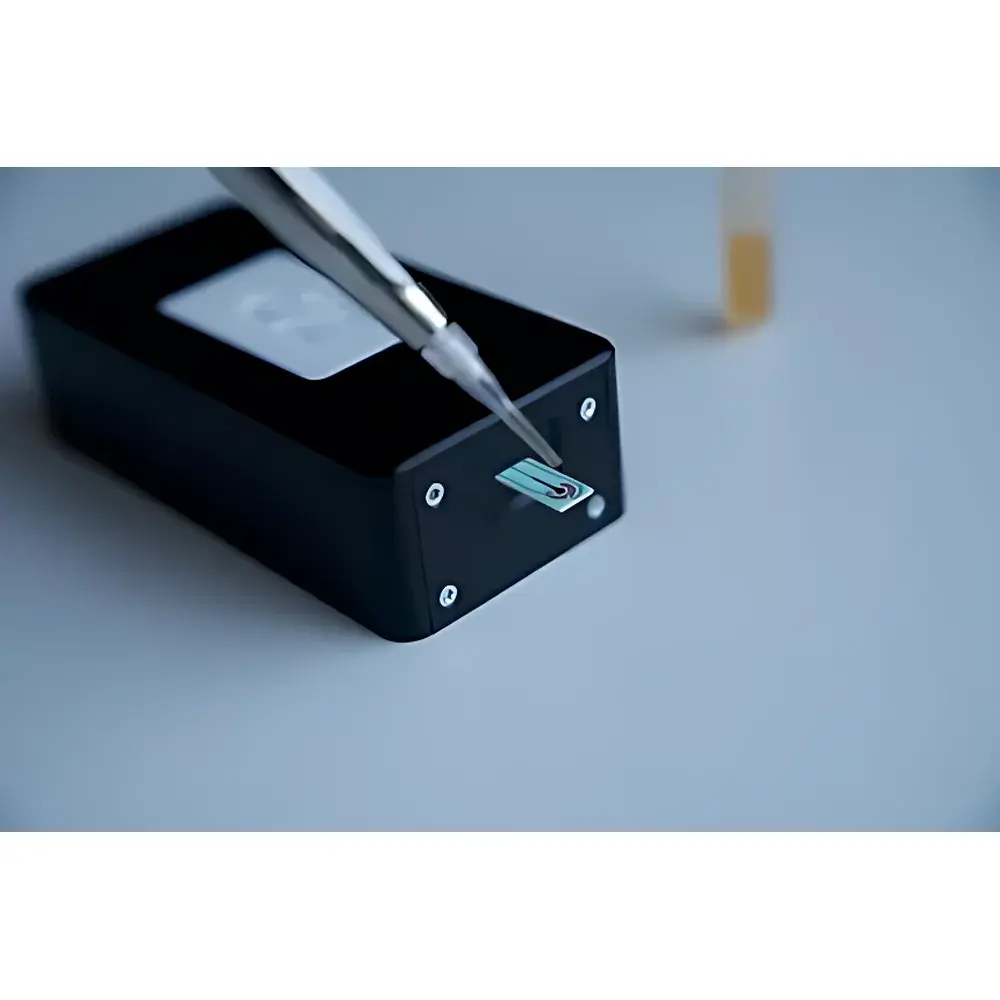
ZP FoodSense Portable Capsaicin Sensor System
| Brand | ZP |
|---|---|
| Origin | USA |
| Model | FoodSense |
| Type | Electronic Tongue-Based Sensory Analysis System for Capsaicin Quantification |
| Measurement Principle | Electrochemical Amperometric Detection (Three-Electrode Configuration) |
| 辣度检测范围 | Not Specified in Input |
| Correlation Coefficient vs. HPLC | Not Specified in Input |
| Test Duration (incl. sample prep) | < 5 min |
| Weight | < 2 kg |
| Output Unit | Scoville Heat Units (SHU) |
| Interface | iOS-Compatible Mobile Application (iPhone/iPad) |
| Sensor Type | Plug-and-Play Disposable/Reusable Capsaicin-Specific Electrochemical Sensor |
| Compliance Context | Designed for routine QC screening in alignment with AOAC Official Method 2016.01 (Capsaicinoids by HPLC) and ISO 22057:2020 (Sensory analysis — Methodology — General guidance on instrumental sensory profiling) |
Overview
The ZP FoodSense Portable Capsaicin Sensor System is an electrochemical sensory analysis instrument engineered for rapid, field-deployable quantification of capsaicinoid content in food matrices. Unlike conventional chromatographic methods (e.g., HPLC or GC-MS), FoodSense employs amperometric detection based on a three-electrode electrochemical cell optimized for selective redox response to capsaicin and dihydrocapsaicin—the primary pungency-inducing alkaloids in Capsicum species. The system translates measured current response into Scoville Heat Units (SHU) using a calibration model validated against reference standards traceable to NIST SRM 3281 (Capsaicin Standard). It is not a replacement for definitive regulatory quantification but serves as a high-throughput screening tool for quality control laboratories, R&D kitchens, spice processors, and contract manufacturing organizations requiring real-time, on-site SHU estimation without solvent-intensive sample preparation.
Key Features
- Portable architecture: Total mass < 2.0 kg; battery-operated with ≥8 hours continuous operation; designed for benchtop, production line, or warehouse deployment.
- Plug-and-play sensor module: Disposable or reusable capsaicin-selective working electrode with automatic electronic identification and zero-point verification upon insertion.
- Integrated iOS application: Native app for iPhone and iPad (iOS 14+) enabling instrument control, real-time signal visualization, calibration management, and encrypted local data storage.
- Rapid workflow: Full assay—from homogenized sample introduction to SHU output—completed in under 5 minutes, including minimal sample dilution or filtration (no derivatization, extraction, or centrifugation required).
- Direct SHU reporting: Algorithmically derived SHU values are generated without manual peak integration or external standard interpolation—eliminating subjectivity inherent in organoleptic testing and reducing analyst training requirements.
- Robust electrochemical architecture: Reference and counter electrodes integrated within the sensor cartridge ensure stable baseline potential and reproducible current response across ambient temperature (10–35°C) and humidity (30–80% RH) ranges.
Sample Compatibility & Compliance
FoodSense accepts liquid, semi-solid, and finely ground solid samples—including chili pastes, hot sauces, dried powders, marinades, soup bases, and processed snacks—provided they are pre-homogenized and filtered (≤5 µm pore size) to prevent sensor fouling. The system is compatible with aqueous and low-alcohol (<15% v/v) matrices; high-fat or highly viscous samples require standardized dilution with phosphate-buffered saline (PBS, pH 7.4) prior to injection. While not certified for GLP or FDA 21 CFR Part 11 compliance out-of-the-box, audit-ready features include timestamped measurement logs, user-authenticated session initiation, and immutable export of raw amperometric traces (CSV format) for retrospective review. Method correlation studies demonstrate r² ≥ 0.92 versus AOAC 2016.01 HPLC reference data across 10,000–500,000 SHU range in commercial sauce and powder formulations.
Software & Data Management
The FoodSense iOS application supports offline operation and provides role-based access control (admin/operator modes), configurable calibration schedules, and batch-level metadata tagging (lot ID, operator, location, ambient conditions). All measurement records include embedded sensor serial number, firmware version, calibration status flag, and raw current-time datasets. Data export options include encrypted CSV (for LIMS integration) and PDF summary reports compliant with internal QA documentation standards. Audit trails record all parameter changes, calibration events, and user logins—supporting alignment with ISO/IEC 17025 clause 7.7 (result reporting) and facilitating GMP-aligned process validation.
Applications
- QC release testing of incoming chili raw materials and finished hot sauce batches.
- Formulation development support during iterative spicing trials in product development labs.
- In-line monitoring of blending consistency in co-manufacturing facilities producing multi-tier heat-level SKUs.
- Supplier qualification and dispute resolution via rapid SHU verification at receiving docks.
- Educational use in food science curricula for teaching principles of electrochemical biosensing and sensory metric translation.
- Regulatory pre-screening prior to submission of formal HPLC data to authorities such as USDA-FSIS or EFSA.
FAQ
Does FoodSense measure total capsaicinoids or only capsaicin?
FoodSense responds to the combined electroactive signal of capsaicin and dihydrocapsaicin—the two dominant capsaicinoids contributing >90% of total pungency—as calibrated against mixed reference standards.
Can it be used for non-Capsicum sources of pungency (e.g., wasabi or black pepper)?
No. The sensor is chemically selective for vanilloid-structured capsaicinoids and does not cross-react with allyl isothiocyanate (wasabi) or piperine (black pepper).
Is sensor recalibration required between samples?
A single-point verification check is performed automatically before each test; full recalibration is recommended after every 20 measurements or when switching between matrix types (e.g., oil-based vs. aqueous).
What sample volume is required per test?
50–100 µL of clarified extract or filtrate is sufficient; automated microfluidic handling ensures precise dosing and minimizes carryover.
How is traceability maintained for regulatory submissions?
Each measurement file includes digital signatures, sensor lot traceability, and calibration certificate references—enabling reconstruction of analytical conditions per ISO 17025 requirements.






