
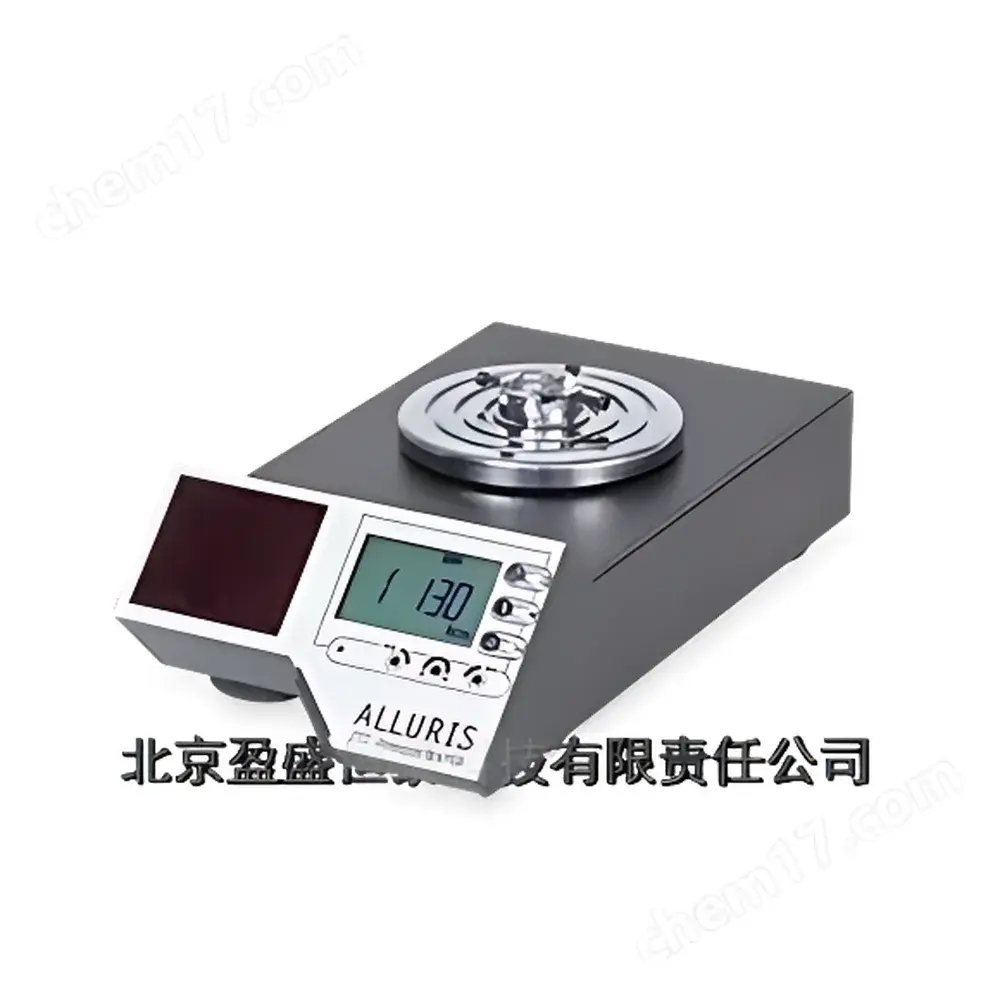
ALLURIS TTT-300 Digital High-Capacity Torque Tester
| Brand | ENSOUL |
|---|---|
| Origin | United Kingdom |
| Manufacturer Type | Authorized Distributor |
| Product Origin | Imported |
| Model | ALLURIS TTT-300 |
| Torque Range Options | 0.2–2 N·m |
| Accuracy | ±0.5% of Full Scale |
| Data Interface | USB |
| Compliance | ISO 6789:2017 (Calibration and Verification of Torque Tools) |
| Reporting | Automated Calibration Certificate Generation |
Overview
The ALLURIS TTT-300 Digital High-Capacity Torque Tester is an engineered precision instrument designed specifically for static and dynamic torque verification and calibration of hand-held torque tools in industrial, maintenance, and quality assurance environments. Based on a high-stiffness torsional loading frame and a strain-gauge-based transducer architecture, the system operates under controlled quasi-static loading conditions to measure applied torque with traceable metrological integrity. Its mechanical design conforms to the structural and procedural requirements defined in ISO 6789:2017 — the internationally recognized standard governing the calibration, verification, and performance evaluation of torque tools including beam wrenches, click-type torque wrenches, dial indicators, and electronic torque screwdrivers. The TTT-300 serves as both a primary verification device in toolrooms and a secondary reference standard in accredited calibration laboratories where traceability to national metrology institutes (e.g., UK’s NPL) is mandated.
Key Features
- Modular torque sensor modules covering five calibrated ranges: 0.2–2 N·m, 0.5–5 N·m, 1–10 N·m, 2.5–25 N·m, and 5–50 N·m — enabling optimal resolution and signal-to-noise ratio across diverse tool classes.
- High-accuracy measurement capability with linearity and repeatability verified to ±0.5% of full scale, compliant with ISO 6789:2017 Annex B requirements for Class I and Class II testers.
- Integrated digital display with real-time torque readout, peak-hold function, and directional indication (clockwise/counterclockwise), supporting both manual and fixture-assisted operation.
- Robust dual-column steel frame with adjustable height and clamping fixtures, accommodating tools from compact screwdrivers to large-format socket wrenches up to 450 mm in length.
- USB 2.0 interface compliant with CDC ACM class protocols, enabling direct connection to Windows-based host systems without proprietary drivers.
- Factory-calibrated transducers supplied with UKAS-accredited calibration certificates (optional), each traceable to CMC-registered standards under ISO/IEC 17025:2017.
Sample Compatibility & Compliance
The TTT-300 supports mechanical and electromechanical torque tools requiring verification per ISO 6789:2017, including but not limited to preset torque wrenches, breakaway torque wrenches, torque multipliers, and torque-angle tools used in automotive assembly, aerospace fastening, and medical device manufacturing. Fixture adaptors accommodate square drive sizes from 1/4″ to 1″ (6.35 mm to 25.4 mm), while custom jaw inserts allow secure engagement of non-standard geometries such as hex keys and torque bits. All test procedures align with ISO 6789:2017 Clause 6 (Verification Methods) and Clause 7 (Acceptance Criteria), ensuring compatibility with internal audit protocols and external accreditation assessments (e.g., ISO 9001, AS9100, ISO 13485). The system meets electromagnetic compatibility (EMC) requirements per EN 61326-1:2013 and safety standards per EN 61010-1:2010.
Software & Data Management
The included TTT-Control Suite v3.2 is a Windows-native application developed for GxP-aligned environments. It provides configurable test templates aligned with ISO 6789:2017 verification cycles, automatic pass/fail flagging based on user-defined tolerance bands, and timestamped audit trails with operator ID logging. Data export functions support CSV, PDF, and XML formats — all retaining full metadata (transducer ID, calibration date, environmental conditions, test sequence number). The software implements role-based access control (RBAC), electronic signatures compliant with FDA 21 CFR Part 11, and immutable record retention for GLP/GMP-regulated workflows. Raw torque vs. time datasets are stored with 1 kHz sampling resolution, enabling post-test analysis of transient behavior during tool actuation.
Applications
- Periodic verification of torque tools prior to use in critical assembly processes (e.g., engine cylinder head bolting, orthopedic implant fixation).
- As-found/as-left calibration reporting for ISO/IEC 17025-compliant calibration laboratories performing third-party torque tool certification.
- Root cause analysis of torque-related nonconformances in Six Sigma or FAIR (Failure Analysis and Investigation Report) investigations.
- Validation of torque tool performance under varying ambient temperatures (15–30 °C operational range) and humidity levels (30–70% RH).
- Supporting internal metrology programs requiring documented uncertainty budgets per ISO/IEC Guide 98-3 (GUM).
FAQ
Is the TTT-300 suitable for calibrating electronic torque wrenches with angle measurement capability?
Yes — the system measures torque independently of angular displacement; however, synchronized angle data must be acquired externally via compatible encoders or motion controllers.
Does the instrument support automated test sequencing for high-volume tool verification?
Yes — TTT-Control Suite includes batch mode scripting with programmable dwell times, multiple setpoint verification, and auto-generated summary reports per ISO 6789:2017 Table 3.
Can calibration certificates be issued with measurement uncertainty statements?
Yes — upon request, UKAS-accredited certificates include expanded uncertainty (k=2) calculated per ISO/IEC Guide 98-3, incorporating contributions from transducer hysteresis, temperature drift, and reference standard stability.
What is the recommended recalibration interval for the TTT-300 system?
ENSOUL recommends annual recalibration against certified reference standards; intervals may be adjusted per risk-based assessment per ISO/IEC 17025:2017 Clause 7.7.1.
Is firmware update capability available remotely?
Firmware updates are distributed via secure ENSOUL portal download and installed locally using signed .hex packages verified by SHA-256 checksums.



