
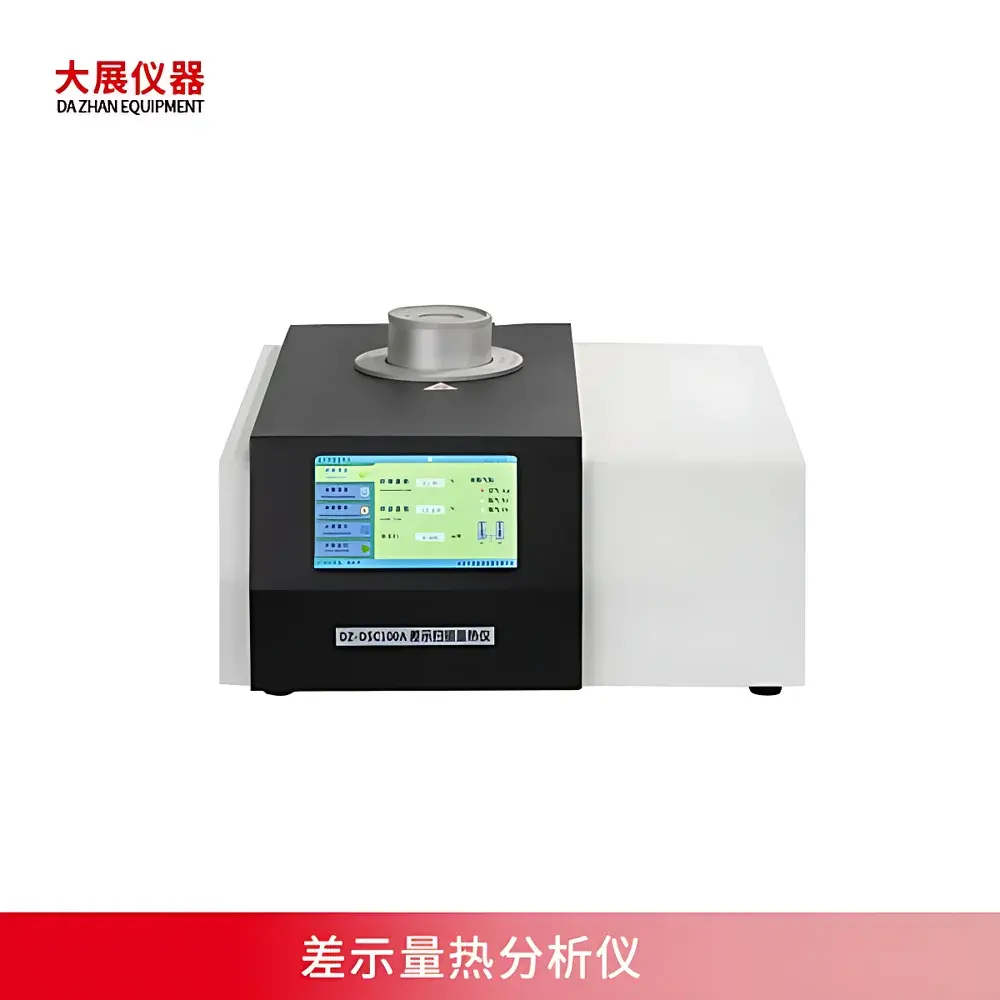
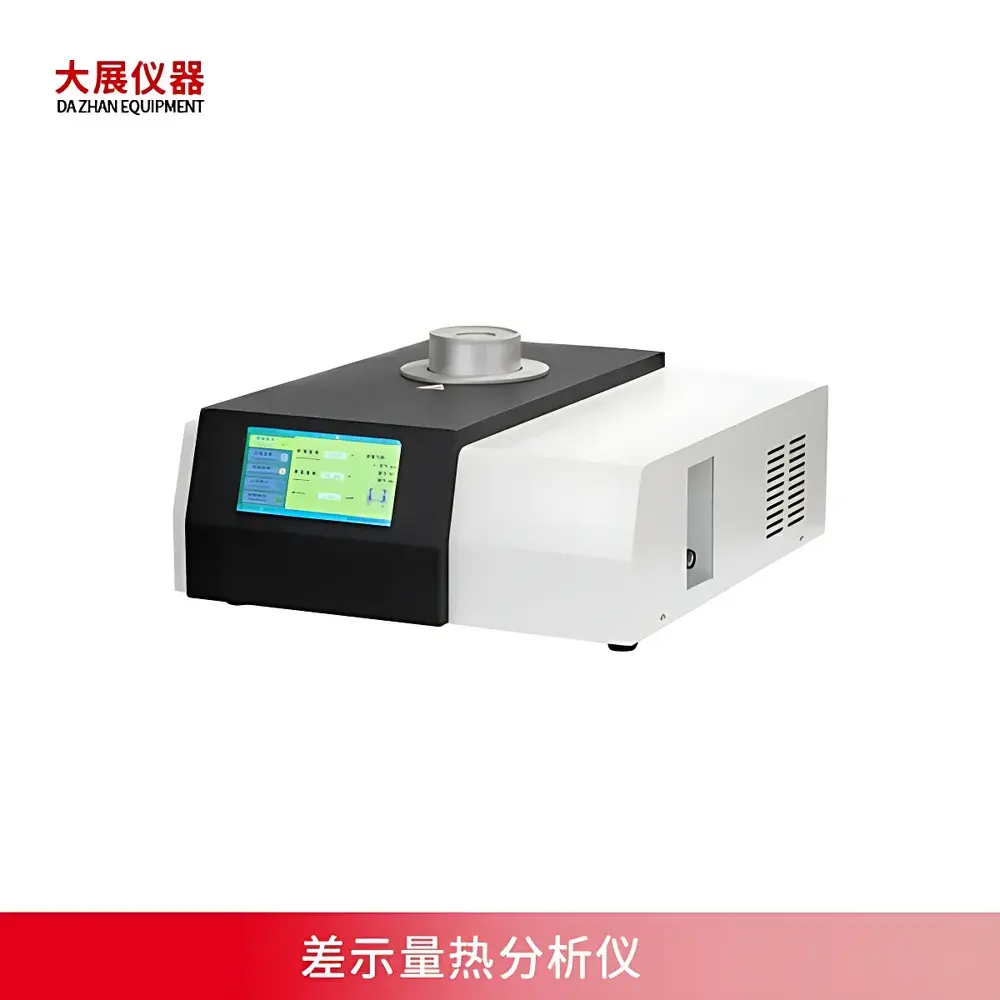
Nanjing Dazhan DZ-DSC100A Differential Scanning Calorimeter
| Brand | Nanjing Dazhan |
|---|---|
| Origin | Jiangsu, China |
| Manufacturer Type | Direct Manufacturer |
| Product Type | DSC |
| Model | DZ-DSC100A |
| Sample Capacity | Single |
| Temperature Range | Ambient to 600 °C |
| Heating/Cooling Rate | 0.1–100 K/min |
| DSC Signal Range | 0 to ±600 mW |
| Temperature Stability | ±0.01 °C |
| Temperature Resolution | 0.01 °C |
| Temperature Repeatability | ±0.1 °C |
| DSC Noise Level | 0.01 μW |
| DSC Sensitivity | 0.001 mW |
| DSC Resolution | 0.01 μW |
| Display | 7-inch 24-bit color LCD touchscreen |
| Gas Flow Control | Digital mass flow controller with database logging |
| Communication Interface | USB 2.0 bidirectional |
| Calibration | Integrated standard reference materials with one-click temperature and enthalpy calibration |
Overview
The Nanjing Dazhan DZ-DSC100A is a high-performance differential scanning calorimeter engineered for precision thermal analysis of solid and semi-crystalline materials. Based on the heat-flux DSC principle, it measures the difference in heat flow between a sample and an inert reference as both are subjected to identical, programmable temperature profiles under controlled atmosphere. This enables quantitative determination of endothermic and exothermic transitions—including glass transition (Tg), cold crystallization, melting (Tm), recrystallization, solid-solid phase changes, oxidative induction time (OIT), oxidative induction temperature (OITT), specific heat capacity (Cp), and cure kinetics—under ISO 11357, ASTM E794, ASTM D3418, and USP <1163> compliant conditions. Its robust furnace architecture, optimized thermal shielding, and alloy-based sensor platform ensure low thermal inertia, high baseline stability, and reproducible signal integrity across extended operational cycles.
Key Features
- Thermally isolated furnace with enhanced insulation design, delivering superior temperature homogeneity and long-term baseline stability (±0.01 °C drift over 30 min at isothermal hold)
- High-resolution 7-inch 24-bit color LCD touchscreen interface with intuitive icon-driven navigation and multi-segment temperature programming capability
- Digital mass flow controller for purge gas (N2, O2, Ar) with real-time flow monitoring and automatic logging into measurement metadata
- Bidirectional control architecture supporting both standalone instrument operation and synchronized PC-based software control via USB 2.0
- Corrosion- and oxidation-resistant alloy sensor assembly, ensuring long-term signal fidelity in aggressive thermal environments
- Integrated calibration suite including certified indium, zinc, and tin standards; supports one-click temperature and enthalpy recalibration per ISO 11357-2
Sample Compatibility & Compliance
The DZ-DSC100A accommodates standard aluminum, gold-coated aluminum, or hermetic stainless-steel crucibles (40 µL capacity), compatible with powders, films, fibers, granules, and cured polymer specimens up to 25 mg. It meets essential regulatory requirements for routine QC and R&D laboratories operating under GLP and GMP frameworks. Data acquisition complies with ALCOA+ principles; raw thermograms, metadata, and calibration logs are stored in vendor-neutral binary format with embedded timestamps and operator ID fields. Optional audit trail module supports FDA 21 CFR Part 11 compliance for electronic records and signatures when deployed with validated software.
Software & Data Management
The instrument operates with proprietary Windows-based analysis software supporting baseline correction, peak integration, Cp calculation via step-heating method, OIT/OITT determination per ASTM D3895, and kinetic modeling (e.g., Ozawa-Flynn-Wall, Kissinger). All raw data files include embedded instrument configuration, gas flow history, and calibration status. Export formats include CSV, TXT, and universal .QTX for third-party thermal analysis platforms. Database structure enables batch comparison, statistical trending (e.g., Tg shift vs. aging time), and automated report generation aligned with internal SOPs or external standards such as ISO/IEC 17025.
Applications
This DSC system serves critical functions across polymer science (crystallinity assessment, crosslink density estimation), pharmaceutical development (polymorph screening, excipient compatibility, lyophilized product stability), metallurgy (phase diagram validation, precipitation kinetics), and advanced composites (cure monitoring, degradation onset analysis). It is routinely applied in failure analysis labs to identify thermal degradation mechanisms, in packaging R&D to assess seal integrity under thermal stress, and in academic research for constructing thermodynamic models of phase transitions. The wide dynamic range (0.001 mW sensitivity, ±600 mW full scale) supports both low-energy transitions (e.g., weak Tg in elastomers) and high-enthalpy events (e.g., metal alloy melting).
FAQ
What reference materials are included for calibration?
Certified indium (Tm = 156.598 °C, ΔHf = 28.45 J/g), zinc (Tm = 419.53 °C), and tin (Tm = 231.928 °C) are supplied with traceable NIST-traceable certificates.
Does the system support modulated DSC (MDSC®) mode?
No—the DZ-DSC100A operates in conventional heat-flux DSC mode only; it does not implement temperature modulation or complex harmonic analysis.
Can the instrument be operated under vacuum or reducing atmospheres?
Yes—compatible with inert (N2, Ar), oxidizing (air, O2), and reducing (5% H2/95% N2) gases; vacuum operation requires optional vacuum-rated furnace lid and pressure sensor upgrade.
Is the software compliant with 21 CFR Part 11?
The base software is not Part 11–validated; however, a validated version with electronic signature, role-based access control, and immutable audit trail is available under separate qualification protocol.
What maintenance intervals are recommended for optimal performance?
Sensor zero-point verification every 100 hours of operation; furnace cleaning and crucible holder inspection every 500 hours; annual full calibration with certified standards recommended for GLP/GMP environments.



