
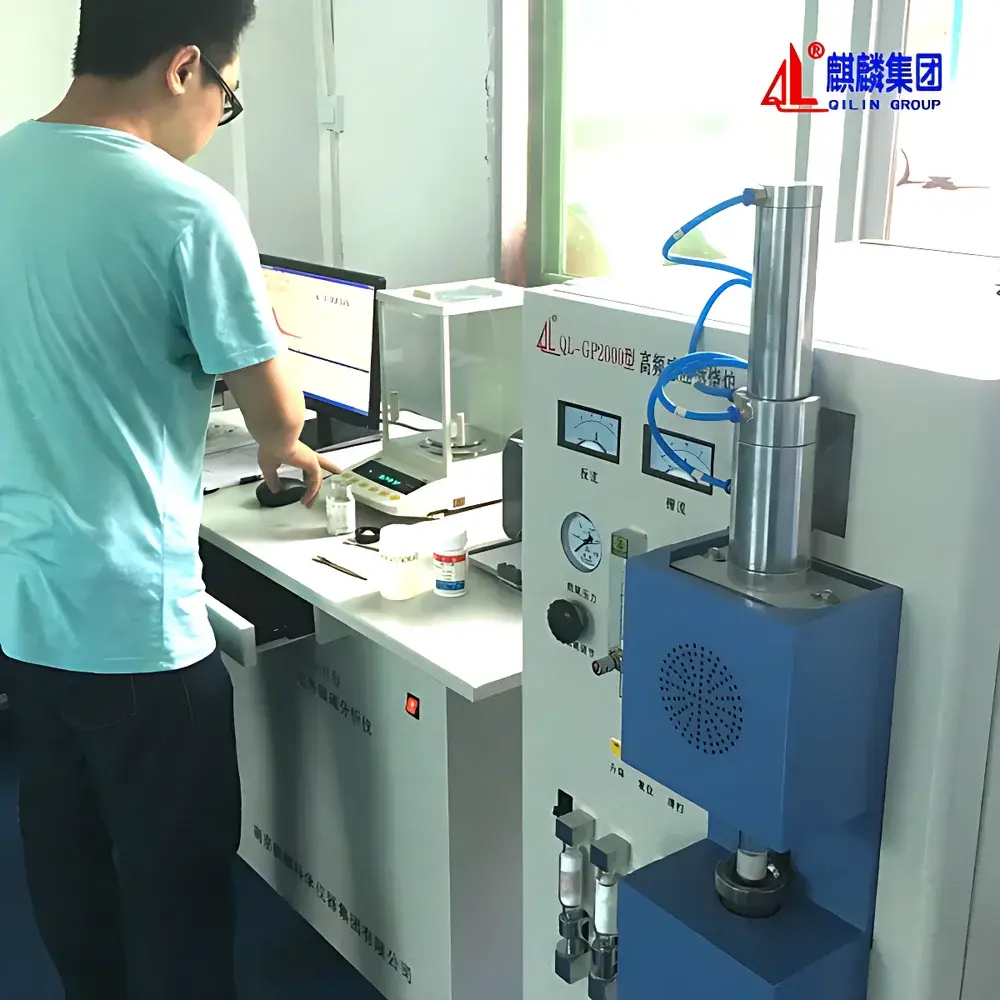
Qilin QL-HW2000B High-Frequency Infrared Carbon-Sulfur Analyzer
| Brand | Qilin/QL |
|---|---|
| Origin | Jiangsu, China |
| Model | HW2000B |
| Measurement Principle | Non-Dispersive Infrared (NDIR) Absorption |
| Heating System | 2.5 kVA High-Frequency Induction Furnace (18–20 MHz) |
| Carbon Range | 0.00001–10.0000 wt% (extendable to 99.999 wt%) |
| Sulfur Range | 0.00001–0.5000 wt% (extendable to 99.999 wt%) |
| Sensitivity | 0.1 ppm (minimum display resolution) |
| Precision | Carbon RSD ≤ 0.5%, Sulfur RSD ≤ 1.0% |
| Analysis Time | 25–60 s (user-adjustable) |
| Sample Weighing Accuracy | 0.0001 g |
| Compliance | GB/T 20123–2006, ISO 15350:2000 |
Overview
The Qilin QL-HW2000B High-Frequency Infrared Carbon-Sulfur Analyzer is a precision elemental combustion analyzer engineered for quantitative determination of total carbon (C) and total sulfur (S) in solid metallic and non-metallic materials. It operates on the principle of high-frequency induction combustion followed by non-dispersive infrared (NDIR) spectroscopic detection. Solid samples are combusted quantitatively in a purified oxygen atmosphere within a 2.5 kVA high-frequency induction furnace operating at 18–20 MHz. The resulting CO₂ and SO₂ gases are carried through a dust- and moisture-removal system into dual independent NDIR cells, where absorbance at characteristic wavelengths (4.26 µm for CO₂, 7.35 µm for SO₂) is measured with high-stability thermal pyroelectric detectors. This architecture ensures stoichiometric conversion, minimal memory effect, and high signal-to-noise ratio across ultra-trace to high-concentration ranges.
Key Features
- High-frequency induction furnace with RF-controlled heating profile ensures reproducible, complete combustion of refractory and heterogeneous samples—including cast iron, stainless steel, ferroalloys, rare-earth metals, cement, coal, coke, ores, catalysts, and ceramic precursors.
- Dual-channel NDIR detection system employing narrow-band interference filters minimizes spectral cross-talk; optimized optical path design eliminates high-carbon matrix interference on sulfur measurement.
- Thermal pyroelectric detectors calibrated for both high-carbon (up to 99.999 wt%) and ultra-low-carbon (down to 0.00001 wt%) regimes, delivering consistent linearity and low drift over extended operation.
- Aerospace-grade synchronous motor drives the infrared gas cell rotation mechanism—rated for >100,000 hours MTBF—ensuring long-term optical alignment stability and zero mechanical hysteresis.
- Modular motherboard architecture with integrated temperature, pressure, and mass flow compensation algorithms corrects for ambient and pneumatic fluctuations in real time, maintaining analytical consistency across laboratory environments.
- Industrial-grade solenoid valves (Airtac, rated for ≥100,000 actuation cycles) and precision mass flow controllers guarantee repeatable carrier gas delivery and purge sequence integrity.
Sample Compatibility & Compliance
The QL-HW2000B accommodates solid samples ranging from 0.1 g to 1.0 g, compatible with standard platinum or ceramic crucibles. It supports analysis of black metals (carbon steels, alloy steels, ductile iron), non-ferrous alloys (Cu-, Al-, Ni-based), inorganic matrices (slags, minerals, refractories), organic-rich solids (coal, coke, polymers), and catalytic materials. All measurements comply with ISO 15350:2000 and GB/T 20123–2006 for combustion-infrared determination of C and S. Instrument validation protocols support GLP and GMP environments, including audit-trail-enabled calibration logging, user-access control, and electronic signature readiness per FDA 21 CFR Part 11 requirements when paired with compliant LIMS integration.
Software & Data Management
The embedded Windows-based analysis software provides full instrument control, real-time gas signal monitoring, multi-point calibration curve management, and automatic baseline correction. Data output includes raw absorbance values, calculated mass fractions (wt%), RSD%, confidence intervals, and QC flagging (e.g., overflow, under-range, combustion failure). Export formats include CSV, Excel, and XML for seamless integration with enterprise quality systems. Software supports method templates, batch reporting, and configurable pass/fail criteria aligned with internal SOPs or ASTM E1019 standards for metallurgical analysis.
Applications
This analyzer serves as a core tool in metallurgical laboratories for incoming raw material verification, melt process control, and final product certification. Typical use cases include: rapid grade verification of stainless steel billets; sulfur segregation analysis in bearing steels; carbon equivalence calculation for weldability assessment; low-sulfur specification compliance in nuclear-grade alloys; carbon content profiling in graphite electrodes; and trace-sulfur screening in high-purity copper used in semiconductor interconnects. It is also employed in geological surveys for coal rank classification, in cement manufacturing for clinker quality control, and in catalyst R&D for sulfur poisoning studies.
FAQ
What sample types require pre-treatment before analysis?
Most solid metals and alloys require only surface cleaning and precise weighing. High-silicon or high-halogen samples (e.g., certain slags or fluorinated catalysts) may require tungsten co-fusion or tin capsule encapsulation to prevent incomplete combustion or quartz tube corrosion.
Is external calibration gas required for daily operation?
No—calibration is performed using certified solid reference materials (CRMs) traceable to NIST or IRMM standards. Gas-phase calibration is optional for diagnostic verification but not routine operation.
Can the instrument be integrated into an automated sample handling system?
Yes—the RS-232 and Ethernet interfaces support SCPI command protocol, enabling bidirectional communication with robotic autosamplers and central LIMS platforms.
What maintenance intervals are recommended for optimal performance?
Daily: desiccant replacement, filter inspection. Weekly: crucible cleaning, O-ring check. Quarterly: detector gain recalibration, furnace coil resistance verification. Annual: full optical path alignment and gas system leak testing.
Does the system meet regulatory requirements for pharmaceutical or aerospace QA labs?
When deployed with validated software configuration, electronic audit trail activation, and documented IQ/OQ/PQ protocols, it satisfies ISO/IEC 17025, AS9100, and ICH Q2(R2) analytical method validation expectations for elemental impurity testing.





