
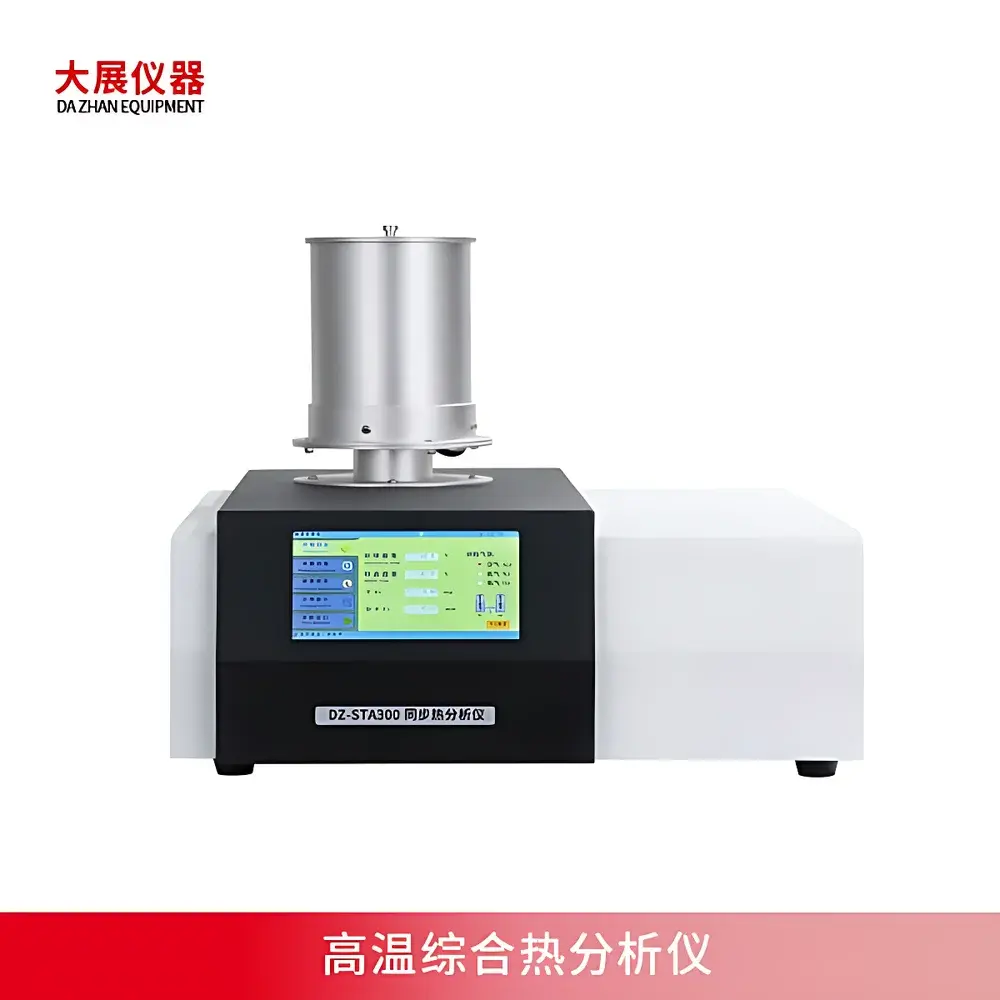
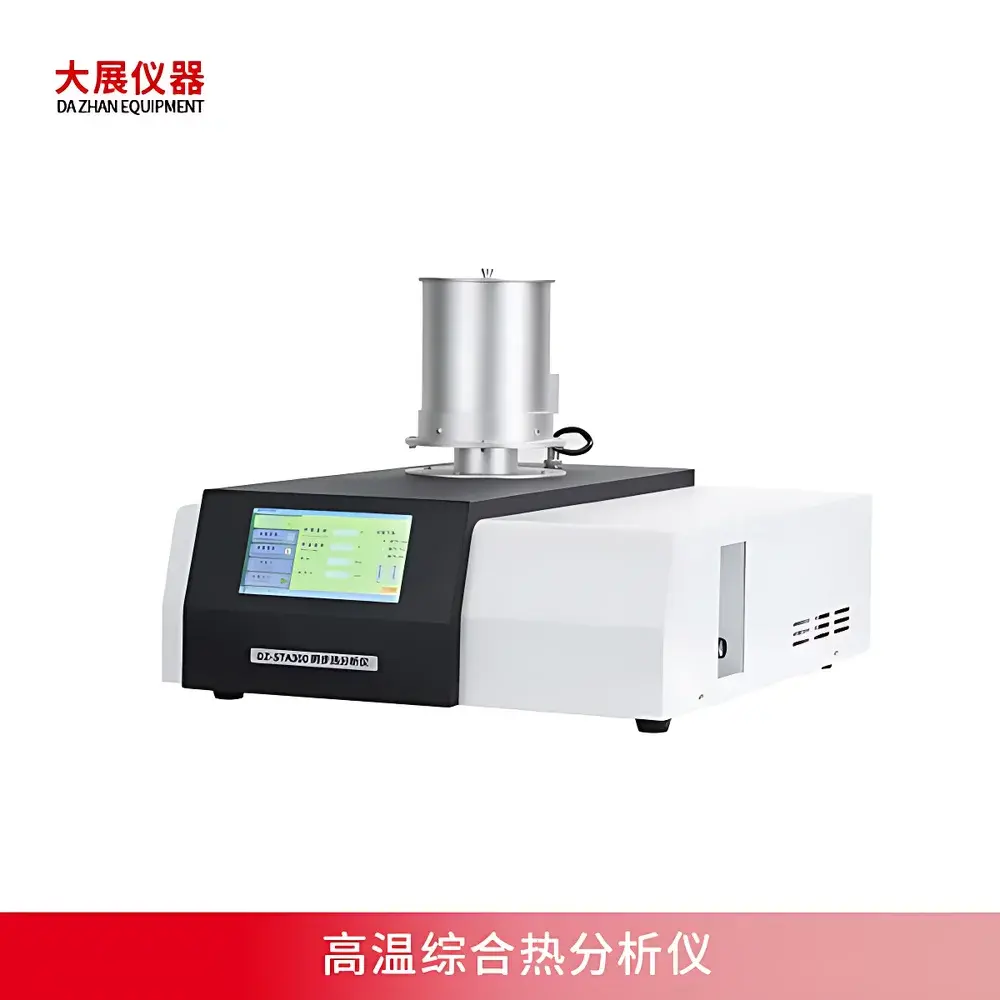
DZ-STA300 High-Temperature Simultaneous Thermal Analyzer (STA) by DAZHAN
| Brand | DAZHAN |
|---|---|
| Origin | Jiangsu, China |
| Model | DZ-STA300 |
| Temperature Range | Ambient to 1250 °C |
| Heating Rate | 0.1–100 °C/min |
| Temperature Stability | ±0.001 °C |
| Max Sample Mass | 30 g |
| DSC Sensitivity | 0.001 mW |
| Mass Resolution | 0.01 mg |
| Atmosphere Control | Integrated Digital Mass Flow Controller |
| Data Interface | Standard USB |
| Power Supply | AC 220 V / 50 Hz |
Overview
The DZ-STA300 High-Temperature Simultaneous Thermal Analyzer (STA) is a precision benchtop instrument engineered for concurrent thermogravimetric analysis (TGA) and differential scanning calorimetry (DSC) measurements on a single sample under identical thermal conditions. Based on the principle of simultaneous mass loss detection (via high-stability microbalance) and heat flow measurement (via symmetrical thermocouple-based sensor), the DZ-STA300 delivers synchronized, time-aligned TG and DSC signals—enabling direct correlation between mass change events (e.g., decomposition, volatilization, oxidation) and thermal transitions (e.g., melting, crystallization, glass transition, reaction enthalpy). Its extended operating temperature range up to 1250 °C supports high-temperature applications in metallurgy, advanced ceramics, refractory materials, and high-performance polymers—where conventional STAs with ≤1000 °C limits are insufficient. The system employs a dual-row wound noble alloy (Ni–Cr) heating element and an insulated furnace architecture to minimize thermal crosstalk, ensuring stable baseline performance and high reproducibility across repeated high-temperature cycles.
Key Features
- Simultaneous acquisition of TG, DTG, and DSC signals from one sample position—eliminating inter-run variability and enabling precise kinetic modeling.
- High-precision microbalance with 0.01 mg resolution and 30 g maximum load capacity, supported by active vibration isolation and separate thermal management of electronics and furnace zones.
- Upward-opening furnace design for rapid, contamination-free sample loading—reducing risk of sensor rod damage and improving workflow efficiency in routine QC labs.
- Dual-zone thermal control architecture: furnace core and balance chamber are physically isolated via multi-layer insulation, minimizing radiative and conductive heat transfer to the weighing mechanism.
- Integrated digital mass flow controller (MFC) for precise, programmable gas atmosphere regulation (N₂, air, O₂, Ar, synthetic air) with real-time flow monitoring and automated purge sequences.
- 7-inch capacitive touchscreen interface with 24-bit data acquisition, supporting full local operation without external PC; firmware includes built-in calibration routines for temperature and sensitivity verification.
Sample Compatibility & Compliance
The DZ-STA300 accommodates solid powders, granules, thin films, metal foils, and ceramic fragments in standard alumina, platinum, or nickel crucibles (up to 100 µL volume). It meets fundamental requirements for GLP-compliant thermal characterization workflows, including traceable temperature calibration (per ISO 11357-1 and ASTM E1131), baseline stability validation (per ISO 11358-1), and repeatability assessment per ICH Q5C guidelines for biopharmaceutical excipients. While not certified to FDA 21 CFR Part 11 out-of-the-box, its software architecture supports audit trail configuration, electronic signature integration, and data export in CSV/ASCII formats compatible with validated LIMS and ELN systems. All hardware components—including thermocouples, balance transducers, and furnace windings—comply with RoHS 2011/65/EU and CE marking directives for laboratory equipment safety (EN 61010-1).
Software & Data Management
The proprietary STAControl™ software provides real-time visualization of TG, DTG, and DSC curves, with synchronized cursor-linked analysis across all channels. Key analytical functions include: automatic onset/peak/endpoint detection for decomposition and phase transitions; stepwise baseline correction for overlapping events; isoconversional kinetic analysis (Friedman, Ozawa–Flynn–Wall); specific heat calculation via modulated DSC protocols; and quantitative residue estimation at user-defined temperatures. Raw data are stored in timestamped binary files with embedded metadata (operator ID, method name, atmosphere, heating rate, crucible type). Export options include CSV, PDF reports (with customizable templates), and image snapshots (PNG/JPEG). USB 2.0 interface enables seamless data transfer to networked workstations; optional API support allows integration with third-party process automation platforms.
Applications
- Metallurgy: Oxidation kinetics of alloys, sintering behavior of powder metallurgy compacts, decomposition of fluxes and slags.
- Polymers & Composites: Thermal degradation profiling of engineering thermoplastics, filler–matrix interaction analysis, flame-retardant efficiency quantification, residual solvent determination.
- Pharmaceuticals: Polymorph screening, hydrate/dehydrate transitions, excipient compatibility studies, stability-indicating assay development per ICH Q1A(R2).
- Ceramics & Glass: Sintering shrinkage modeling, phase evolution in multicomponent oxides, devitrification onset in bulk metallic glasses.
- Energy Materials: Decomposition thermodynamics of battery cathode precursors (e.g., LiCoO₂, NMC), thermal runaway threshold mapping for solid-state electrolytes.
- Food Science: Moisture loss kinetics, starch gelatinization enthalpy, lipid oxidation induction times under controlled atmospheres.
FAQ
What is the maximum recommended continuous operating temperature for long-term stability?
The DZ-STA300 is rated for continuous operation up to 1200 °C; sustained use above this temperature may accelerate furnace element aging and require more frequent calibration.
Can the instrument perform dynamic vacuum or reduced-pressure TGA experiments?
No—the system is designed for controlled gas atmospheres only (positive pressure up to 5 bar optional); vacuum operation requires external pumping and is not supported by the standard configuration.
Is the DSC signal calibrated using indium and zinc reference standards?
Yes—factory calibration includes certified reference materials (CRM) for temperature (In, Zn, Sn, Pb) and enthalpy (In, KClO₄); users can perform periodic recalibration using supplied standards.
Does the software support ASTM E698 kinetic analysis for activation energy determination?
Yes—ASTM E698 (Ozawa) and ASTM E1641 (Kissinger) methods are implemented as selectable modules within the kinetic analysis suite.
What maintenance intervals are recommended for the microbalance and furnace assembly?
Balance zero-point verification every 24 hours of operation; full furnace inspection and thermocouple verification every 200 operational hours or quarterly—whichever occurs first.



