
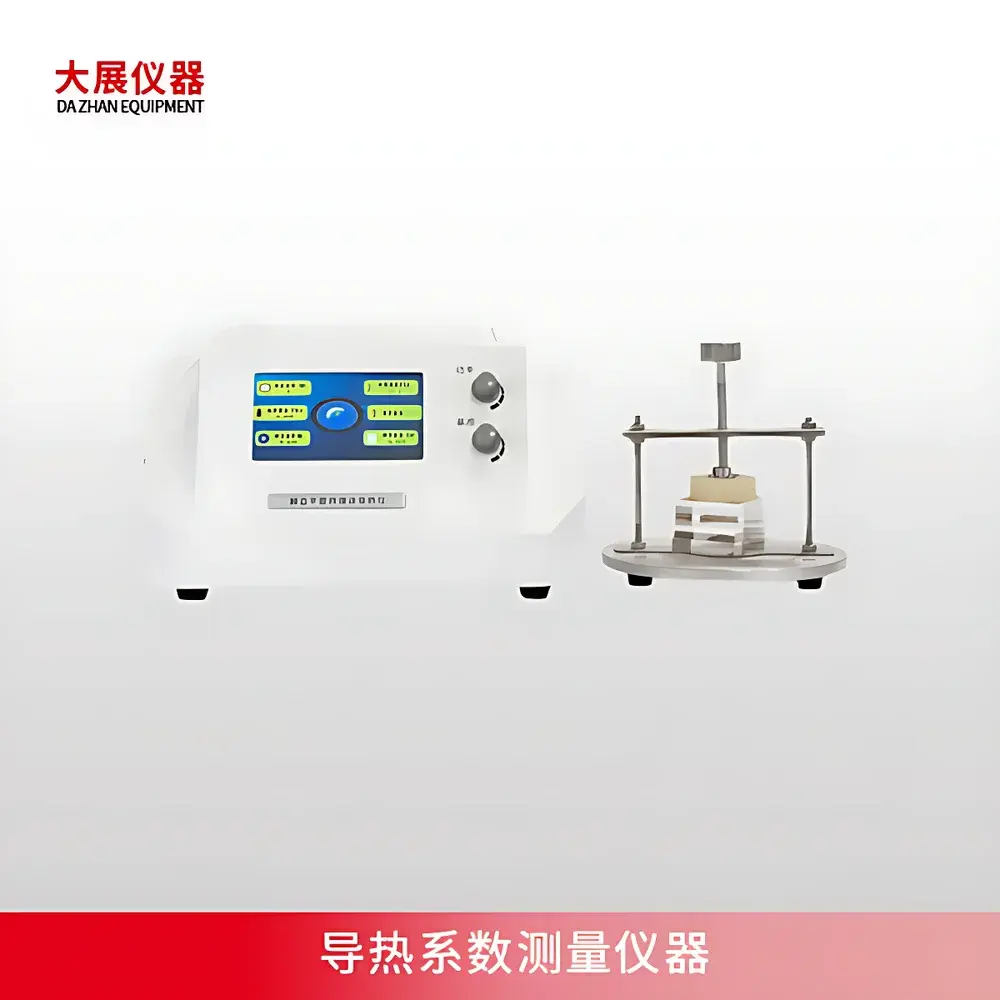
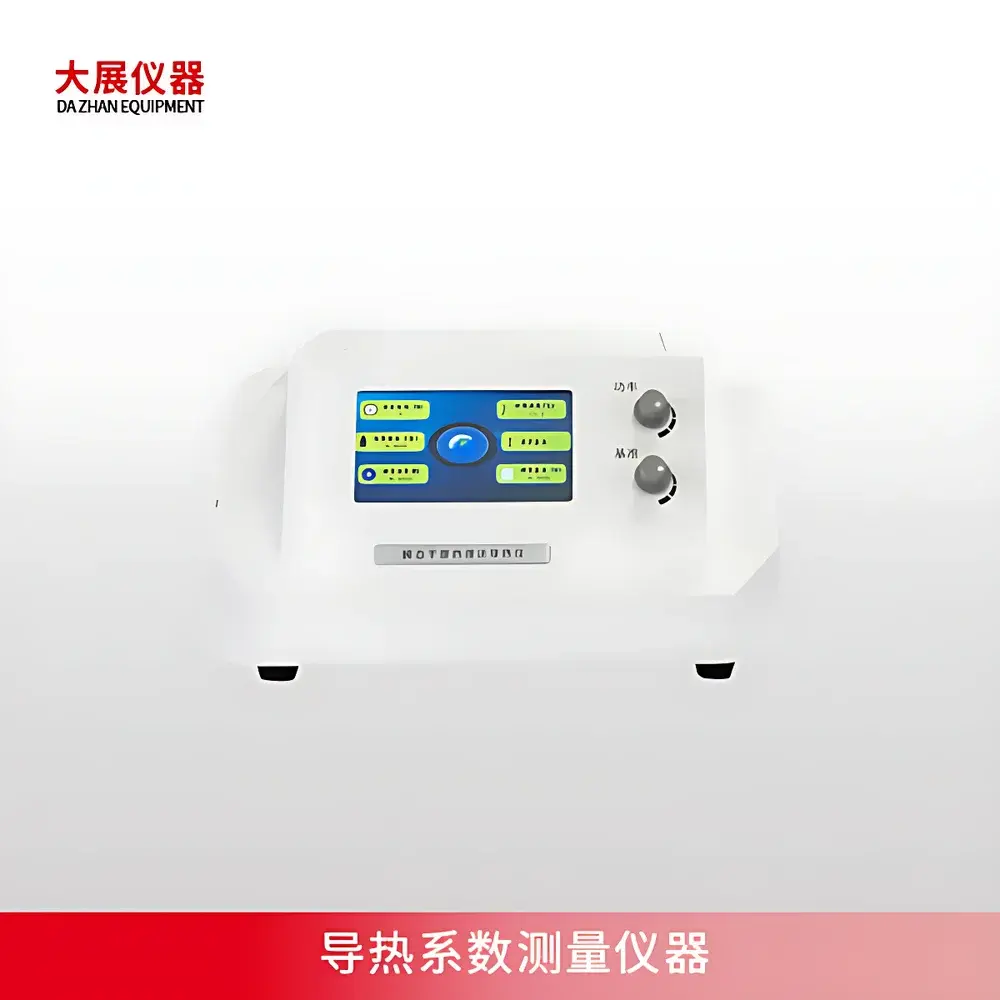
Nanjing Dazhan DZDR-S Transient Plane Source (TPS) Thermal Conductivity Analyzer
| Brand | Nanjing Dazhan |
|---|---|
| Origin | Jiangsu, China |
| Manufacturer Type | Direct Manufacturer |
| Instrument Type | Transient Plane Source (TPS) Method |
| Sample Throughput | Single sample per test |
| Test Environment | Ambient temperature (20–30 °C) |
| Thermal Conductivity Range | 0.0001–300 W/(m·K) |
| Accuracy | ±3% |
| Repeatability | ≤3% |
| Sample Forms | Liquids, powders, metals, thin films, pastes, gels, coatings, bulk solids, and insulating materials |
| Probe Options | 7.5 mm, 15 mm, and 50 mm diameter dual-spiral probes |
| Measurement Time | 5–160 s (user-configurable) |
| Operating Temperature Range | RT to 130 °C |
| Power Supply | AC 220 V, <500 W |
| Minimum Sample Dimensions | 15×15×3.75 mm (for 7.5 mm probe), 30×30×7.5 mm (for 15 mm probe), 50×50×7.5 mm (for 50 mm probe) |
| Powder Test Kit | Optional custom container included |
Overview
The Nanjing Dazhan DZDR-S Transient Plane Source (TPS) Thermal Conductivity Analyzer is a precision instrument engineered for rapid, non-destructive determination of thermal conductivity across a broad spectrum of materials. It operates on the transient plane source principle—a well-established, ISO/ASTM-aligned technique (ISO 22007-2, ASTM D5470) in which a thin, double-spiral nickel foil sensor acts simultaneously as both a heat source and a resistance thermometer. Upon application of a constant electrical current, the sensor generates a controlled thermal pulse; the resulting time-dependent temperature rise is recorded with high temporal resolution. Thermal conductivity is derived from the slope of the log(temperature rise) versus log(time) curve, eliminating dependence on absolute temperature calibration and minimizing sensitivity to interfacial contact resistance. This physics-based approach ensures high reproducibility and eliminates the need for extensive sample preparation—making the DZDR-S particularly suitable for R&D laboratories, QC environments, and material development workflows where speed, flexibility, and traceable metrology are critical.
Key Features
- Triple-probe configuration (7.5 mm, 15 mm, and 50 mm diameters) enables optimized testing across diverse sample geometries—from small lab-scale powders to large insulation panels.
- ARM-based embedded control system delivers deterministic real-time data acquisition and on-board computation, reducing dependency on external PCs and enhancing measurement stability.
- High-resolution analog front-end using imported data acquisition ICs ensures sub-millikelvin thermal resolution and low-noise signal conditioning.
- Non-invasive, single-sided contact measurement preserves sample integrity—enabling repeated testing of the same specimen without structural or thermal degradation.
- Intuitive 7-inch color TFT touchscreen interface with localized English firmware supports guided workflow navigation, parameter presetting, and immediate result visualization.
- Modular sample stage accommodates variable thicknesses and irregular topographies; no clamping force or vacuum required—only nominal surface planarity (≥2× probe diameter in lateral dimensions) is necessary.
- Compliant with fundamental TPS assumptions: homogeneous isotropic media, negligible radial heat loss during short-duration pulses, and uniform sensor-sample interfacial contact.
Sample Compatibility & Compliance
The DZDR-S accepts an exceptionally wide range of physical states without requiring molding, pressing, or coating: liquids (including nanofluids), loose powders (with optional containment vessel), metallic alloys, polymer films (≥25 µm), ceramic substrates, aerogels, phase-change materials, thermal greases, and composite laminates. Its measurement protocol aligns with internationally recognized standards for transient methods—including ISO 22007-2 (Plastics — Determination of thermal conductivity and thermal diffusivity — Part 2: Transient plane source [hot disc] method) and ASTM D5470 (Standard Test Method for Thermal Transmission Properties of Thermally Conductive Electrical Insulation Materials). While not certified for GLP/GMP production release, its architecture supports audit-ready operation: all test parameters (probe ID, duration, power, ambient temp), raw voltage-time traces, and final k-values are timestamped and stored with full metadata—enabling retrospective validation and 21 CFR Part 11–compatible data archiving when integrated with validated LIMS platforms.
Software & Data Management
The analyzer includes proprietary Windows-compatible software (DZDR-Studio v3.x) supporting automated batch reporting, statistical analysis (mean, SD, CV%), comparative trending, and export to CSV, PDF, or XML formats. Raw sensor voltage vs. time datasets are retained alongside computed thermal conductivity, diffusivity, and volumetric heat capacity (if density input is provided). The software enforces parameter locking for SOP-controlled environments and logs operator IDs, instrument serial numbers, and calibration timestamps. All data files carry embedded digital signatures to prevent post-acquisition tampering—critical for regulatory submissions and inter-laboratory round-robin studies.
Applications
- Thermal interface material (TIM) qualification for semiconductor packaging and battery module thermal management.
- Quality control of refractory ceramics, graphite electrodes, and carbon-fiber composites in aerospace manufacturing.
- Rapid screening of nanoparticle-enhanced polymers and phase-change slurries in energy storage R&D.
- Validation of thermal insulation performance in building materials (aerogels, VIPs, mineral wool).
- Characterization of biological tissues, hydrogels, and pharmaceutical excipients under ambient and mild elevated temperatures (up to 130 °C).
- Academic research in heat transfer physics, including anisotropic conduction modeling and interfacial thermal resistance estimation.
FAQ
What standards does the DZDR-S comply with?
It implements the transient plane source method per ISO 22007-2 and ASTM D5470. Full compliance documentation—including uncertainty budgets and traceable calibration certificates—is available upon request.
Can it measure anisotropic materials?
The standard configuration assumes isotropy. For directional conduction analysis (e.g., layered composites), orthogonal multi-axis mounting fixtures and custom probe orientation protocols are supported under engineering consultation.
Is density input required for thermal conductivity calculation?
No. Thermal conductivity (k) is determined directly from the TPS response. Density is only needed if users wish to derive thermal diffusivity (α = k / ρcp) or specific heat capacity.
How often does the system require recalibration?
Annual verification against NIST-traceable reference materials (e.g., Pyroceram 9606, sapphire) is recommended. Factory calibration uses certified stainless steel, copper, and glycerol standards spanning the full 0.0001–300 W/(m·K) range.
Does the instrument support automated temperature control?
The base model operates at ambient temperature. A Peltier-cooled/heated sample stage (–20 °C to +150 °C) is available as an optional accessory with independent PID regulation and thermal shielding.



