
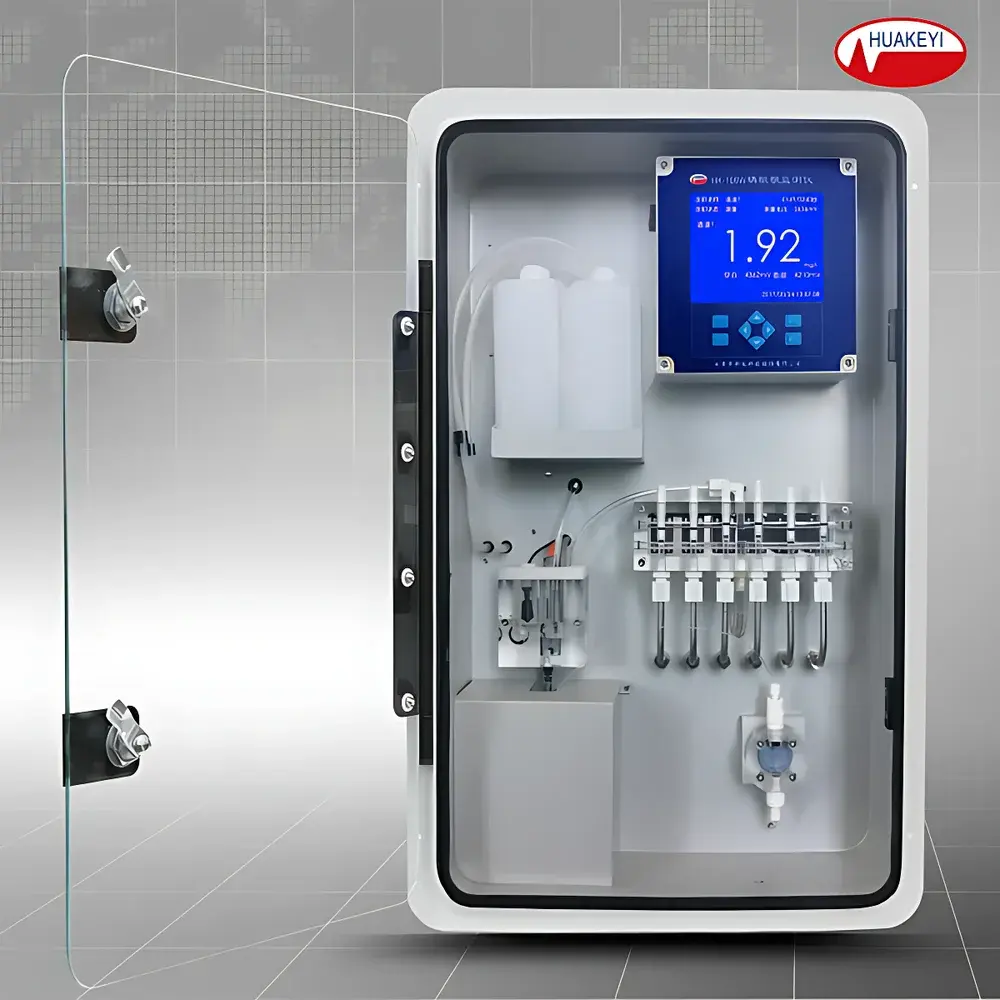
Huake Instrument HK-108W Online Phosphate Analyzer
| Brand | Huake Instrument |
|---|---|
| Origin | Beijing, China |
| Manufacturer Type | Authorized Distributor |
| Country of Origin | Domestic (China) |
| Model | HK-108W |
| Price Range | USD 14,000 – 42,000 (FOB) |
| Instrument Type | Online Continuous Analyzer |
Overview
The Huake Instrument HK-108W Online Phosphate Analyzer is a dedicated photometric analyzer engineered for continuous, unattended measurement of orthophosphate (PO₄³⁻) concentration in process and environmental water streams. It operates on the principle of molybdenum blue spectrophotometry—where phosphate reacts with ammonium molybdate and ascorbic acid under acidic conditions to form a stable phosphomolybdenum blue complex, quantified at 405 nm using a precision optical path. Designed for industrial reliability, the HK-108W integrates sample conditioning, reagent delivery, reaction kinetics control, temperature stabilization, and photometric detection into a single compact chassis. Its application scope spans high-purity water monitoring in thermal power plants (e.g., boiler feedwater and condensate), effluent compliance tracking in petrochemical refineries, and process control in pulp & paper mills—environments where sub-mg/L phosphate detection directly correlates with corrosion inhibition, scale prevention, and regulatory reporting requirements (e.g., EPA Method 365.4, ISO 6878:2004).
Key Features
- Integrated optical module with patented monolithic flow cell design—combines dosing, mixing, incubation, and measurement in one thermally isolated unit, minimizing cross-contamination and path-length variability.
- Stable 405 nm cold-white LED light source with <500-hour drift <±0.5% FS, eliminating lamp replacement and warm-up delays typical of tungsten-halogen systems.
- Peristaltic-free reagent delivery via chemically resistant diaphragm metering pumps (PTFE/PFA wetted parts), achieving ±0.5% volumetric accuracy across 0.1–5 mL dosing range.
- Dual-temperature control: sample stream and optical chamber independently regulated to 25.0 ±0.3°C; optional reagent incubation module maintains reagents at 25.0 ±0.5°C to preserve chromogenic stability.
- Automatic blank compensation algorithm dynamically corrects for turbidity, color interference, and cuvette fouling—reducing long-term baseline drift to <0.1 mg/L over 7-day operation without manual recalibration.
- Configurable multi-channel operation: supports up to 6 independent sample inputs via programmable solenoid valve manifold; cycle time per channel adjustable from 4 to 60 minutes to optimize reagent consumption and temporal resolution.
- Comprehensive self-diagnostic suite: real-time monitoring of pump actuation cycles, valve response latency, photodiode signal-to-noise ratio, heater duty cycle, and reagent level (via ultrasonic level sensor).
Sample Compatibility & Compliance
The HK-108W accepts aqueous samples with suspended solids ≤5 µm (no colloidal or gelatinous particulates), flow rate 150–300 mL/min, pressure ≤14 kPa, and temperature 5–50°C. It complies with IEC 61000-6-2 (immunity to electromagnetic interference) and IEC 61000-6-4 (emission limits). For regulated environments, its data integrity architecture supports audit-ready operation: all calibration events, alarm logs, and configuration changes are timestamped and stored with user ID attribution. While not pre-certified for FDA 21 CFR Part 11, its RS485 Modbus RTU protocol enables integration into validated SCADA systems meeting GLP/GMP traceability requirements.
Software & Data Management
Embedded firmware provides local HMI navigation via 5.7-inch VGA LCD (320×240) with bilingual (English/Chinese) menu system. All measurement parameters—including span calibration points, blank offset, temperature coefficients, and alarm thresholds—are configurable via front-panel keypad or remote terminal. Historical data storage retains ≥12 months of 1-minute averaged values (timestamped, channel-tagged) in non-volatile memory. USB 2.0 port enables encrypted CSV export of raw absorbance, calculated concentration, diagnostic flags, and event logs. Firmware updates are performed via signed binary packages to prevent unauthorized modification.
Applications
- Power generation: Real-time phosphate monitoring in ultra-pure boiler feedwater (target: 2–10 µg/L) to prevent caustic gouging and hideout in steam cycles.
- Petrochemical wastewater: Compliance verification against discharge limits (e.g., EU WFD Annex V, US Clean Water Act NPDES permits) requiring detection down to 0.1 mg/L PO₄-P.
- Pharmaceutical water systems: Support for purified water (PW) and water for injection (WFI) quality assurance per USP and EP 2.2.42.
- Municipal tertiary treatment: Process optimization of phosphate removal via coagulation (e.g., FeCl₃ dosing control) and biological nutrient removal (BNR) validation.
FAQ
What is the minimum detectable phosphate concentration?
The instrument achieves a practical limit of quantitation (LOQ) of 0.05 mg/L PO₄-P under standard operating conditions (10-min cycle, 25°C, fresh reagents).
Can the HK-108W measure total phosphorus?
No—it measures only orthophosphate (reactive phosphorus) via direct colorimetry. Total phosphorus requires acid digestion (e.g., persulfate oxidation), which is outside its design scope.
Is remote calibration supported?
Yes—calibration can be initiated and verified remotely via Modbus commands; however, physical standard introduction remains required for traceable calibration.
How often must reagents be replaced?
At 10-minute sampling intervals, 3 L of reagent solution lasts approximately 30 days; consumption scales linearly with frequency and number of active channels.
Does the analyzer support automatic zero/span verification?
It performs automatic zero correction using deionized water blanks but requires manual introduction of certified phosphate standards for span verification.







