
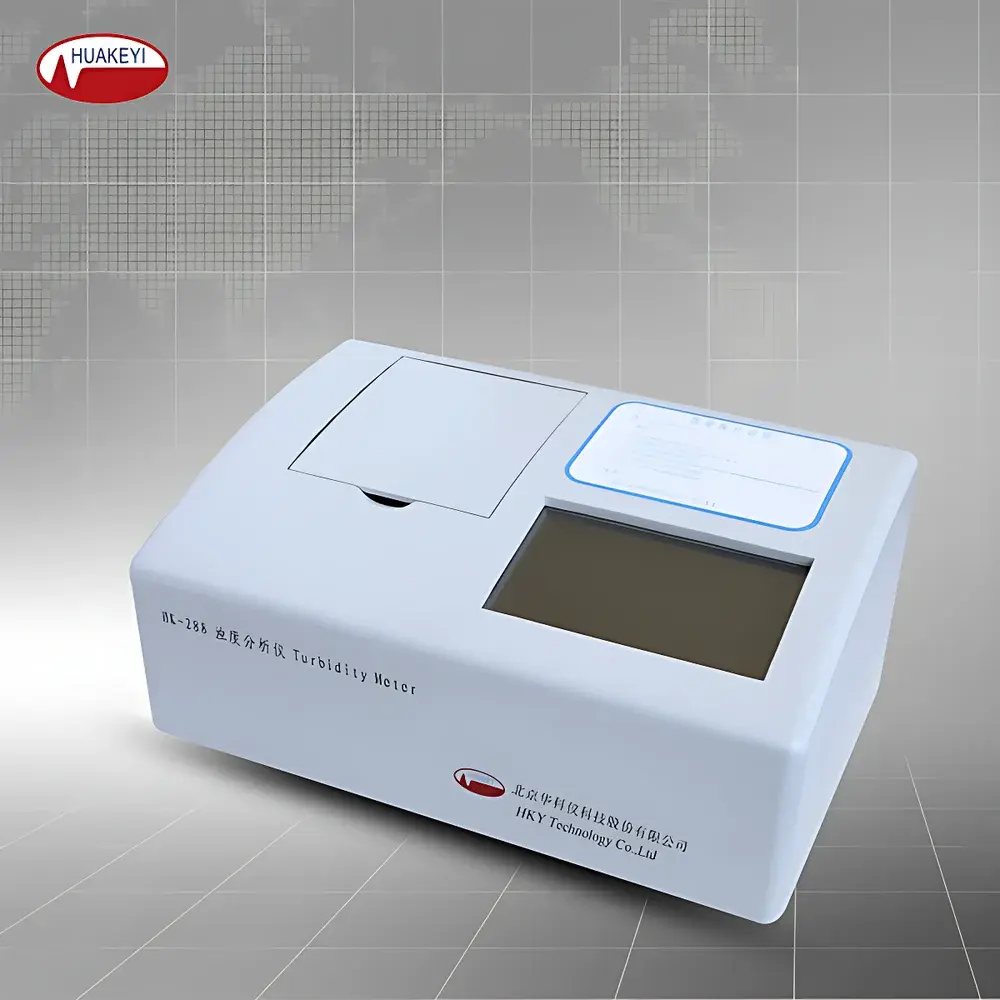
Huake Instrument HK-288 Benchtop Turbidimeter
| Brand | Huake Instrument |
|---|---|
| Origin | Beijing, China |
| Manufacturer Type | Authorized Distributor |
| Country of Origin | China |
| Model | HK-288 |
| Price Range | USD 4,200 – 7,000 (FOB) |
| Instrument Type | Laboratory Turbidimeter |
| Measured Parameter | Turbidity |
| Operating System | Windows CE |
| Display | 7-inch TFT LCD Touchscreen |
| Light Source | High-Stability Infrared LED (850 nm) |
| Measurement Principle | Nephelometric Detection (90° Scattered Light) with Chromatic Compensation |
| Range | 0–1000 NTU |
| Resolution | 0.01 NTU |
| Accuracy | ±5% of reading |
| Repeatability | ±1% RSD |
| Drift | ≤±1.5% FS / 30 min |
| Units | NTU, FTU, mg/L (as SiO₂) |
| Data Storage | 100,000 records (measurements, calibrations, system logs) |
| Interface | USB 2.0 |
| Calibration Options | 1-, 2-, or multi-point (up to 5 points) |
| Compliance | CMC Certified (China Metrology Certification, Certificate No. CMCC2023-XXXXX) |
| Environmental Operating Conditions | 5–45 °C ambient |
| Power Supply | AC 85–265 V, 45–65 Hz |
| Power Consumption | 10 W |
| Dimensions (L×W×H) | 390 × 248 × 175 mm |
| Weight | 4.2 kg |
Overview
The Huake Instrument HK-288 Benchtop Turbidimeter is a precision laboratory-grade instrument engineered for reliable, traceable turbidity measurement in accordance with ISO 7027-1:2016 and EPA Method 180.1. It employs nephelometric detection—measuring 90° scattered light intensity from suspended particles illuminated by a stable 850 nm infrared LED—ensuring high immunity to color interference and minimal spectral drift over time. Unlike traditional photometric systems, the HK-288 integrates an active chromatic compensation algorithm that dynamically corrects for absorbance contributions from colored samples (e.g., humic substances in surface water or dyed process streams), significantly improving accuracy in real-world environmental and industrial matrices. Its robust optical architecture—including a patented dual-beam reference path and temperature-stabilized detector assembly—delivers exceptional low-range stability (<0.5 NTU) and long-term signal reproducibility, making it suitable for compliance-critical applications such as drinking water validation (WHO Guidelines, US EPA 100 Series), wastewater effluent monitoring (ISO 8794), and pharmaceutical water system qualification (USP , EP 2.2.2).
Key Features
- 7-inch capacitive touchscreen interface running Windows CE OS, supporting bilingual (English/Chinese) UI with intuitive navigation and context-sensitive help
- Infrared LED light source (850 nm) with narrow spectral bandwidth (<15 nm FWHM), low thermal drift (50,000-hour operational lifetime
- Optical path design compliant with ISO 7027-1 geometry: 90° scatter detection with integrated dark-current compensation and stray-light rejection
- Multi-point calibration capability (1-, 2-, or up to 5-point) using NIST-traceable Formazin or StablCal standards; automatic curve fitting with residual error reporting
- Real-time auto-stabilization detection: algorithmic convergence assessment eliminates subjective endpoint judgment during calibration and measurement
- Configurable unit output: NTU (nephelometric turbidity units), FTU (formazin turbidity units), and mg/L (as SiO₂ equivalent) — all traceable to primary standards
- Onboard data management: 100,000-entry non-volatile memory with timestamped records, including measurement values, calibration history, operator ID (optional), and system diagnostics
- USB 2.0 host port for direct export of CSV-formatted datasets to external storage or LIMS integration; no proprietary software required
- CMC-certified metrological performance (Certificate No. CMCC2023-XXXXX), verified under JJG 880–2019 national verification regulation for turbidimeters
Sample Compatibility & Compliance
The HK-288 accommodates standard 25-mm round glass cuvettes (included set of 8 precision-polished vials) and supports sample volumes from 10 to 40 mL. It is validated for use with raw and treated potable water, wastewater influent/effluent, groundwater, industrial cooling water, boiler feedwater, and clean-in-place (CIP) rinse solutions. The instrument meets key regulatory and quality framework requirements: ISO/IEC 17025:2017 (for accredited labs performing turbidity testing), GLP-compliant data integrity (audit trail enabled via timestamped logs), and alignment with FDA 21 CFR Part 11 principles for electronic records (when used with optional user authentication module). Its CMC certification confirms conformance to Chinese national metrological standards for resolution (0.01 NTU), linearity (R² ≥ 0.9995 across 0–100 NTU), and repeatability (≤1% RSD at 20 NTU).
Software & Data Management
No external PC or proprietary software is required for routine operation—the HK-288 operates as a fully autonomous measurement platform. All calibration parameters, measurement protocols, and user preferences are stored internally. Data export via USB yields plain-text CSV files compatible with Excel, MATLAB, LabArchives, and most LIMS platforms. Each exported record includes: date/time stamp, sample ID (user-defined), measured value, unit, calibration status flag, operator code (if enabled), and instrument serial number. Internal memory maintains full audit trails: every calibration event logs standard concentration, measured response, deviation, and technician ID (where configured). Firmware updates are performed via USB drive using signed binary packages, ensuring version control and integrity verification.
Applications
- Drinking water treatment plants: raw intake screening, coagulation/flocculation optimization, filter performance verification, and final distribution system compliance (e.g., WHO <1 NTU, EU Directive 98/83/EC)
- Environmental monitoring labs: surface water quality assessment (EPA STORET, WFD reporting), sediment transport studies, and eutrophication trend analysis
- Pharmaceutical manufacturing: purified water (PW) and water for injection (WFI) system monitoring per USP and EU GMP Annex 1
- Food & beverage QA/QC: clarification efficiency in juice, beer, and dairy processing; cleaning validation of tanks and pipelines
- Academic research: colloid stability experiments, nanoparticle dispersion characterization, and flocculant dosage optimization
- Industrial process control: cooling tower blowdown management, semiconductor rinse water purity, and bioreactor broth clarity monitoring
FAQ
What turbidity standards are supported for calibration?
The HK-288 accepts Formazin, StablCal, AMCO AEPA-1, and custom user-defined standards. Multi-point calibration supports up to five concentrations spanning the full 0–1000 NTU range.
Does the instrument comply with ISO 7027-1:2016?
Yes—the optical geometry, wavelength (850 ± 10 nm), detector angular acceptance (±2.5° around 90°), and stray-light limits meet all mandatory requirements of ISO 7027-1:2016.
Can measurement data be integrated into a LIMS environment?
Yes—CSV exports contain structured fields compatible with common LIMS import templates; optional RS-232 or Ethernet modules (available as accessories) support automated polling via Modbus RTU/TCP.
Is the CMC certificate valid for international use?
CMC certification is recognized under ILAC MRA signatory frameworks; for EU or North American regulatory submissions, users should perform local verification per EN ISO/IEC 17025 or ANSI/NCSL Z540-1.
What maintenance is required for long-term optical stability?
Annual verification using certified reference standards is recommended; optical path cleaning requires only MAXCLEAN microfiber cloths (included) and isothermal air-drying—no solvents or ultrasonics needed.
Related Products







